L’ouverture du Grand Egyptian Museum (GEM), au pied du plateau de Gizeh, est l’un de ces événements culturels qui marquent durablement un territoire. Outre le musée, qui s’impose par son architecture, ses collections, son budget et ses ambitions, c’est avant tout l’affirmation d’une puissance ancienne, encore capable de fixer les règles du jeu culturel.
Après vingt ans de chantier (un concours lancé en 2003, des travaux intensifs à partir de 2005), l’Égypte inaugure un complexe muséal de près de 500 000 m², dont environ 24 000 m² d’exposition permanente, avec plus de 50 000 objets exposés. On y retrouve notamment l’intégralité du trésor de Toutânkhamon et la barque solaire du pharaon Khéops.
L’architecture du cabinet Heneghan Peng Architects fait écho aux pyramides, avec une façade en albâtre translucide, un grand escalier panoramique traversé de statues pharaoniques et des espaces techniques ultra-modernes : laboratoires de conservation, zones de recherche, espaces enfants… Le coût annoncé, repris par la presse mondiale, se situe entre 1 et 3 milliards de dollars.
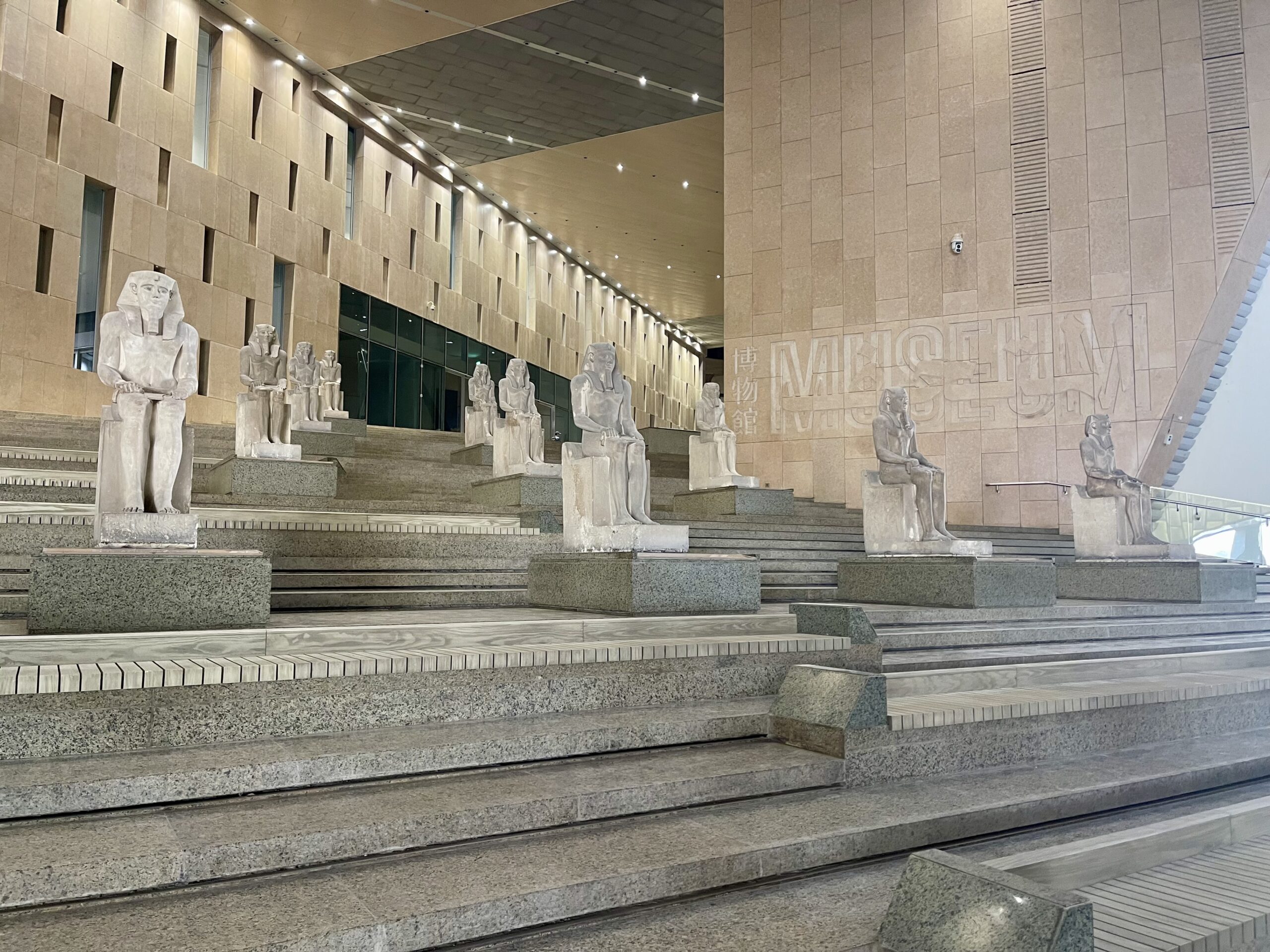
Ce musée s’inscrit dans une stratégie nationale forte : relancer le tourisme (objectif affiché : 30 millions de visiteurs/an d’ici 2030), moderniser la médiation patrimoniale et reprendre la main sur la narration d’un récit historique longtemps confié aux structures culturelles occidentales. Lors de l’inauguration le week-end dernier se trouvait, parmi d’autres délégations internationales, une représentation marocaine : le ministre de la Culture du Royaume, Mohammed Mehdi Bensaid y représentait le Roi Mohammed VI, signe d’une importance régionale réelle.
Pour le monde arabe, on ne peut pas ne pas voir le momentum. Qatar, Émirats arabes unis, Arabie saoudite investissent massivement dans les musées, les biennales, les institutions de création, les foires. Le modèle « musée-marque » (Louvre, Guggenheim) est devenu un outil de diplomatie culturelle et de développement économique. Cependant l’Égypte pose un modèle alternatif : un musée majeur, requis par le pays lui-même, et non une franchise extérieure. Autrement dit, le pays prend en charge sa narration et son modèle.
Le contexte mondial renforce cette posture. Le débat sur la décolonisation des musées, sur les restitutions d’objets patrimoniaux, a enclenché un moment de reconfiguration des rapports de savoir et de pouvoir. L’Égypte y participe activement. Il suffit de parcourir les réseaux sociaux du weekend pour constater que les demandes de restitution alimentent la conversation. Elles visent notamment la pierre de Rosette exposée au British Museum, le buste de Néfertiti à Berlin, le zodiaque de Dendérah au Louvre. Avec le GEM, le pays affirme qu’il a désormais les capacités matérielles, scientifiques et institutionnelles pour accueillir ces pièces, les interpréter et les inscrire dans un récit propre.
Enfin, ce projet ramène l’Égypte à sa position de « puissance culturelle historique ». On n’oublie pas que le pays est déjà présent sur la scène artistique globale : seul pays arabe à avoir son pavillon aux Giardini de la Biennale de Venise, notamment avec l’artiste Wael Shawky (commissariat 2024). Le pays affiche une scène contemporaine active et pensée depuis Le Caire. Le GEM n’est qu’une nouvelle étape, certes grandiose, de cette dynamique.
Pour le Maroc, et pour l’ensemble des scènes arabes et africaines, c’est un repère lumineux : il confirme que les récits patrimoniaux et les institutions ne sont pas nécessairement importés. Ils peuvent être conçus, pilotés, financés et incarnés localement.
Meryem Sebti
The opening of the Grand Egyptian Museum (GEM) at the foot of the Giza plateau marks a defining moment in the region’s cultural landscape. Beyond its monumental scale and extraordinary collections, it stands as the assertion of an ancient power still capable of shaping the rules of cultural sovereignty.
Two decades in the making — an international competition launched in 2003, construction beginning in 2005 — the new complex spans nearly 500,000 m², including 24,000 m² of permanent galleries and more than 50,000 artifacts on view. Among them, the complete treasure of Tutankhamun is presented in its entirety for the first time, alongside the Solar Boat of Pharaoh Khufu, previously displayed in a small museum at the base of the Great Pyramid. Designed by Heneghan Peng Architects, the building echoes its surroundings: a translucent alabaster façade, a monumental staircase lined with colossal statues, and cutting-edge conservation laboratories and research spaces. Global estimates place its cost between $1 billion and $3 billion.
The GEM is more than a museum; it is a national strategy. Egypt aims to reignite tourism — with a target of 30 million visitors a year by 2030 — while reclaiming control over a historical narrative long mediated by Western institutions. Its inauguration last weekend gathered numerous international delegations, including Morocco’s Minister of Culture Mohammed Mehdi Bensaid, representing King Mohammed VI — an acknowledgment of the museum’s regional significance.
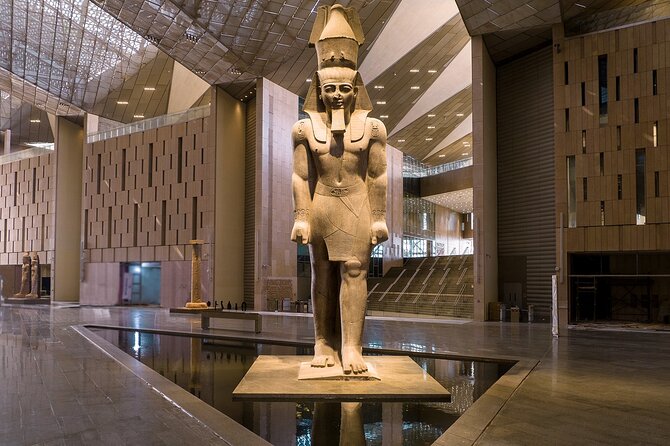
Across the Arab world, the cultural momentum is unmistakable. Qatar, the United Arab Emirates, and Saudi Arabia have invested heavily in museums, biennials, and cultural infrastructures. The “museum-brand” model—Louvre Abu Dhabi, Guggenheim Abu Dhabi—has become both a tool of diplomacy and an economic driver. Yet Egypt offers an alternative: a sovereign institution, conceived and funded locally, speaking in its own voice rather than through an international franchise.
The global conversation on decolonization and restitution amplifies this position. Egypt is an active participant. Over the inauguration weekend, calls resurfaced for the return of emblematic objects such as the Rosetta Stone at the British Museum, the bust of Nefertiti in Berlin, and the Zodiac of Dendera at the Louvre. With the GEM, Egypt demonstrates not only its claim but its capacity to conserve, to research, and to reinterpret its heritage within its own institutions.
The museum also restores Egypt’s standing as a historic cultural power. It remains the only Arab nation with a permanent pavilion in the Giardini at the Venice Biennale, where artist Wael Shawky represented the country in 2024 with Drama 1882, a work revisiting the Urabi revolution and colonial resistance. The GEM is not a starting point, but the continuation on a monumental scale of a long-standing intellectual and artistic presence centered in Cairo.
For Morocco, and for the broader Arab and African art scenes, Egypt’s new museum is a luminous benchmark. It confirms that cultural authority and institutional creation need not be imported. They can be imagined, built, and sustained locally, rooted in history, but firmly turned toward the future.
Meryem Sebti