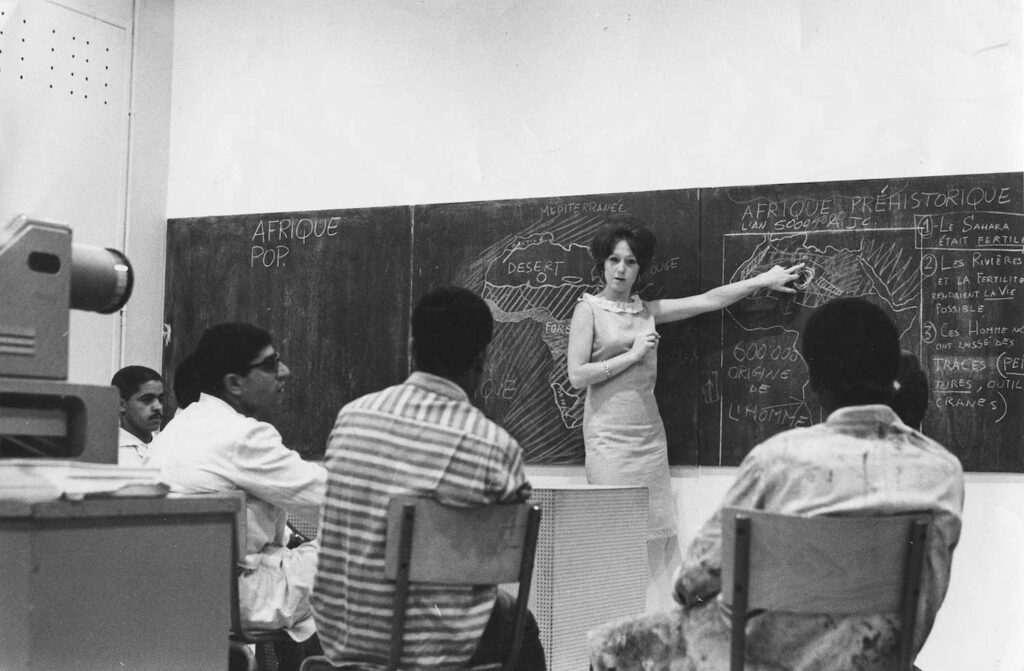
Pour sa 4ᵉ édition, la Biennale internationale de Sculpture de Ouagadougou (BISO) a accueilli 13 artistes en résidence. L’exposition de clôture, organisée dans un contexte sécuritaire fragile, a réuni artistes, amateurs et institutions dans une ambiance aussi festive que résiliente.
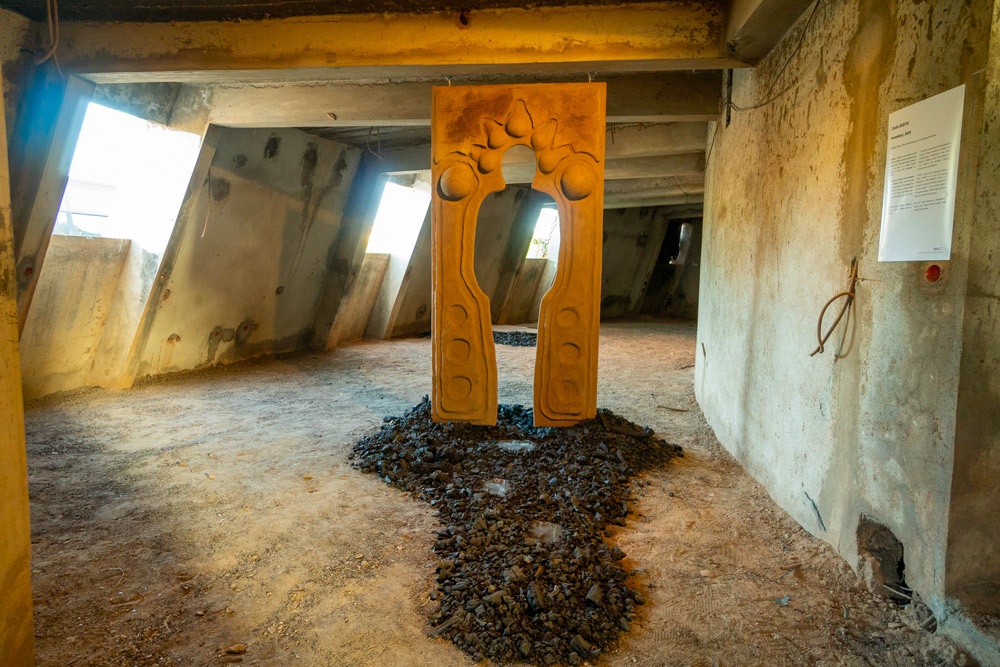
La 4e édition de la Biennale internationale de Sculpture de Ouagadougou s’est ouverte le 20 novembre, dans un contexte difficile alors que le Burkina Faso affronte tension sécuritaire et fragilité économique. Pourtant, Ouagadougou garde la tête haute. « Le peuple Burkinabè est résilient et uni », rappelle Nyaba Léon Ouédraogo, photographe et cofondateur avec le galeriste Christophe Person de BISO. Inspiré par les vers de la poétesse ivoirienne Tanella Boni, le thème de cette année, « Insoutenables frontières », « affirme que nous sommes là, debout. L’art est notre arme », poursuit-il. Devenue malgré elle un symbole de résistance au gré des soubresauts géopolitiques de la région, la biennale poursuit pourtant son travail de fond : mettre en avant la sculpture au sens large en offrant à des artistes émergents comme confirmés la possibilité de passer un mois en résidence à Ouagadougou pour travailler aux côtés d’artisans burkinabè. Les œuvres réalisées sur place sont ensuite exposées au sein du Théâtre Inachevé du FESPACO, amphithéâtre d’inspiration brutaliste.

Sagesse ancestrale et science-fiction
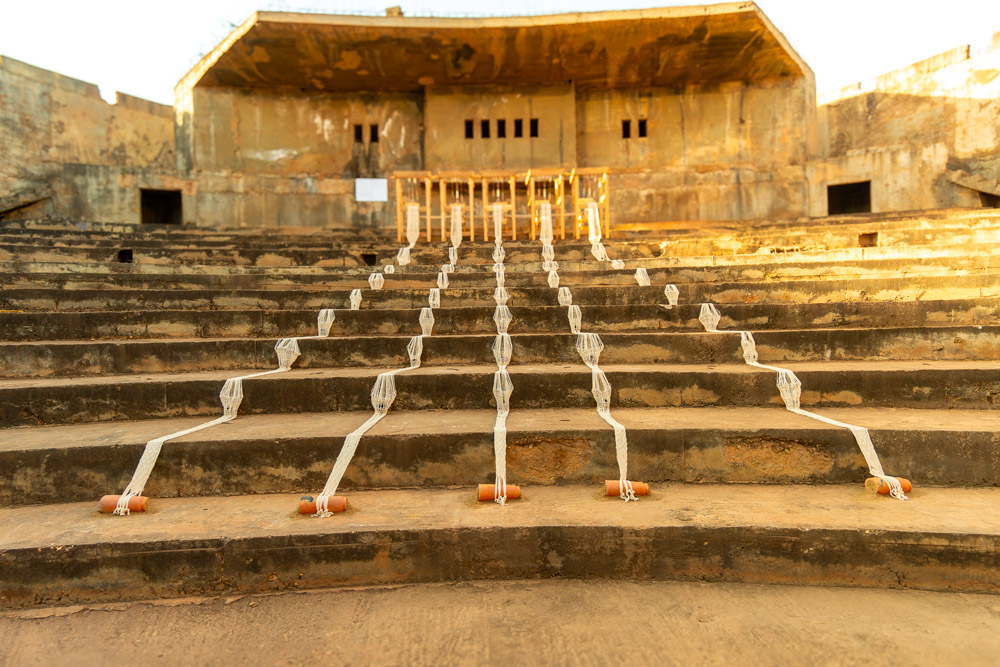
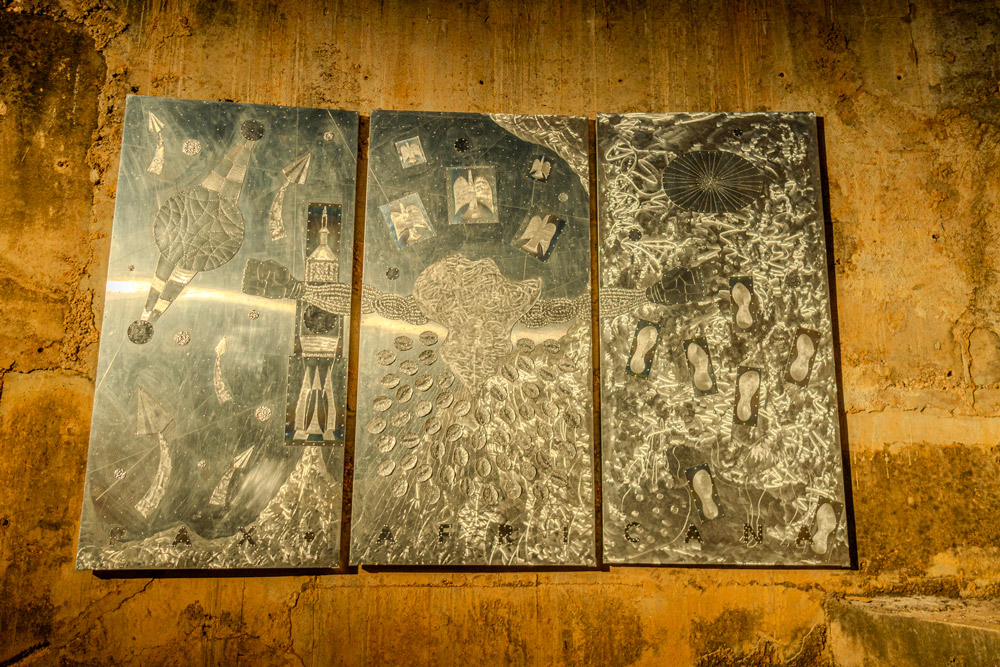
Cet élan vital de résilience a indéniablement porté cette édition qui assume pleinement les tensions fondatrices de la création africaine contemporaine : l’alliance des gestes ancestraux et des projections futuristes, la mémoire comme premier territoire, et la frontière comme lieu de transformation. Trois œuvres en donnent la mesure. Fatim Soumaré (Sénégal) poursuit ainsi sa quête des pratiques autochtones africaines de tissage. Elle investit les marches centrales de l’amphithéâtre avec une installation monumentale construite à partir de métiers à tisser, inspirés de ceux du Siin au Sénégal et recréés pour l’occasion par des artisans du bois burkinabè. De ces structures se déploient de longs tissages ponctués de bougies, qui s’achèvent dans des pièces en céramique ancrées au sol. Une œuvre qui relie matières, territoires et temporalités. Kaïs Dhifi (Tunisie) déploie Pax Africana, un vaste panneau d’aluminium gravé, véritable artefact issu d’un futur fictif où l’Afrique aurait conquis son autonomie jusque dans l’espace. Une vision minutieuse, dense, volontairement mythologique qui dépeint la conquête spatiale africaine. Ode à un futur panafricain radieux.
Dans une petite pièce isolée, Wilfried MBIDA (Cameroun) recompose la cuisine de sa grand-mère, invitant à une immersion sensorielle faite de mémoire, d’odeurs et de gestes. Au cœur de l’installation, dissimulée, une vanité en bronze d’une finesse prodigieuse se révèle comme le cœur secret de l’œuvre. Une œuvre d’une intelligence et d’une sensibilité forte qui nous plonge dans une réflexion sur la frontière intérieure de la mémoire première.
Là où la matière franchit les seuils
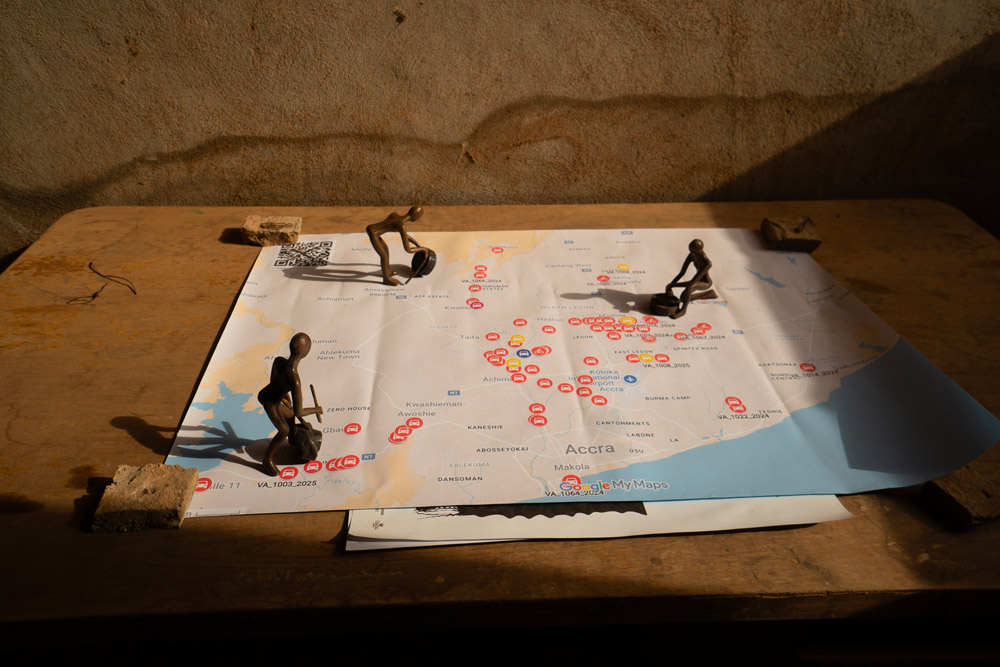
Les frontières sont explorées dans toutes leurs dimensions, symboliques ou réelles. Dans les méandres du théâtre inachevé, le Burkinabé Mohamed Ouedraogo (Prix d’encouragement de BISO) aborde la migration clandestine à travers un dispositif frontal où le langage de l’enfance renforce l’horreur des frontières fermées. Célia Cassaï (France), qui juxtapose céramique, terre, végétaux, latex et bronze, offre une réflexion délicate sur la matière vivante, tandis que l’œuvre carmine Paga de Ghizlane Sahli (Maroc), mêlant pagne traditionnel tissé et cocons de bronze, interroge ces mutations où la matière enfante et relie. Enfin, si la frontière enferme, Thiemoko Claude Diarra (Belgique–Mali) en propose une traduction sensorielle : il nous plonge dans une chambre noire pour découvrir ses Protistes (micro-organismes unicellulaires, ndlr), combinant peinture sur bogolan et sculpture réalisée à partir de fibres de balais traditionnels. L’ensemble se découvre tour à tour à la lumière et dans l’obscurité, où l’œuvre révèle alors sa phosphorescence.Dans une région traversée par les incertitudes, cette édition rappelle que BISO n’est pas seulement une biennale : c’est un geste fort de création et de résistance. Les artistes y explorent la frontière comme espace de tension, de transmission ou de projection et rappellent qu’en Afrique, la création demeure un lieu de résilience, de circulation et d’espoir. À Ouagadougou, l’art continue d’ouvrir des passages là où tout semble se refermer.
Shiran Ben AbderrazakPalmarès BISO 2025 :
Le Grand Prix BISO a été attribué à Carla Gueye
Le prix Galerie Christophe Person a été attribué au collectif Bogoké
Le prix d’encouragement a été attribué à Mohamed Ouedraogo
Le prix spécial, résidence Fondation Donwahi, a été attribué à Ghizlane Sahli
Le prix spécial, exposition à AKAA, a été attribué au collectif Bogoké
Le jury de cette 4e édition réunissait Alex Moussa Sawadogo (directeur du Fespaco), Ousseynou Wade (curateur et ancien secrétaire général de la biennale de l’art africain contemporain de Dakar), Sitor Senghor (directeur artistique de la foire AKAA) , Illa Donwahi (fondatrice de la fondation éponyme) et Olivia Fahmy (curatrice à la Fondation Gandur pour l’art).
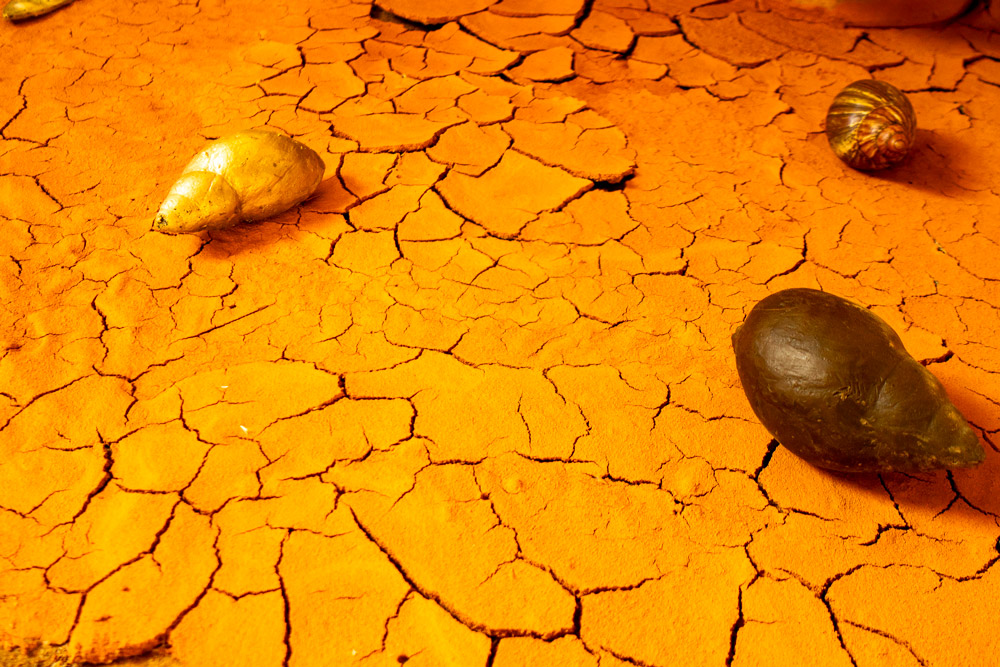
For its fourth edition, the Ouagadougou International Sculpture Biennale (BISO) welcomed 13 artists for a month-long residency. The final exhibition, held against a backdrop of fragile security, brought together artists, visitors and institutions in an atmosphere that felt both festive and defiantly resilient.
The biennale opened on 20 November, at a time when Burkina Faso continues to grapple with security tensions and economic hardship. Yet Ouagadougou stands tall. “The Burkinabè people are resilient and united,” says photographer Nyaba Léon Ouédraogo, who co-founded BISO with gallerist Christophe Person. Inspired by verses from Ivorian poet Tanella Boni, this year’s theme, “Unsustainable Borders,” affirms, in his words, that “we are here, standing. Art is our weapon.”
Almost in spite of itself, the biennale has come to embody a form of resistance in a region shaken by geopolitical upheavals. Yet its core mission remains unchanged: to bring sculpture, in the broadest sense, to the fore by inviting emerging and established artists to work alongside Burkinabè artisans for a month. The works produced during the residency are then shown at the unfinished FESPACO Theatre, a vast amphitheatre with a raw, brutalist character.
Ancestral wisdom meets science fiction
A strong undercurrent of resilience runs through this edition, which embraces the tensions at the heart of contemporary African creativity: ancestral gestures paired with futuristic visions, memory as a primary territory and the border as a site of transformation. Three works illustrate this dynamic especially well.
Senegalese artist Fatim Soumaré continues her exploration of indigenous African weaving traditions. She fills the central steps of the amphitheatre with a monumental installation built around looms inspired by those of the Siin region in Senegal and recreated by Burkinabè woodworkers. Long woven pieces descend from these structures, punctuated by candles and anchored in ceramic forms placed on the ground. The work connects materials, territories and temporalities with striking clarity.
Tunisian artist Kaïs Dhifi presents Pax Africana, a large engraved aluminium panel imagined as an artefact from a fictional future in which Africa has achieved full autonomy, even in space. Meticulous and deliberately mythological, it envisions an African conquest of the cosmos and pays tribute to a radiant Pan-African future.
In a small, quiet room, Wilfried MBIDA of Cameroon recreates his grandmother’s kitchen and offers a sensory immersion shaped by memory, scent and gesture. At the centre of the installation, hidden at first, a remarkably delicate bronze vanity emerges as the secret heart of the piece. Intimate and intelligent, it reflects on the inner frontier where early memories take form.
Where materials cross thresholds
Borders, whether symbolic or real, appear throughout the exhibition in many different forms. In the winding passages of the unfinished theatre, Burkinabè artist Mohamed Ouedraogo, winner of the Encouragement Prize, addresses clandestine migration with a stark visual language that uses childhood imagery to heighten the tragedy of closed borders.
French artist Célia Cassaï brings together ceramics, soil, plants, latex and bronze in a quiet reflection on living matter. Moroccan artist Ghizlane Sahli presents Paga, a vivid carmine piece that merges traditional woven textiles with bronze cocoons and invokes states of metamorphosis, moments when matter gives birth and links worlds together.
Thiemoko Claude Diarra, who works between Belgium and Mali, approaches the idea of the border through sensation. He leads visitors into a darkened room to discover his Protistes (unicellular microorganisms) which draw on bogolan painting and sculptural forms made from the fibres of traditional brooms. The installation changes with the lighting and reveals phosphorescent details in the dark.
In a region marked by uncertainty, this edition of BISO stands as a reminder that the biennale is more than a cultural event. It is a gesture of creation and resistance. The artists here explore the border as a place of tension, transmission and projection, and they reaffirm that in Africa, artistic creation remains a space of resilience, circulation and hope. In Ouagadougou, art continues to open paths where everything else appears to close.
Shiran Ben Abderrazak