« Mon sujet principal est le paysage urbain, il est en perpétuelle mutation, il se modifie sans cesse afin d’être habitable et à la dimension de l’homme, je traduis cette métamorphose de différents modes d’expression, avec le dessin, l’aquarelle, la peinture et la sculpture. Les fragments qui constituent l’espace sont une somme d’éléments calligraphiques, du signe et des motifs ornementaux extraits de l’architecture. » (entretien accordé à Al Bayane, 12 novembre, 2014)
La disparition d’Abdallah Sadouk, survenue aujourd’hui, referme une trajectoire discrète mais persistante de la modernité picturale marocaine. Né à Casablanca en 1950, formé à Tétouan puis à Paris, l’artiste a vécu toute sa vie dans une tension fertile que le critique Xavier Gizard décrivait déjà comme une exploration élargissant « des cercles toujours plus vastes d’identité et d’altérité » (cité dans la section Réception critique, Wikipédia Abdallah Sadouk). Sa peinture a pleinement habité cet entre-deux : celui d’un paysagiste abstrait pour qui la mémoire était structurante.
Après ses premières études à l’Institut national des beaux-arts de Tétouan auprès d’Abdellah Fekhar et Thami El Kasri Dad, Sadouk poursuit son apprentissage à Paris, d’abord aux Arts décoratifs, puis aux Beaux-Arts et enfin à l’université Paris 1. Cette triple formation explique beaucoup : une rigueur constructive héritée de la sculpture, une attention décorative aux surfaces, et une réflexion théorique rarement explicite mais néanmoins perceptible.
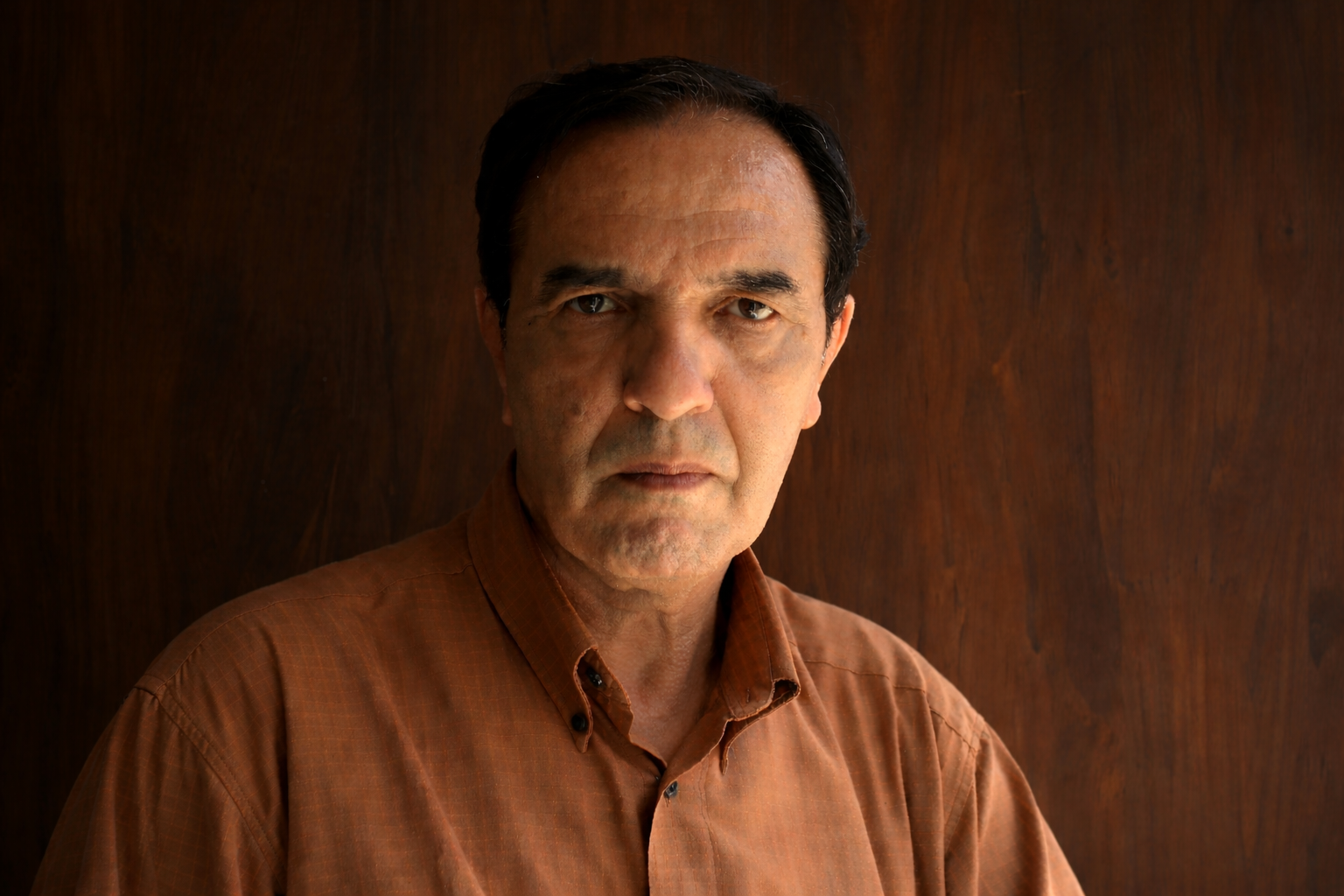
Il commence sa carrière en France avant d’exposer plus régulièrement au Maroc dans les années 1990, partageant sa vie entre la région parisienne, Casablanca et un atelier près de Marrakech. La critique Véronique Barre notait déjà que cet exil volontaire constituait paradoxalement la condition d’un retour : vivre à Paris, écrivait-elle, était pour lui « la condition du rattachement à sa propre tradition » (cité dans la section Réception critique, Wikipédia Abdallah Sadouk).
Chez Sadouk, le paysage ne se donne jamais comme motif mais comme phénomène. Il efface le détail pour conserver la charpente, gomme la topographie pour garder la poussée des lignes. Edmond Amran El Maleh voyait dans ses toiles un jeu de plans géométriques générant la matière picturale, proche du cubisme mais nourri d’architecture et d’inspiration berbère.
Farid Zahi évoquait pour sa part « l’appel du visible », une stylisation du réel où la mémoire affleure comme une survivance fragile. L’artiste lui-même insistait sur la transformation permanente du monde : « Mon sujet principal est le paysage urbain… je traduis cette métamorphose de différents modes d’expression » (Dits d’Abdallah Sadouk, Wikipédia), décrivant un espace constitué de fragments calligraphiques et de motifs architecturaux.
Son œuvre s’organise autour de cette tension : construire et dissoudre. Les villes s’y dressent comme des masses presque sculpturales, puis se désagrègent dans la vibration lumineuse. La critique Marie-Christine Vandoorne relevait que l’artiste « allie savamment l’imprécis de la vibration au précis de la construction » (Réception critique, Wikipédia Abdallah Sadouk). La lumière y est « un marteau central » travaillant la toile de l’intérieur (Réception critique, Wikipédia Abdallah Sadouk). Ce rapport interne à la lumière, plus structurel qu’optique, explique la sensation d’architecture irradiée qui traverse toute sa production.
Sadouk n’était pourtant pas uniquement peintre. Graveur, lithographe, sculpteur, il intervenait aussi dans l’espace public, comme pour la façade métallique du siège de TGCC à Casablanca (Artorium). Dans ses livres d’artiste réalisés avec Abdelkébir Khatibi, Abdellatif Laâbi ou Tahar Bekri, l’image dialogue avec le texte sans vraiment l’illustrer. La lettre arabe y devient matériau plastique. « Je remplis mes toiles jusqu’à saturation, ensuite j’élimine et je nettoie… je ne suis que le témoin du chaos quotidien de mon époque » (Dits d’Abdallah Sadouk, Wikipédia), disait-il encore, décrivant une méthode proche du palimpseste. La peinture naît chez lui d’une soustraction plus que d’une addition.
La réception critique de son travail a souvent insisté sur ce rapport paradoxal entre mémoire et modernité. Le Dictionnaire Bénézit mentionne déjà son inscription dans la scène internationale dès les années 1980 (notice biographique mentionnée dans Wikipédia Abdallah Sadouk), tandis que des institutions comme l’Institut français de Tanger ou le Musée Mohammed VI à Rabat l’ont exposé et collectionné. Mais l’essentiel tient peut-être à la perception d’une œuvre située à distance des écoles sans jamais être isolée. Sadouk appartient à cette génération d’artistes marocains des années 90 qui ont déplacé la question de l’identité hors du folklore pour l’inscrire dans la structure même de la peinture.
Il n’a pas cherché le spectaculaire. Ses paysages urbains demeurent des lieux mentaux : villes sans foule, architectures sans narration, espaces traversés par le temps. La superposition des zones naturelles et construites suggère, selon Vandoorne, « une accumulation d’existences » (Réception critique, Wikipédia Abdallah Sadouk) dont subsiste la trace dans l’interstice. C’est là que réside peut-être la singularité de son œuvre : peindre, certes, la ville mais surtout son souvenir immédiat, encore chaud, presque absent.
Dans l’histoire de l’art marocain, Sadouk occupe une place oblique. Ni figure de rupture, ni héritier d’un mouvement, il prolonge la modernité picturale tout en la ralentissant. Là où certains ont revendiqué la radicalité conceptuelle ou le geste politique, il a poursuivi la question plus ancienne de la lumière et de la forme, mais en la reconfigurant par l’architecture urbaine contemporaine. Son abstraction demeure toujours adossée au monde réel, comme si la peinture devait rester habitable.
The death of Abdallah Sadouk, announced today, closes a discreet yet enduring trajectory within Moroccan pictorial modernity. Born in Casablanca in 1950 and trained in Tétouan before continuing his studies in Paris, the artist lived his entire life within a fertile tension that critic Xavier Gizard once described as an exploration extending “ever wider circles of identity and alterity.” His painting fully inhabited that in-between space: that of an abstract landscapist for whom memory functioned as structure.
After his initial studies at the National Institute of Fine Arts in Tétouan under Abdellah Fekhar and Thami El Kasri Dad, Sadouk pursued his training in Paris, first at the Arts Décoratifs, then at the Beaux-Arts and finally at Université Paris 1. This triple education explains much: a constructive rigor inherited from sculpture, a decorative attention to surfaces, and a theoretical reflection rarely explicit yet constantly perceptible.
He began his career in France before exhibiting more regularly in Morocco in the 1990s, dividing his time between the Paris region, Casablanca and a studio near Marrakech. Critic Véronique Barre observed that this voluntary exile paradoxically constituted the condition of a return: living in Paris, she wrote, was for him “the condition of attachment to his own tradition.”
In Sadouk’s work, landscape never appears as motif but as phenomenon. He erases detail to preserve structure, removes topography to retain the thrust of lines. Edmond Amran El Maleh saw in his canvases a play of geometric planes generating pictorial matter, close to cubism yet nourished by architecture and Berber inspiration.
Farid Zahi, for his part, evoked an “appeal of the visible,” a stylisation of reality in which memory surfaces as a fragile persistence. The artist himself insisted on the permanent transformation of the world: “My main subject is the urban landscape… I translate this metamorphosis through different modes of expression,” he explained in an interview, describing a space composed of calligraphic fragments and architectural motifs.
His work unfolds within this tension: to construct and to dissolve. Cities rise like almost sculptural masses, then disintegrate into luminous vibration. Critic Marie-Christine Vandoorne noted that the artist “skillfully combines the imprecision of vibration with the precision of construction.” Light becomes a “central hammer” working the canvas from within, an internal rather than optical presence that explains the sense of irradiated architecture running through his production.
Sadouk was not only a painter. A printmaker, lithographer and sculptor, he also intervened in public space, notably with the metal façade of the TGCC headquarters in Casablanca (Artorium). In his artist books created with Abdelkébir Khatibi, Abdellatif Laâbi or Tahar Bekri, image converses with text without illustrating it. The Arabic letter becomes a plastic material. “I fill my canvases to saturation, then I eliminate and clean… I am only the witness to the daily chaos of my time,” he said, describing a method akin to the palimpsest. Painting, for him, was born of subtraction more than addition.
Critical reception of his work has often emphasized this paradoxical relation between memory and modernity. The Bénézit Dictionary already noted his presence on the international scene as early as the 1980s, while institutions such as the Institut français de Tanger and the Mohammed VI Museum in Rabat have exhibited and collected his work. Yet the essential point lies perhaps in the perception of an oeuvre situated at a distance from schools without ever being isolated. Sadouk belongs to that generation of Moroccan artists of the 1990s who displaced the question of identity beyond folklore, inscribing it instead within the very structure of painting.
He did not seek spectacle. His urban landscapes remain mental sites: cities without crowds, architectures without narrative, spaces traversed by time. The superposition of natural and constructed zones suggests, as Vandoorne wrote, “an accumulation of existences” whose trace survives in the interstice. There perhaps resides the singularity of his work: to paint, certainly, the city — but above all its immediate memory, still warm, almost absent.
Within the history of Moroccan art, Sadouk occupies an oblique position. Neither figure of rupture nor heir to a defined movement, he prolonged pictorial modernity while slowing it down. Where others claimed conceptual radicality or political gesture, he pursued the older question of light and form, reconfigured through contemporary urban architecture. His abstraction always remained anchored to the real world, as though painting had to remain inhabitable.