

At the Palazzo Grassi, Michael Armitage transforms the tragedies of contemporary Africa into paintings of striking beauty, in which each color seems to delay the revelation of violence.
By Emmanuelle Outtier
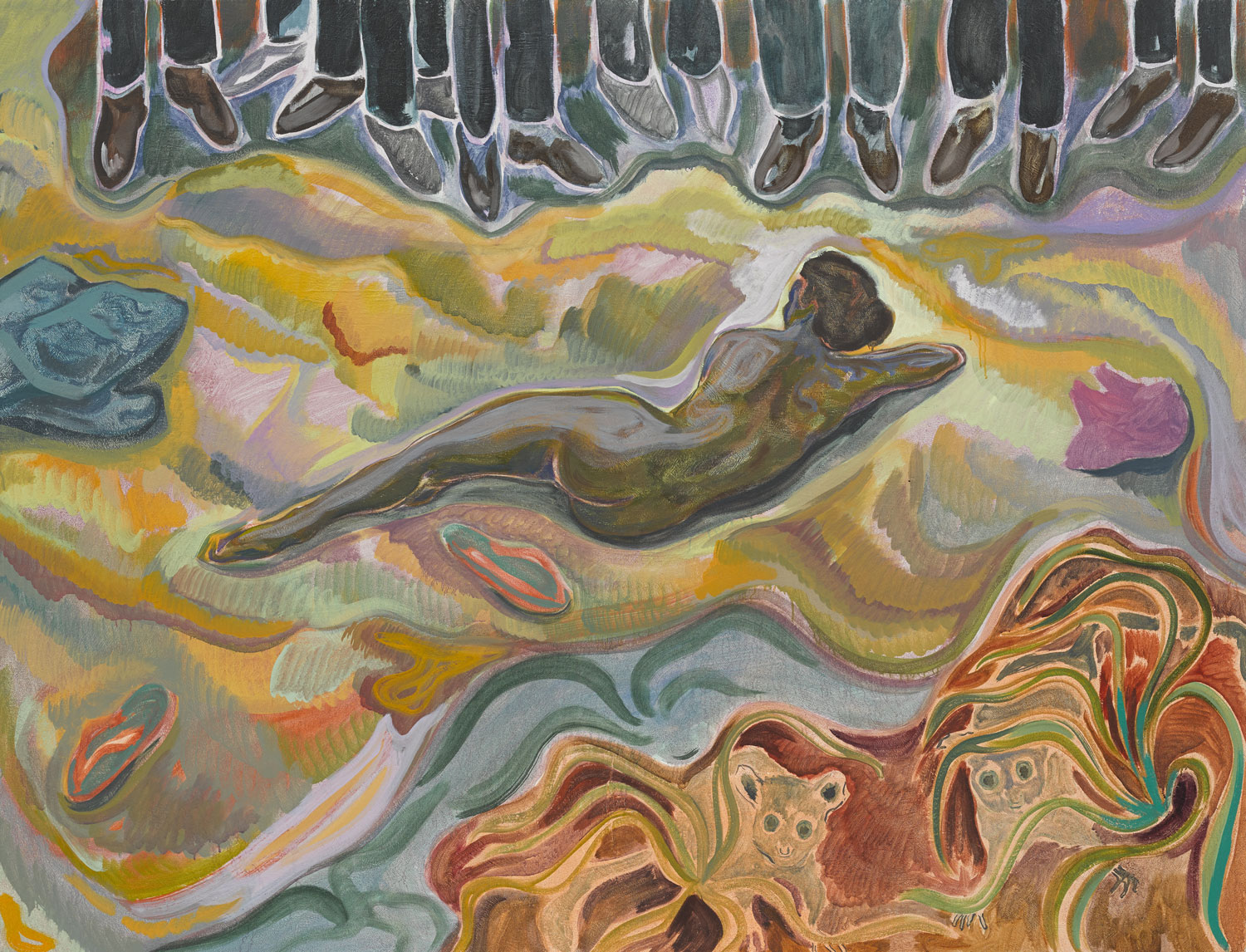
Following Marlène Dumas in 2022 and Julie Mehretu in 2024, the Palais Grassi continues its flawless run with an impressive exhibition dedicated to the Kenyan painter Michael Armitage. Bright pinks, electric greens, dazzling yellows: the first sensation is one of being dazzled by color. At times, one is reminded of the Fauves; at others, of German Expressionism—Kirchner in particular—as the color seems less to describe the world than to make it vibrate. Elsewhere, the supple lines of the vegetation and the silhouettes that blend into the landscape evoke the arabesques of Art Nouveau. But these references are never, in Armitage’s work, literal quotations. The painter absorbs this entire history of art to forge a language of his own. His iconography is deeply rooted in East Africa, with its tropical trees, lush vegetation, local mythologies, and Black bodies—the true protagonists of this work.
Perhaps the most interesting aspect is the paradox embedded in this painting. Armitage paints scenes of pressing current events—political repression, the criminalization of homosexuality, the migrant crisis—using the slow, deliberate pace of painting. He contrasts the immediacy of current events with the slowness of painting. There is something almost anachronistic about this way of transforming political commentary into enduring, even iconic, images. The richness of his painting also stems from his ability to navigate between various registers—satirical, poetic, or epic—notably using large formats associated with history painting, the quintessential genre of the 19th century.
But no matter what style she adopts, violence is always just beneath the surface. Amid the profusion of details in her compositions, it doesn’t always jump out at first glance. In #mydressmychoiceAt first glance, the odalisque seems to belong to the classical tradition of painting. It takes a few seconds to realize that the body is, in fact, being violated and that the scene is based on a contemporary news story. Male legs emerge from the edge of the canvas, faceless and anonymous. The beauty of the composition does not mask the brutality of the scene; it merely delays its impact. The viewer’s gaze is compelled to return, to observe, to discover what lay hidden beneath the obvious. The violence is imprinted on the canvas itself—a lubugo canvas, made from tree bark according to a Ugandan tradition. Stitched, scuffed, and sometimes torn, it also bears the scars of this violence. You leave this exhibition reeling, your eyes saturated with color. A must-see.
Michael Armitage, “The Promise of Change,” Palazzo Grassi, Venice, through January 10, 2027.
This translation was generated using AI. For the original text, please see the French version of this article.
