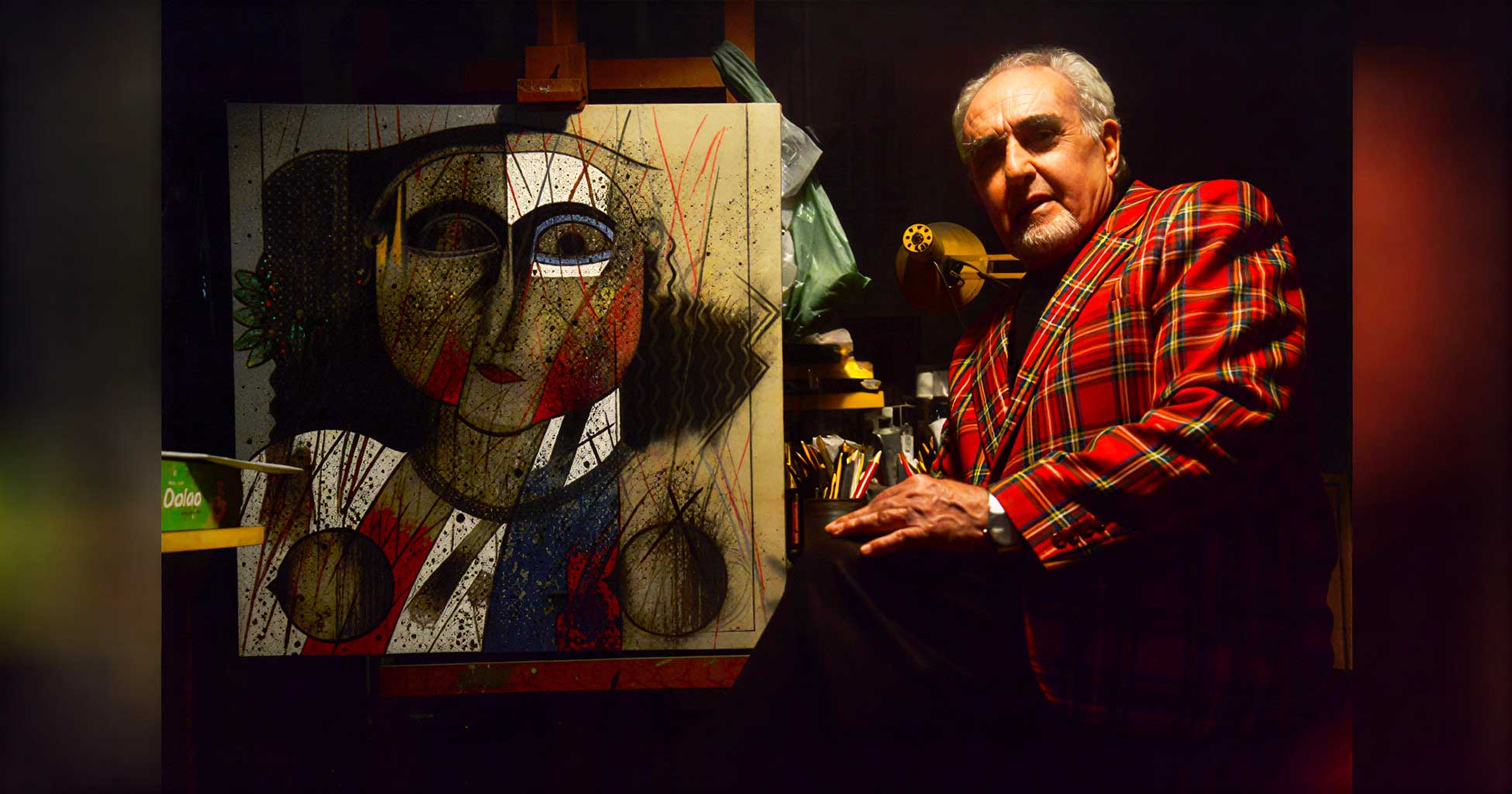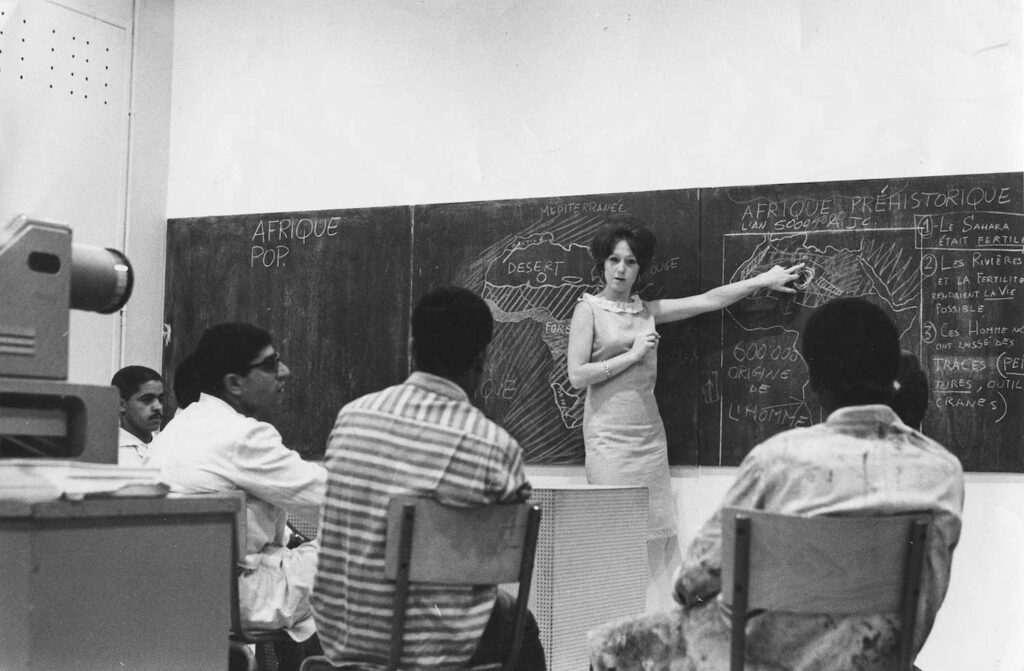
Explorant les énigmes de la mémoire collective, la peinture de Saâd Ben Cheffaj convoque les symboles et les mythologies de la culture marocaine, mais aussi espagnole. À Tétouan, où il est né en 1939 et vit encore aujourd’hui, il s’est fait l’artisan de rencontres entre les deux rives de la Méditerranée.
Exposé au Maroc dès 1956, Ben Cheffaj est l’un des principaux acteurs de la jeune histoire de l’art du royaume. Durant tout son parcours, dès ses études aux Beaux-Arts de Séville et à l’École du Louvre dans les années 1950, puis tout au long de sa carrière d’artiste et d’enseignant aux Beaux-Arts de Tétouan, il n’a cessé de progresser dans la recherche plastique. Il a connu plusieurs périodes : figuration, expressionnisme, néoréalisme, abstraction. Osant remettre en question ses processus créatifs et codes picturaux, il a alterné avec une rare radicalité une abstraction géométrique au moyen de matériaux pauvres et une figuration hyperréaliste au raffinement extrême, pour finalement opérer, cette dernière décennie, une synthèse des deux modes en y représentant, avec la force de ses constructions antérieures, les figures mythologiques des civilisations de la Méditerranée.
Le tableau comme talisman
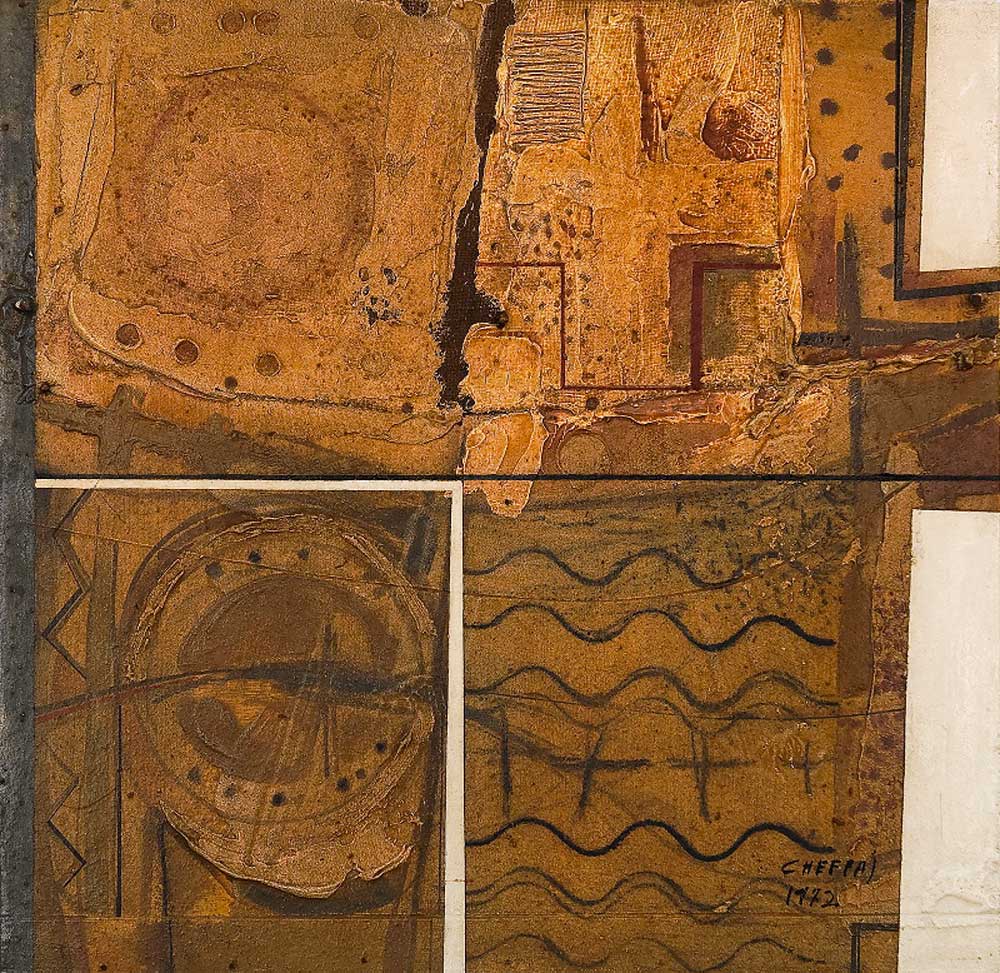
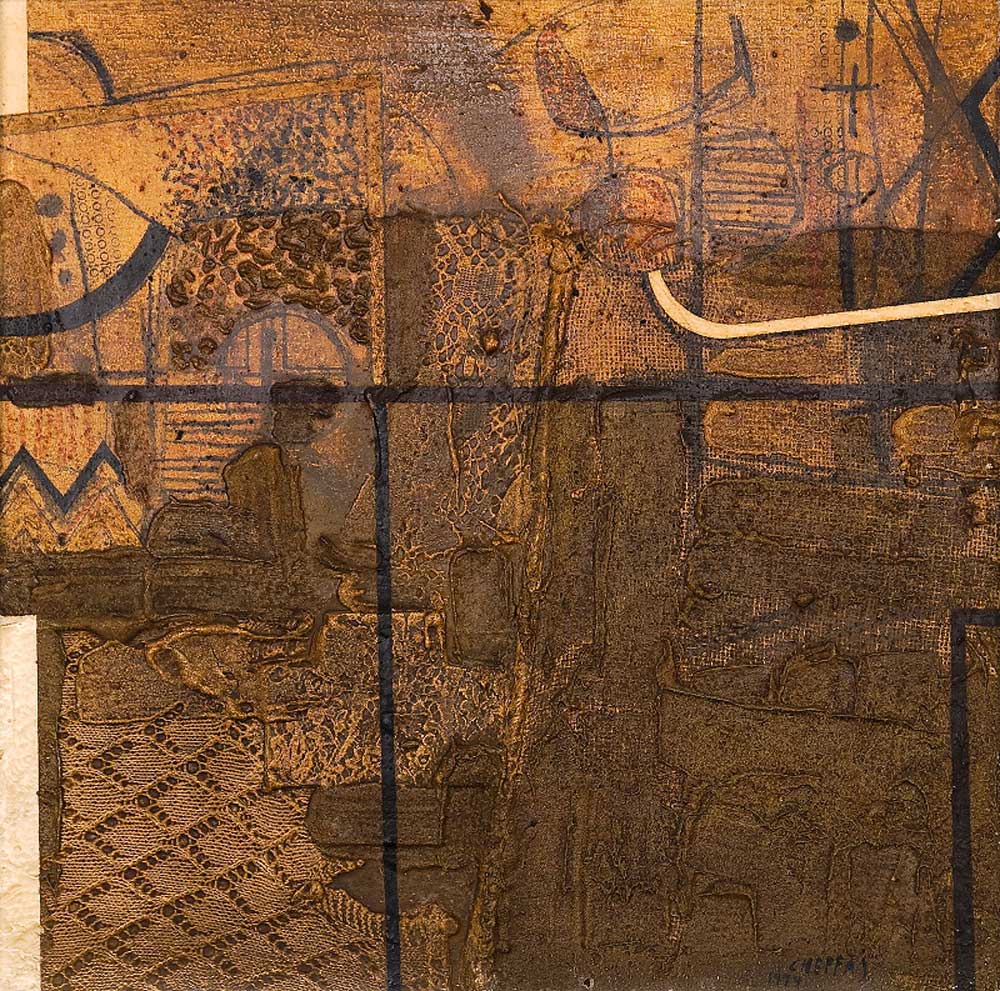
Les deux œuvres reproduites ici, datées de 1972 et 1979, témoignent de l’époque où l’artiste s’intéressait à l’architecture ainsi qu’aux artisans potiers du nord du Maroc. Ainsi peut-on voir dans ces œuvres des réminiscences de la poterie féminine du Rif, à une époque où l’intérêt pour les arts ruraux et leur symbolique abstraite fournissaient aux artistes le motif idéal pour rompre avec l’orientalisme. Croix, ondes, signes, géométries hachées, pointillés sont dessinés à l’aide de charbon sur une surface où se superposent plusieurs couches de plâtre, sable, clous, toile de jute, débris de jouets, cordes, textiles usagés, déchiquetés. Les teintes cuivre, bistre, carmin et cendre sont parfois appliquées au couteau. La composition, souvent en croix, découpe l’espace en étages indépendants, chacun pouvant se voir comme un tableau dans le tableau.
Saâd Ben Cheffaj est connu pour sa « lumière noire », fruit de la remarquable maîtrise des techniques (huile, vernis, glacis…), qui masque son œuvre comme au travers d’un voile, invitant à l’incertitude, à deviner le chaos derrière ces compositions austères ; chaos qui n’est pas exempt de mélancolie. Apanage – ou malédiction – des artistes et poètes, cette mélancolie « d’aimer une image du monde dont on sait qu’elle n’est qu’une image, et qu’elle prive donc ce retour que l’on désire », comme l’écrit Yves Bonnefoy, transparaît au travers des voiles successifs des couches picturales, des grattages, des traits qui hachurent la toile tel un moucharabieh, un écran entre l’état d’âme et la réalité.
Concevant le tableau comme un support où plusieurs strates épaisses se superposent, l’artiste, à la manière de l’archéologue, sauvegarde la mémoire des signes. Le tableau devient alors talisman, réceptacle prophylactique des consciences, invitant à y déposer son histoire ou à deviner celles, invisibles, que la peinture enferme. Il y est alors question de mythes redessinés et de cette multiplicité qu’offre la peinture en ce qu’elle est toujours inachevée parce qu’offerte au regard de l’autre.
Une écriture de la muralité
Regarder une œuvre de Saâd Ben Cheffaj, c’est aussi plonger dans les architectures de la ville marocaine, avec leur part d’ombre et de lumière, c’est y voir les structures qui se trament derrière la représentation. Par sa nature ambivalente, l’architecture andalouse interpelle l’artiste. Avec ses contrastes entre espaces clos et ouvertures, ses ruelles étroites et obscures où la lumière se dépose par appoints comme des touches de peinture, ses toits crénelés se découpant sur le ciel, ses coupoles pleines s’opposant à ses minarets tout en hauteur, mais surtout avec l’histoire qu’enferment ses murs du dehors comme du dedans, elle est le lieu où l’artiste peut matérialiser toutes ces tensions dans le défi de la surface frontale et bidimensionnelle.
Cette écriture de la muralité s’inscrit en outre dans un contexte typiquement méditerranéen, avec la fécondation mutuelle, depuis le début du XXe siècle, entre artistes de l’Espagne voisine et artistes du nord du Maroc. Le graffiti, les traces brèves d’un passage et la conscience aigue de l’éphémère ont trouvé chez des artistes comme Antoni Tàpies, Carlos Saura, Manolo Millares, feu Meki Meghara ou plus récemment Hassan Bourkia, une expression sans compromis. Comme si prolonger avec le vocabulaire plastique les couches s’inscrivant dans les murs était une manière de continuer à écrire l’histoire, politique pour Tàpies, poétique pour Meghara, réunificatrice pour Ben Cheffaj…
Aujourd’hui, les éléments visuels d’une culture méditerranéenne se trouvent unifiés dans la peinture de Saâd Ben Cheffaj : les figures de la mythologie antique, le bleu outremer, la construction en plans géométriques et abstraits… Chez cet artiste à la culture immense, il faut y voir non seulement le devoir de transmission du professeur qu’il est aussi, mais surtout un désir de réunifier et de condamner l’indifférence meurtrière. Sa leçon magistrale se trouve dans les remises en question de son art, la réinvention étant le moteur par essence de la création.
Par Ghitha Triki
Exploring the enigmas of collective memory, Saâd Ben Cheffaj’s painting summons the symbols and mythologies of Moroccan culture, as well as Spanish culture. In Tetouan, where he was born in 1939 and still lives today, he has fashioned himself into a craftsman of encounters between the two shores of the Mediterranean.
Exhibited in Morocco as early as 1956, Ben Cheffaj is one of the leading figures in the young history of art in the kingdom. Throughout his career, beginning with his studies at the School of Fine Arts in Seville and at the École du Louvre in the 1950s, and continuing through his work as both artist and professor at the Fine Arts School of Tetouan, he has continually advanced in his formal research. He has gone through several periods: figuration, expressionism, neo-realism, abstraction. Boldly questioning his creative processes and pictorial codes, he alternated with rare radicalism between geometric abstraction using humble materials and hyperrealist figuration of extreme refinement. Over the past decade, he has ultimately achieved a synthesis of these two modes, representing – with the strength of his earlier constructions – the mythological figures of Mediterranean civilizations.
The Painting as Talisman
The two works reproduced here, dated 1972 and 1979, bear witness to the period when the artist was interested in architecture as well as in the potter artisans of northern Morocco. In these works one can perceive echoes of women’s pottery from the Rif, at a time when interest in rural arts and their abstract symbolism offered artists an ideal motif for breaking away from Orientalism. Crosses, waves, signs, jagged geometries, and dotted lines are drawn in charcoal on a surface layered with plaster, sand, nails, burlap, toy fragments, ropes, and worn, shredded textiles. Copper, bistre, carmine, and ash tones are sometimes applied with a palette knife. The composition, often structured in the form of a cross, divides the space into independent tiers, each of which can be seen as a painting within the painting.
Saâd Ben Cheffaj is known for his “black light,” the result of his remarkable mastery of technique (oil, varnish, glazes…), which veils his work as though seen through a screen, inviting uncertainty, prompting the viewer to sense the chaos behind these austere compositions,a chaos not devoid of melancholy. The prerogative, or perhaps the curse of artists and poets, this melancholy of “loving an image of the world while knowing it is only an image, and that it therefore denies the return one desires,” as Yves Bonnefoy writes, emerges through the successive veils of pictorial layers, the scrapings, the strokes that hatch the canvas like a moucharabieh, a screen between the inner state and reality.
Conceiving the painting as a support upon which several thick strata overlap, the artist, like an archaeologist, preserves the memory of signs. The painting thus becomes a talisman, a prophylactic receptacle of consciousness, inviting one to deposit one’s own history within it or to discern the invisible ones that the painting encloses. It is a matter here of redrawn myths and of the multiplicity that painting offers in that it is always unfinished, because it is offered to the gaze of the other.