Sous les boiseries de La Mamounia, 1-54 Marrakech rassemble 22 galeries.
Modernité, abstraction, matière : un regard sur les tendances de cette année, stand par stand.
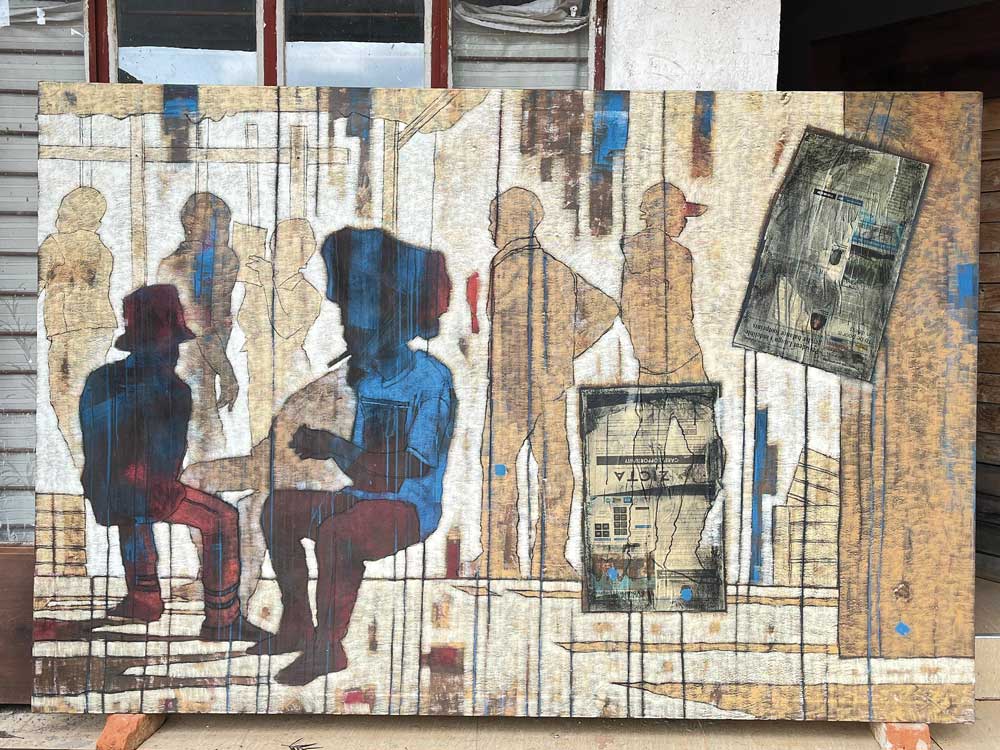
Courtesy Imvelo Studio.
Geoffrey Phiri
Façonnant la scène artistique zambienne contemporaine depuis plus de trente ans, le peintre et sculpteur Geoffrey Phiri est reconnu pour sa capacité à repousser les frontières créatives. Ses toiles aux couleurs éclatantes, peuplées de silhouettes en ombres chinoises, interrogent les mutations sociales à l’œuvre dans les rues de son pays. Ses œuvres figurent notamment dans la Chaminuka Collection, l’une des plus importantes collections privées d’art en Zambie.
A key figure in Zambia’s contemporary art scene for over three decades, painter and sculptor Geoffrey Phiri is known for pushing creative boundaries. His vibrantly coloured canvases, populated by silhouetted figures, examine the social transformations unfolding in the streets of his country. His work is held in major collections, including the Chaminuka Collection, one of Zambia’s leading private art collections.
IMVELO STUDIO
14 000 € / 150 000 MAD.
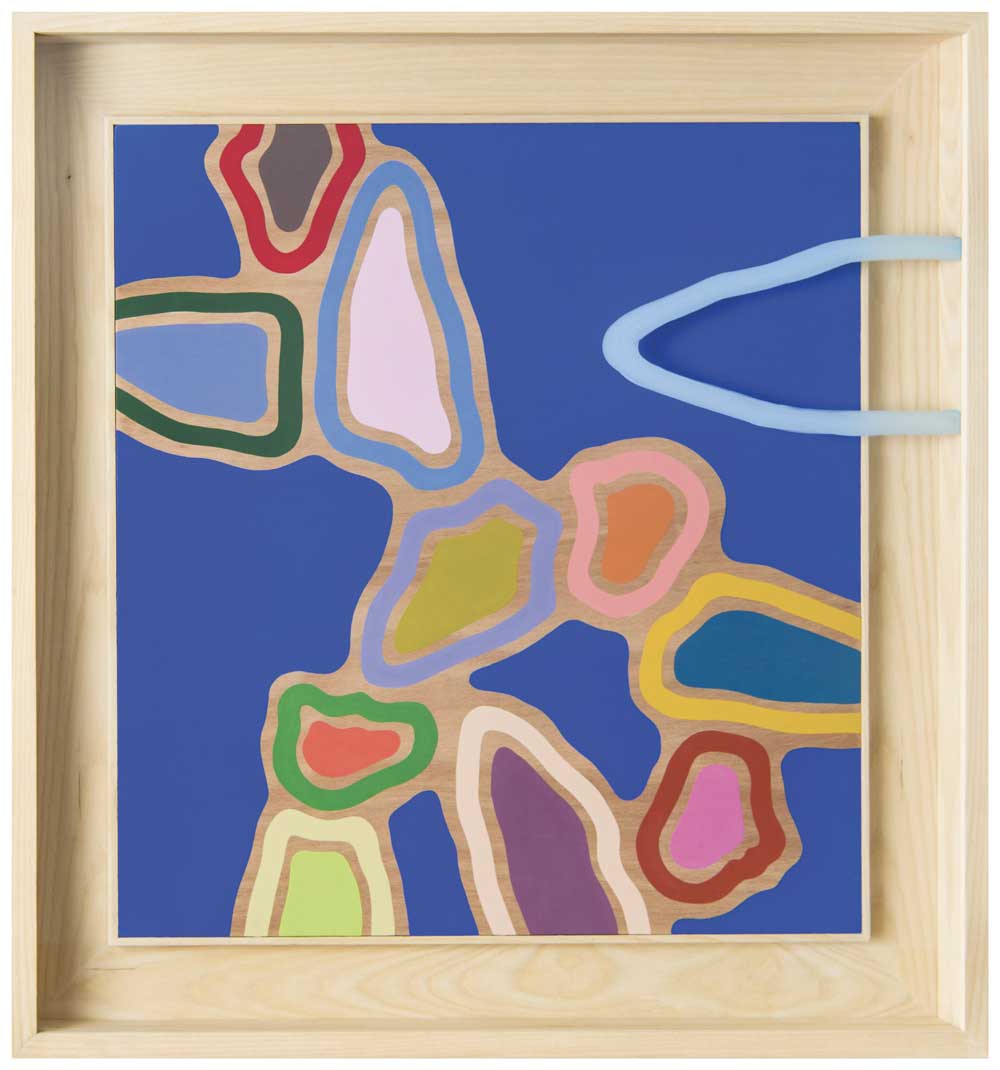
peinture sur verre, 115 x 125 cm. Courtesy La Galerie 38.
Yacout Hamdouch
Après des études en joaillerie et gemmologie, l’artiste marocaine Yacout Hamdouch, née à Casablanca en 1994, se forme à l’Académie des Beaux-Arts de Milan, où elle s’oriente vers une abstraction aux couleurs vives. Travaillant le bois et le verre, elle développe des compositions dynamiques aux formes oblongues. Ses œuvres figurent dans les collections du MACAAL et du Musée Mohammed VI d’art moderne et contemporain de Rabat.
After studying jewellery and gemmology, Moroccan artist Yacout Hamdouch, born in Casablanca in 1994, trained at the Academy of Fine Arts in Milan, where she turned towards a vibrant abstract language. Working with wood and glass, she develops dynamic compositions marked by oblong forms. Her work is held in the collections of MACAAL and the Mohammed VI Museum of Modern and Contemporary Art in Rabat.
LA GALERIE 38
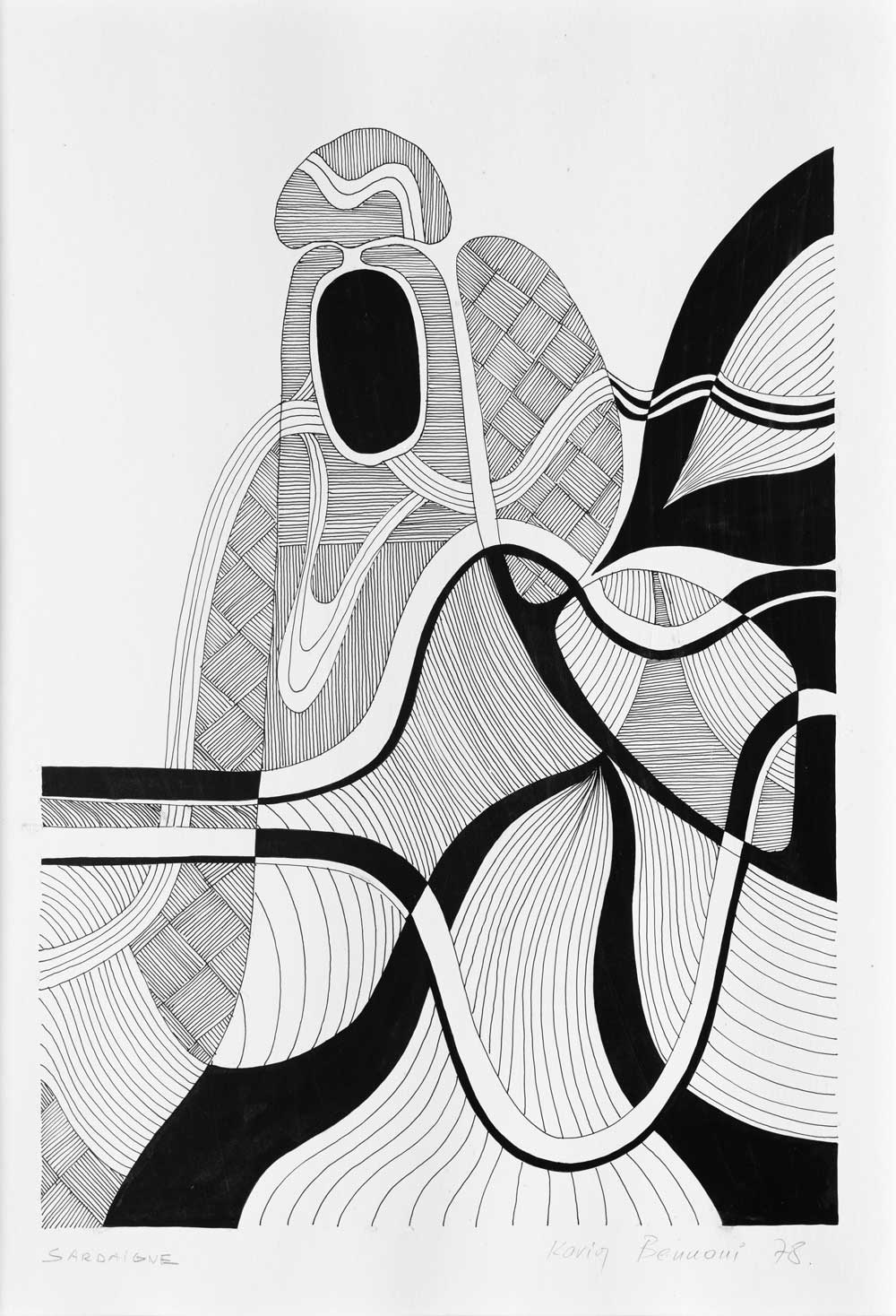
Karim Bennani
Figure de l’art moderne au Maroc, le peintre et architecte-designer Karim Bennani (1936–2023) a réalisé de nombreuses toiles abstraites et des bas-reliefs marqués par un penchant matiériste affirmé. Moins connues, ses œuvres sur papier à l’encre de Chine dessinent tout en finesse et arabesques des figures singulières évoquant son Maroc natal. Ses œuvres ont notamment intégré les collections du Musée Mohammed VI d’art moderne et contemporain de Rabat.
A figure of modern art in Morocco, painter and architect-designer Karim Bennani (1936–2023) produced a substantial body of abstract paintings and bas-reliefs marked by a strong material sensibility. Less well-known, his ink on paper works reveal finely drawn, arabesque-like figures that evoke his native Morocco. His work has also entered the collections of the Mohammed VI Museum of Modern and Contemporary Art in Rabat.
AA GALLERY
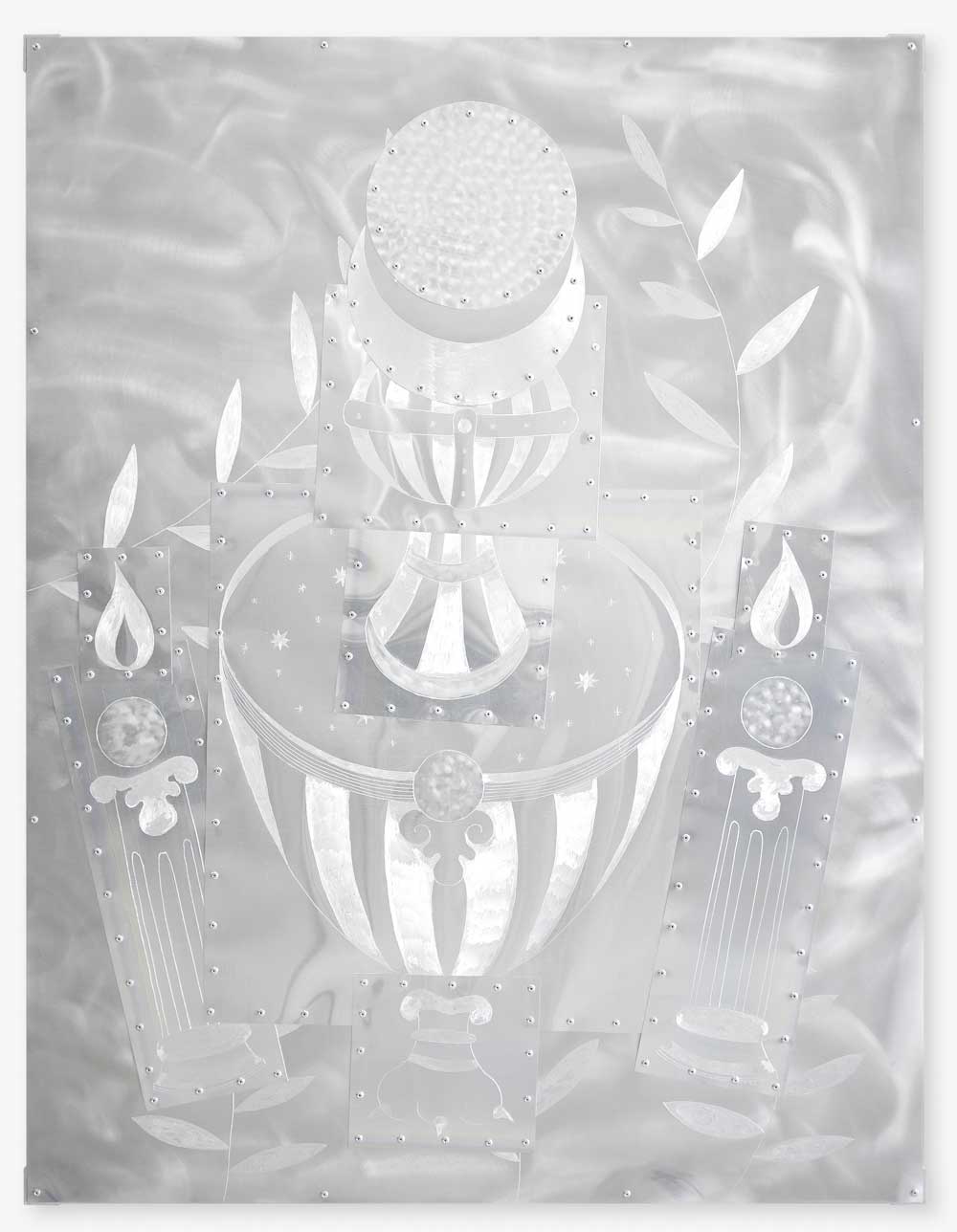
2025, aluminium gravé et riveté (engraved
and riveted aluminum), 100 x 130 x 4 cm.
Courtesy Galerie La La Lande
Kaïs Dhifi
Artiste tunisien né en 1980, Kaïs Dhifi situe sa pratique artistique entre savoir-faire artisanal et esthétique futuriste. Gravant des plaques d’aluminium sur lesquelles se mêlent des motifs et des symboles empruntant à des univers aussi dissemblables que l’archéologie, la cosmologie ou un réalisme fantastique qui lui est propre, il rabat les cartes d’un afro-futurisme en constante gestation.
Born in 1980, Tunisian artist Kaïs Dhifi works at the crossroads of artisanal craft and a futuristic aesthetic. Through engraved aluminum plates combining motifs drawn from archaeology, cosmology and his own brand of fantastical realism, he reworks the codes of an Afro-futurism in constant formation.
GALERIE LA LA LANDE
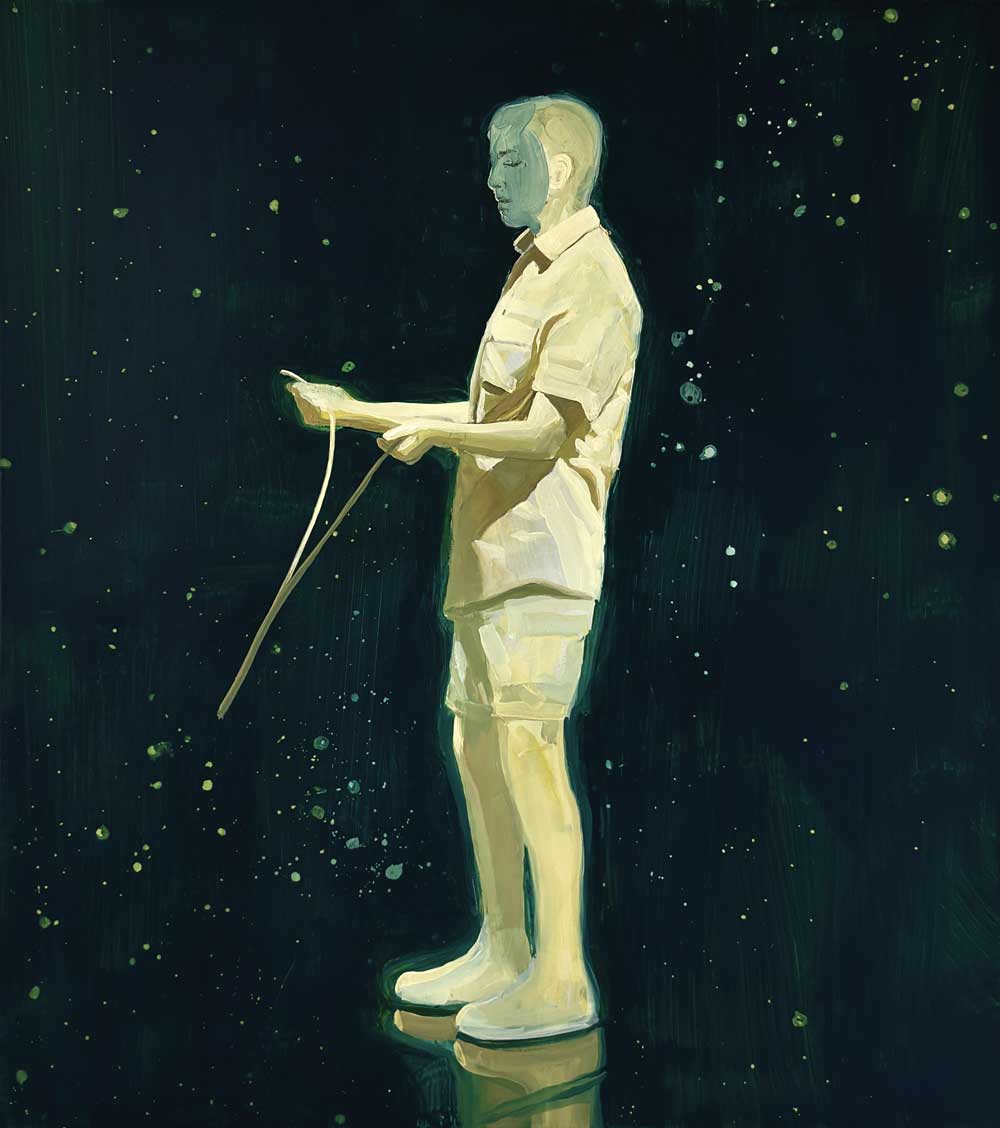
(acrylic on canvas), 90 x 80 cm. Courtesy L’Atelier 21.
Nabil El Makhloufi
Originaire de Fès, Nabil El Makhloufi est diplômé de l’Académie des arts visuels de Leipzig, où il réside. Sa peinture figurative, peuplée de portraits de groupe ou de figures solitaires, déploie un imaginaire souvent nocturne porté par des aplats oniriques. Dans Astral, un sourcier indécis semble cristalliser les angoisses d’une génération. Ses œuvres figurent notamment dans les collections de la Sharjah Art Foundation.
Born in Fez, Nabil El Makhloufi is a graduate of the Academy of Visual Arts in Leipzig, where he is currently based. His figurative painting, populated by group portraits and solitary figures, evokes a frequently nocturnal world shaped by dreamlike fields of colour. In Astral, an uncertain dowser appears to crystallise the anxieties of a generation. His work is held in the collections of the Sharjah Art Foundation.
L’ATELIER 21
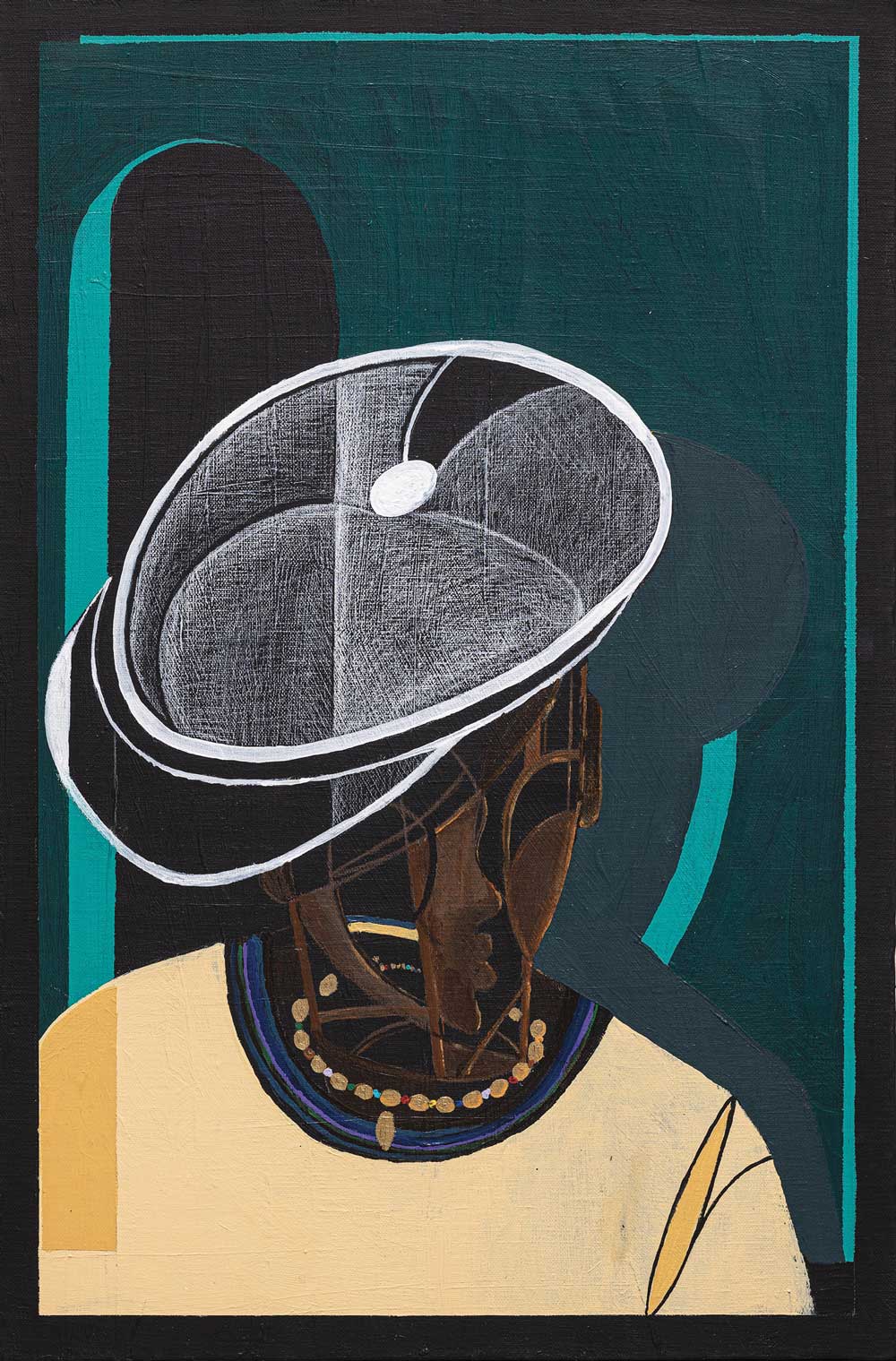
technique mixte sur toile (mixed media on canvas), 60 x 40 cm
Courtesy Galerie Cécile Fakhoury
Carl-Edouard Keïta
Des lignes anguleuses de la statuaire africaine aux géométries fragmentées du cubisme, en passant par le vohou-vohou ivoirien, Carl-Edouard Keïta puise dans un vaste répertoire formel. Né à Abidjan, autodidacte avant d’être diplômé de la New York Academy of Art en 2021, le trentenaire développe une pratique où héritages culturels et langage contemporain se répondent avec finesse.
Influenced by traditional African sculpture, Cubist fragmentation and Ivorian vohou-vohou, Carl-Edouard Keita draws from a broad formal vocabulary. Born in Abidjan and self-taught before graduating from the New York Academy of Art in 2021, he develops a practice that brings cultural heritage into conversation with contemporary visual language.
GALERIE CÉCILE FAKHOURY
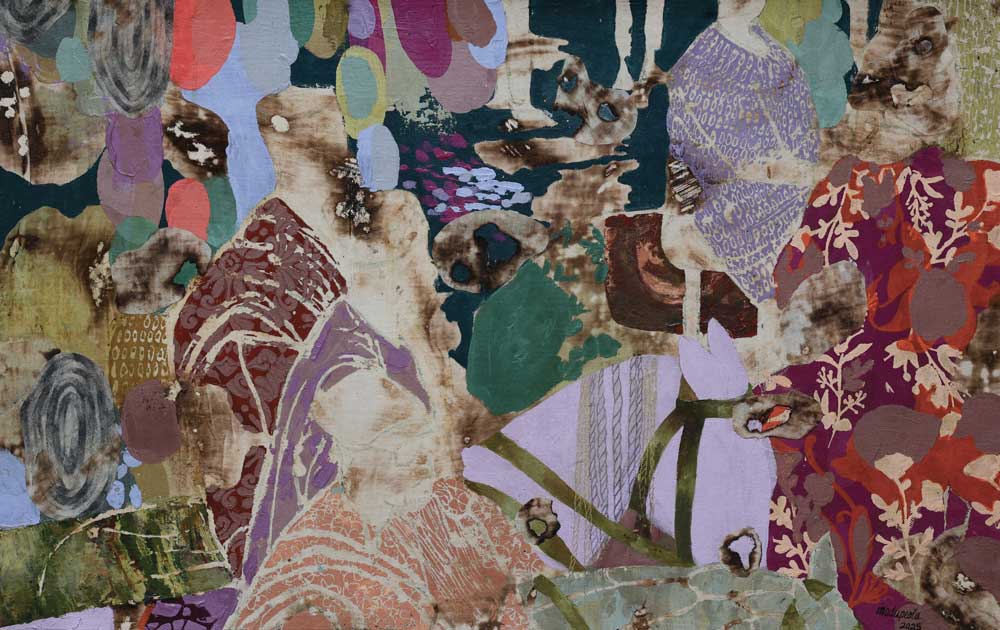
graphite et encre sur toile brûlée (acrylic, graphite, and ink on
burned canvas), 55,9 × 87,6 cm. Courtesy Gallery 1957
Modupeola Fadugba
The Three Horse Men de Modupeola Fadugba suggère plus qu’il ne décrit. Sur une surface stratifiée et des formes fragmentées, l’artiste togolaise laisse entrevoir des mouvements et des personnages à travers les motifs textiles des tenues cérémonielles de son pays. Les œuvres de Modupeola Fadugba figurent dans les collections du Smithsonian ou du Minneapolis Institute of Art. Elle est par ailleurs lauréate du Norval Sovereign African Art Prize 2025.
The Three Horse Men by Modupeola Fadugba suggests more than it describes. Through layered surfaces and fragmented forms, the Togolese artist evokes movement and figures filtered through the textile patterns of her country’s ceremonial dress. Her work is held in the collections of the Smithsonian and the Minneapolis Institute of Art. She is a recipient of the 2025 Norval Sovereign African Art Prize.
GALLERY 1957
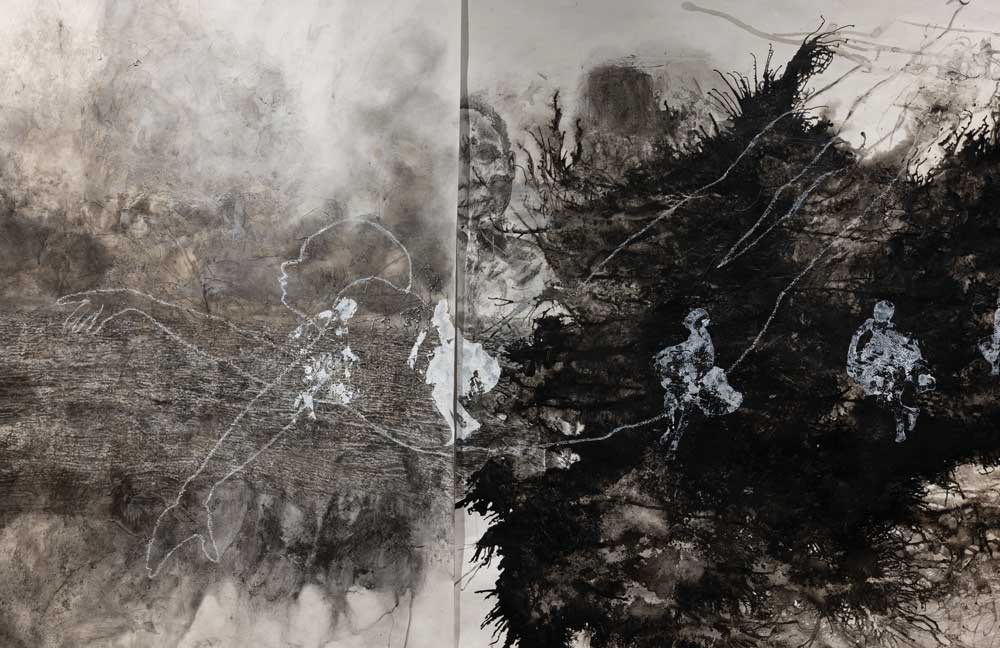
encre, charbon, acrylique, café et papier fait main sur papier coton
(four panels, Ink, charcoal, acrylic, coffee and handmade paper on
cotton paper), 183 × 665,5 cm. Courtesy Gallery Ellephant.
Stanley Wany
Mêlant encre, charbon de bois, café, acrylique, papier et tissage de coton, la pratique de Stanley Wany explore la non-linéarité narrative et l’inconscient. Artiste multidisciplinaire, il revisite les archives coloniales pour exhumer l’histoire de ses ancêtres d’origine africaine. En puisant dans une iconographie antillaise, l’artiste reconstruit ainsi des liens traditionnels et historiques qui ont forgé son identité créole.
Blending ink, charcoal, coffee, acrylic, paper and cotton weaving, Stanley Wany explores narrative nonlinearity and the unconscious. Through colonial archives and Caribbean iconography, the multidisciplinary artist traces Afro-descendant histories and reconstructs the ties that shaped his Creole identity.
GALLERY ELLEPHANT
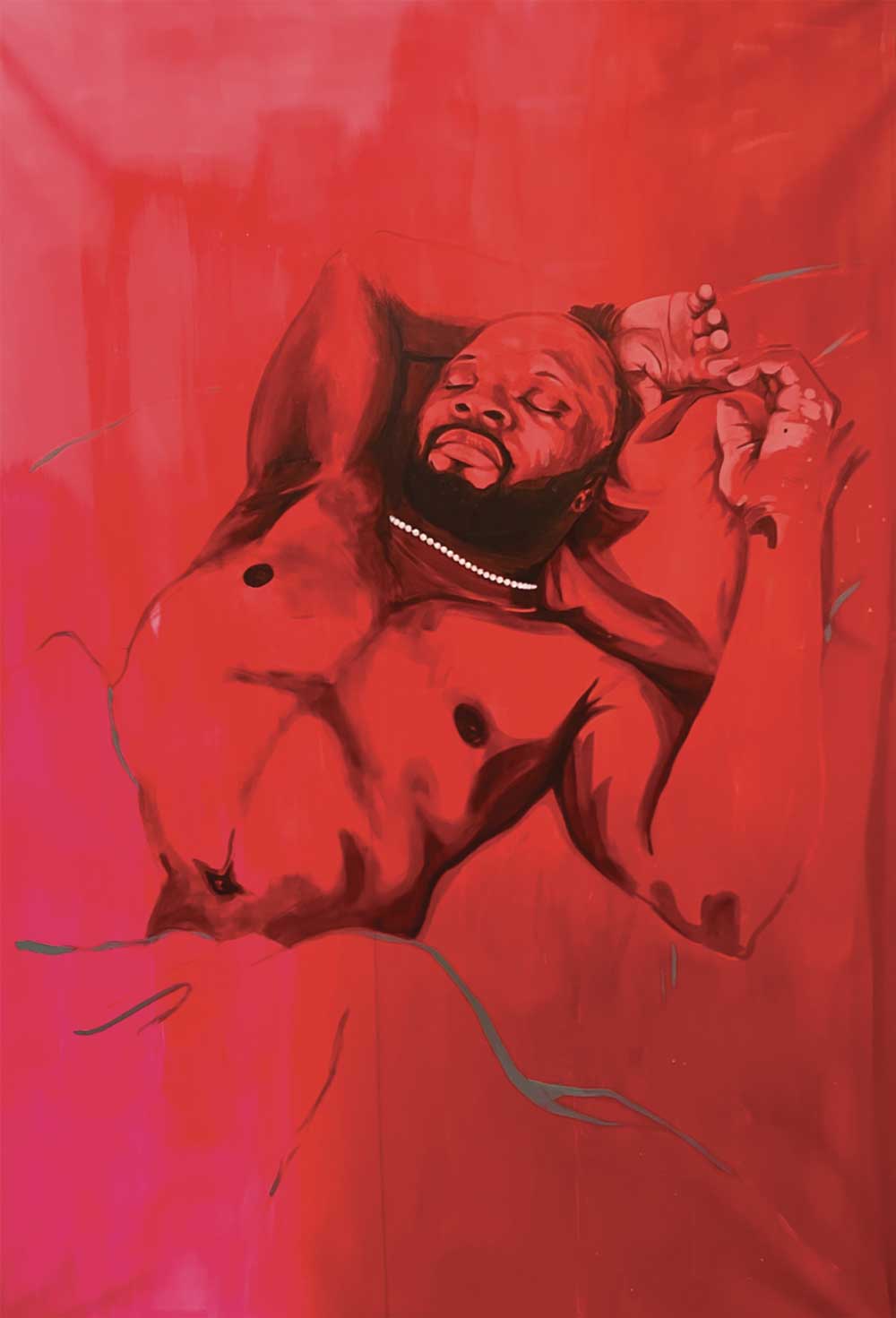
sur toile (acrylic on canvas), 150 x 100 cm.
Courtesy MCC Gallery
Salma Cheddadi
Originaire de Casablanca, Salma Cheddadi est connue pour ses films documentaires, dont le récent Qu’est-ce qu’on va faire de toi ?, coréalisé avec Karelle Fitoussi. Également sculptrice et peintre, elle explore les notions d’altérité et les frontières entre humanité et animalité. Ses portraits récents, sur fond rouge vif, mettent en scène de jeunes hommes dont les poses révèlent une beauté sculpturale et une fragilité masculine souvent occultée.
Based in Casablanca, Salma Cheddadi is known for her documentary films, including the recent What Are We Going to Do with You?, co-directed with Karelle Fitoussi. Working across sculpture and painting, she explores questions of otherness and the shifting boundaries between humanity and animality. Her recent portraits, set against vivid red backgrounds, depict young men whose poses reveal a sculptural beauty and a rarely acknowledged masculine vulnerability.
MCC GALLERY
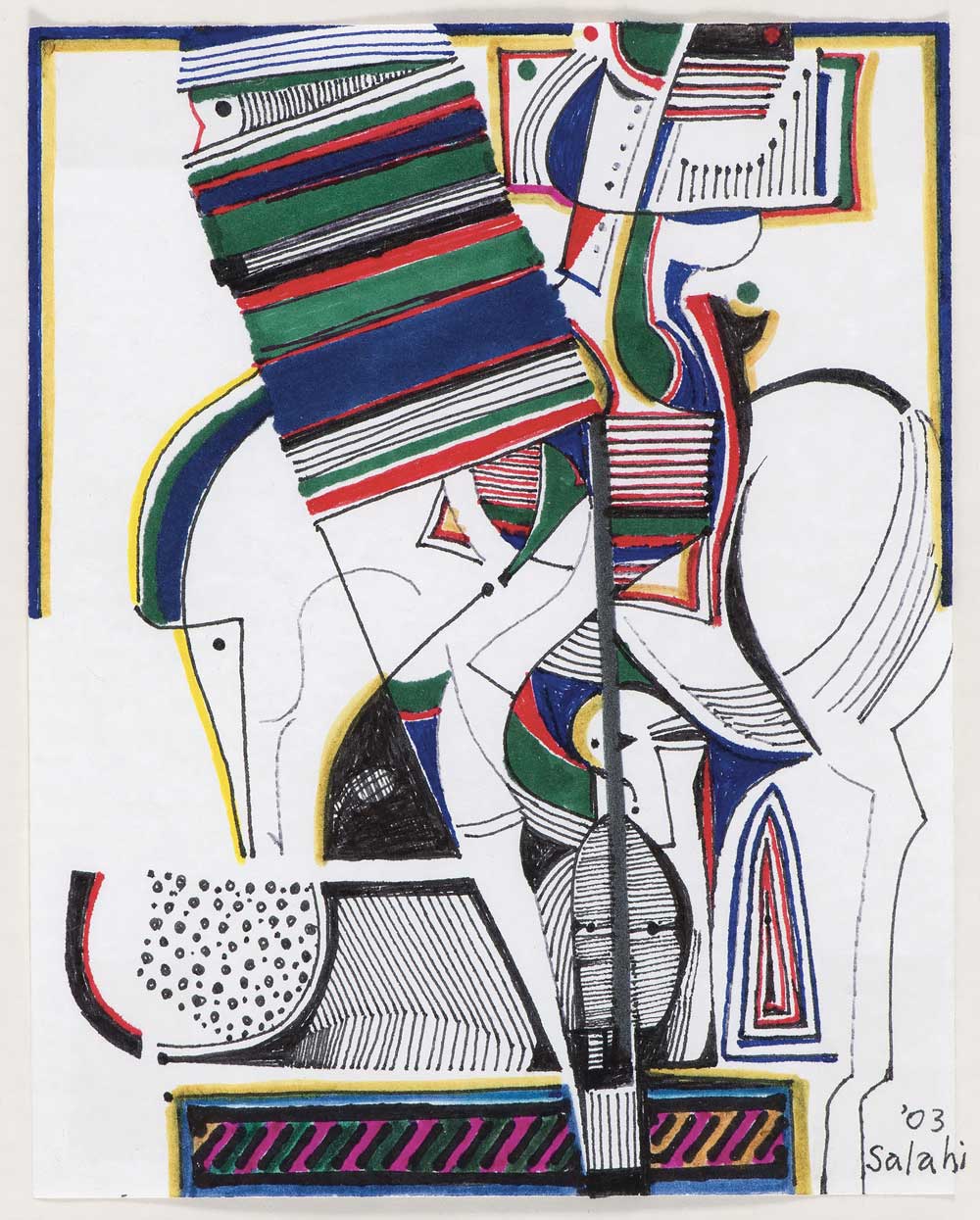
Courtesy Vigo Gallery.
Ibrahim El-Salahi
À 93 ans, Ibrahim El-Salahi est l’une des figures majeures de l’art africain contemporain. Formé à la Slade School de Londres, il développe dès 1957, à son retour au Soudan, un langage visuel inédit mêlant traditions vernaculaires, africaines, arabes et occidentales. Sa rétrospective à la Tate Modern en 2013 fut la première dédiée au modernisme africain. Ses œuvres figurent dans les collections du MoMA, du Met ou encore de la Tate Modern.
At 93, Ibrahim El-Salahi is a leading figure of contemporary African art. Trained at London’s Slade School of Fine Art, he developed a distinctive visual language after returning to Sudan in 1957, merging vernacular, African, Arab and Western traditions. His 2013 retrospective at Tate Modern was the first dedicated to African modernism. His work is held in major collections including MoMA, the Metropolitan Museum of Art and Tate Modern.
VIGO GALLERY
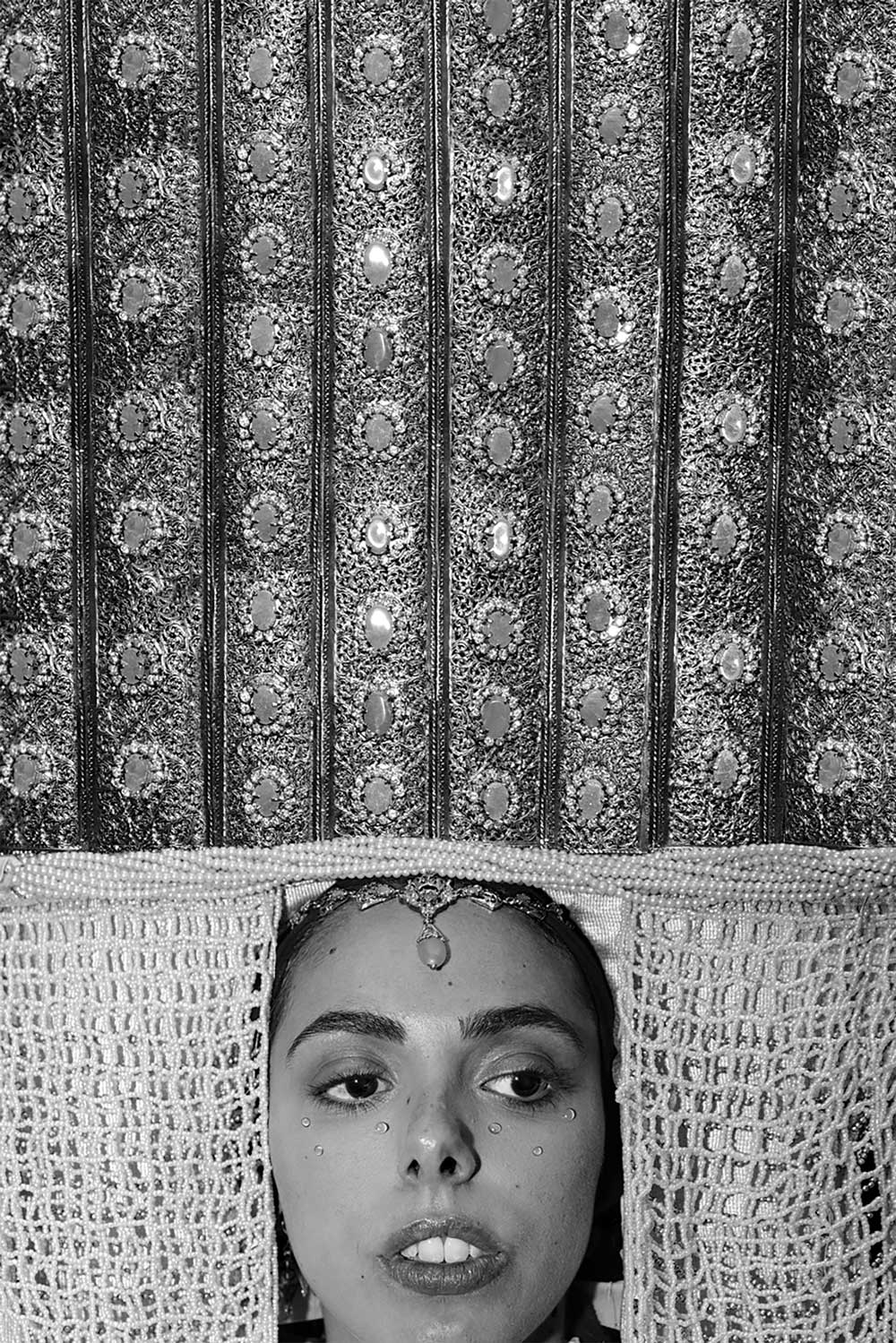
tirage photographique laminé sur aluminium (laminated
photographic print on aluminum), 100 x 150 cm. Courtesy
de l’artiste et Nil Gallery Paris.
Sara Benabdallah
Formée à la New York Film Academy et au Savannah College of Art and Design, la photographe et cinéaste marocaine Sara Benabdallah a grandi dans la médina de Marrakech. Elle en garde un lien viscéral avec les métiers de l’artisanat, avec lesquels elle collabore pour l’encadrement de ses œuvres, et interroge la condition féminine à travers des récits émancipateurs. Sans renier son héritage culturel, elle propose une relecture contemporaine de la féminité.
Trained at the New York Film Academy and the Savannah College of Art and Design, Moroccan photographer and filmmaker Sara Benabdallah grew up in the medina of Marrakech. She maintains a visceral connection to artisanal crafts, collaborating with artisans on the framing of her works, while exploring women’s experiences through emancipatory narratives. Rooted in her cultural heritage, she proposes a contemporary vision of femininity.
NIL GALLERY
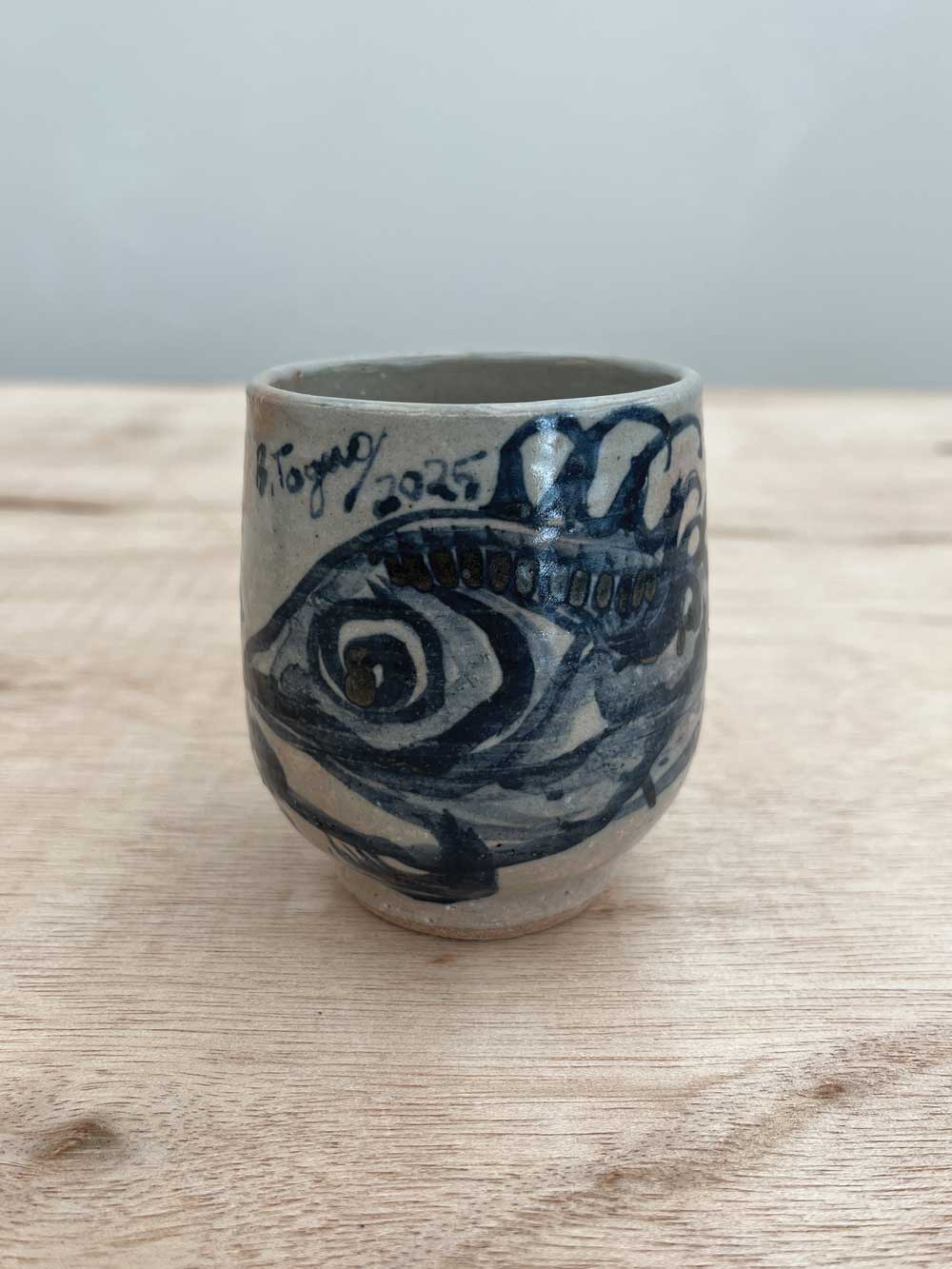
Courtesy Galerie Lelong, production space Un
Barthélémy Toguo
Exposée dans les plus grands musées du monde, l’œuvre protéiforme de Barthélémy Toguo (peinture, sculpture, gravure, performance…) aborde l’exil, la mémoire, la mondialisation et les droits humains. Régulièrement en résidence aux quatre coins du globe, l’artiste vit entre la France et le Cameroun, son pays d’origine, où il a fondé en 2007 le centre d’art Bandjoun Station, un lieu de transmission qui incarne sa vision humaniste.
Exhibited in major museums around the world, Barthélémy Toguo’s wide-ranging practice (encompassing painting, sculpture, printmaking and performance) engages with questions of exile, memory, globalisation and human rights. Regularly working in residence across the globe, he divides his time between France and Cameroon, his home country, where he founded Bandjoun Station in 2007, an art centre dedicated to transmission and shaped by a humanist vision.
SPACE UN
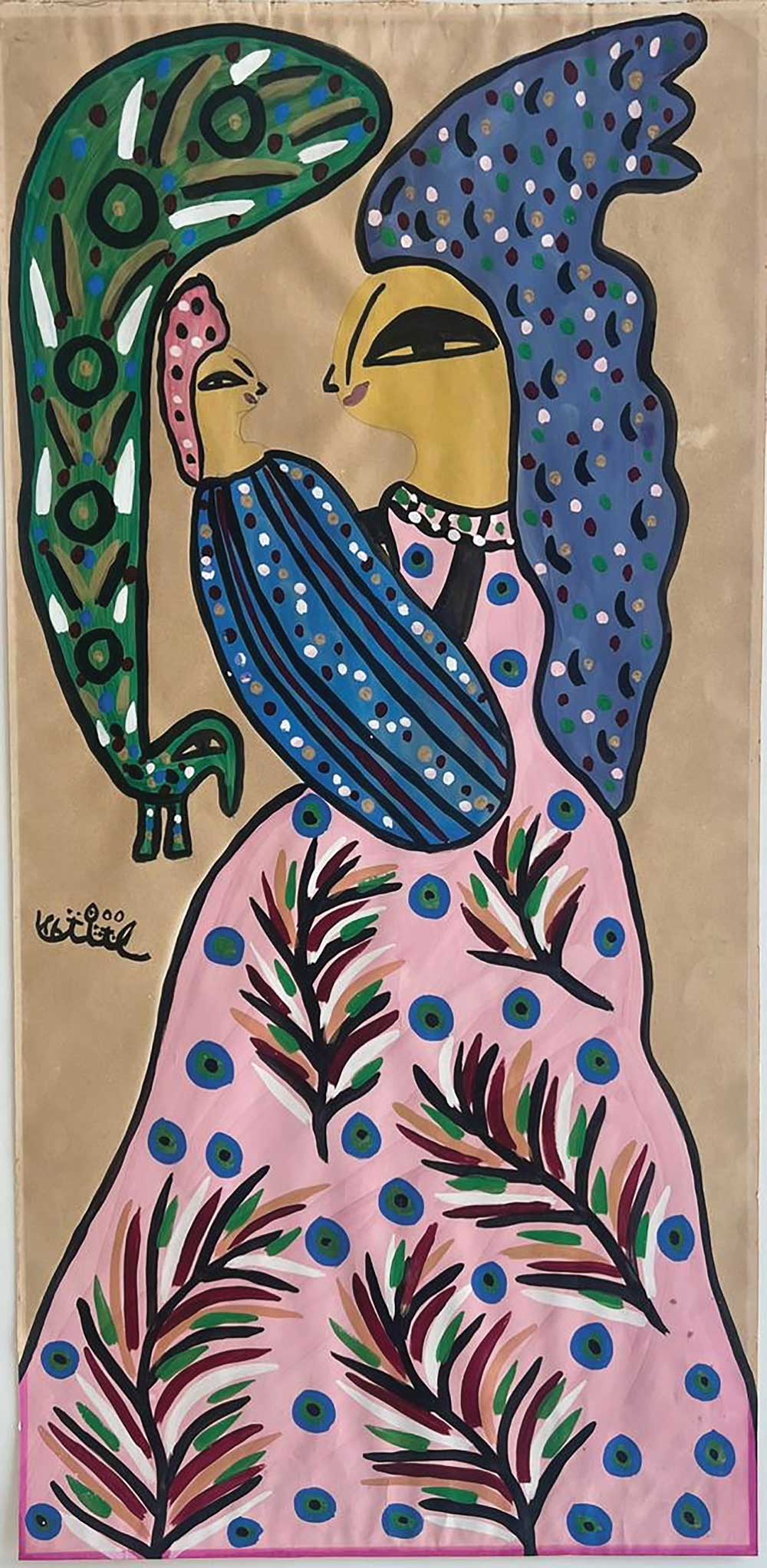
Courtesy Le Violon Bleu.
Baya
« Enfant-magicienne » selon l’écrivaine Assia Djebar, l’artiste autodidacte algérienne Baya (1931–1998) est une figure incontournable de l’art moderne de son pays. Après avoir exposé très jeune à la galerie parisienne Maeght et fasciné les artistes surréalistes, elle revient vivre en Algérie, où s’épanouissent ses portraits de femmes élancées se détachant d’une végétation luxuriante. La gouache sur papier de 1986 présentée ici témoigne d’un trait majestueux et d’un imaginaire onirique peuplé d’un bestiaire légendaire.,
Described as a “child magician” by writer Assia Djebar, the self-taught Algerian artist Baya (1931–1998) is a pivotal figure in her country’s modern art history. After exhibiting at a very young age at Paris’s Galerie Maeght and captivating the Surrealists, she returned to Algeria, where her elongated female figures unfold against lush vegetation. The 1986 gouache on paper presented here reveals a majestic line and a dreamlike imagination populated by a legendary bestiary.
LE VIOLON BLEU
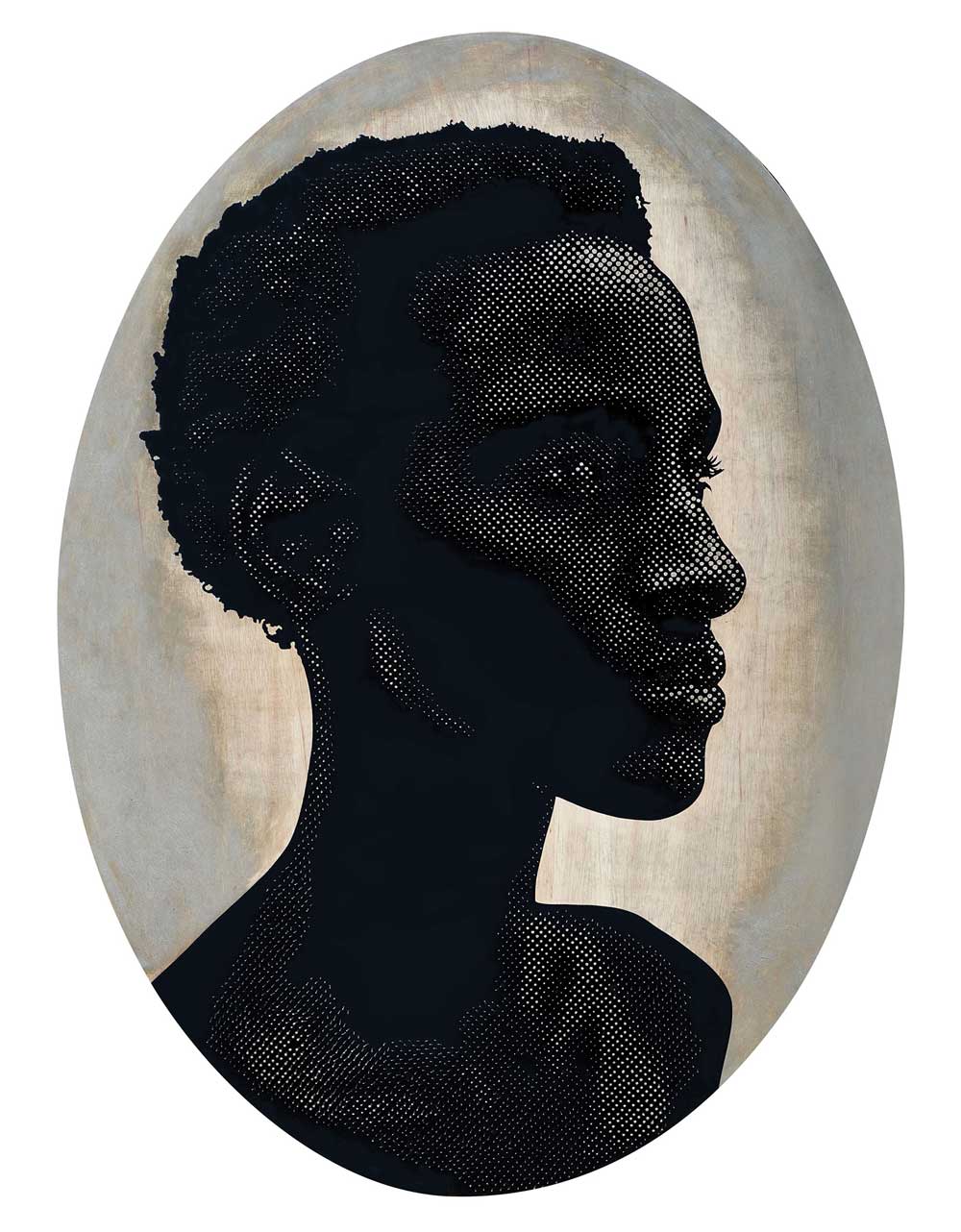
Alexis Peskine
Représentant la diaspora africaine, les portraits grand format d’Alexis Peskine sont réalisés à partir de clous recouverts de feuilles d’or, minutieusement enfoncés dans du bois teinté au café et à la boue. Ses personnages incarnent la force et la persévérance, rappelant les nkisi, figures rituelles du bassin du Congo associées à des pouvoirs spirituels. Né en France de parents russes et brésiliens, Alexis Peskine travaille aujourd’hui entre Paris, Salvador et New York
Alexis Peskine creates large-scale portraits of the African diaspora using gold-leafed nails driven into wood stained with coffee and mud. His figures embody strength and resilience, recalling nkisi, ritual objects from the Congo Basin associated with spiritual power. Born in France to Russian and Brazilian parents, Peskine now works between Paris, Salvador and New York.
FILAFRIQUES
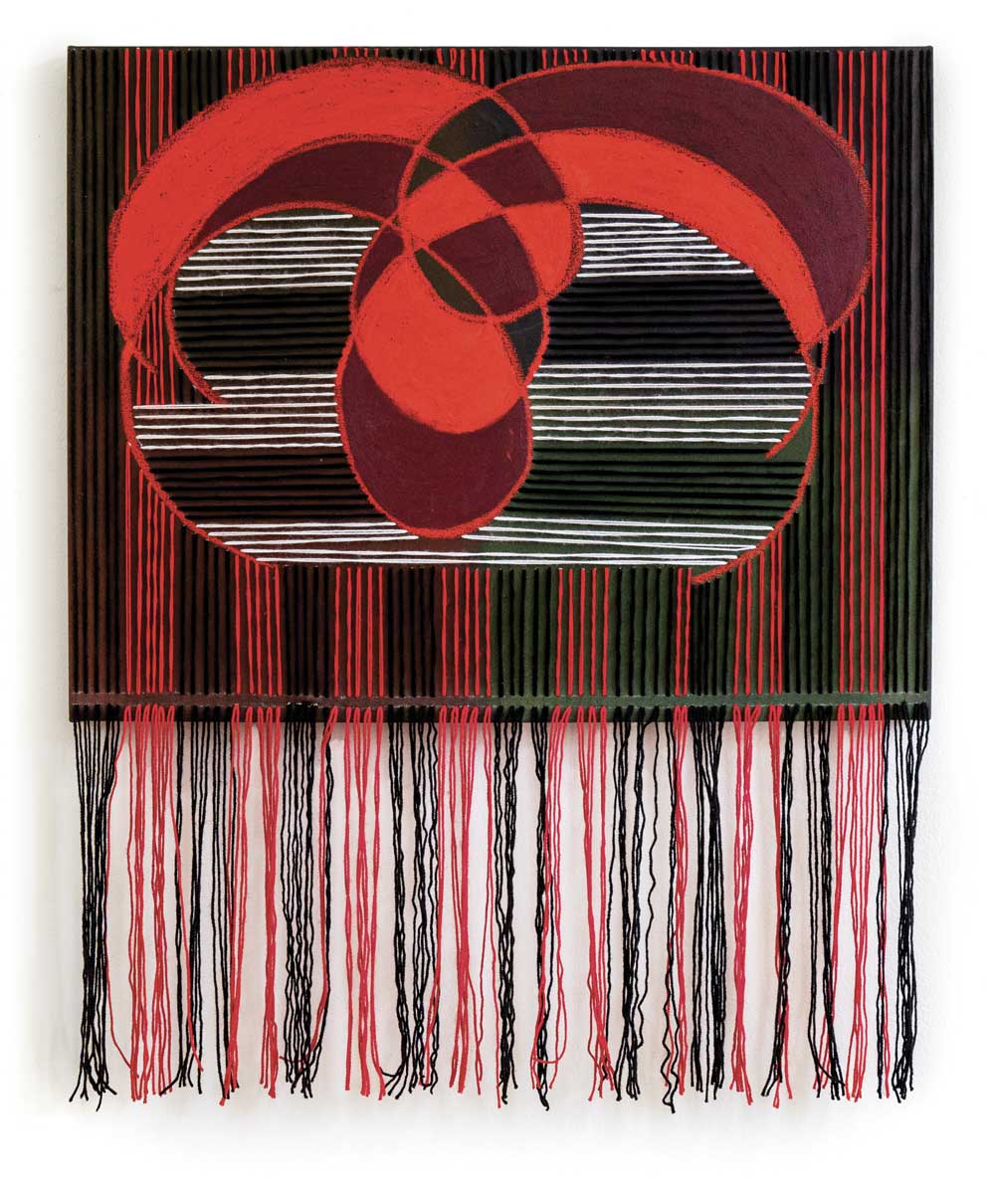
mosquito, pastel à l’huile et fil sur toile
(oil pastel and yarn on canvas), 110 x 90
cm. Courtesy The Bridge Gallery.
Khanyi Mawhayi
Artiste multidisciplinaire, écrivaine et curatrice, Khanyi Mawhayi explore les résonances esthétiques et émotionnelles de la couleur. Dans le sillage de Howard Hodgkin, Chris Ofili et Katharina Grosse, elle déploie une abstraction portée par l’éclat chromatique des bâtons d’huile, laissant le sens affleurer au fil du geste. Diplômée de l’université du Witwatersrand en 2020, elle est, à moins de trente ans, assistante curatoriale au Zeitz MOCAA, au Cap.
A multidisciplinary artist, writer and curator, Khanyi Mawhayi explores the aesthetic and emotional potential of colour. In dialogue with Howard Hodgkin, Chris Ofili and Katharina Grosse, she develops an abstract practice shaped by the chromatic intensity of oil sticks, where meaning emerges through gesture. A 2020 graduate of the University of the Witwatersrand, she is an assistant curator at Zeitz MOCAA in Cape Town.
THE BRIDGE GALLERY
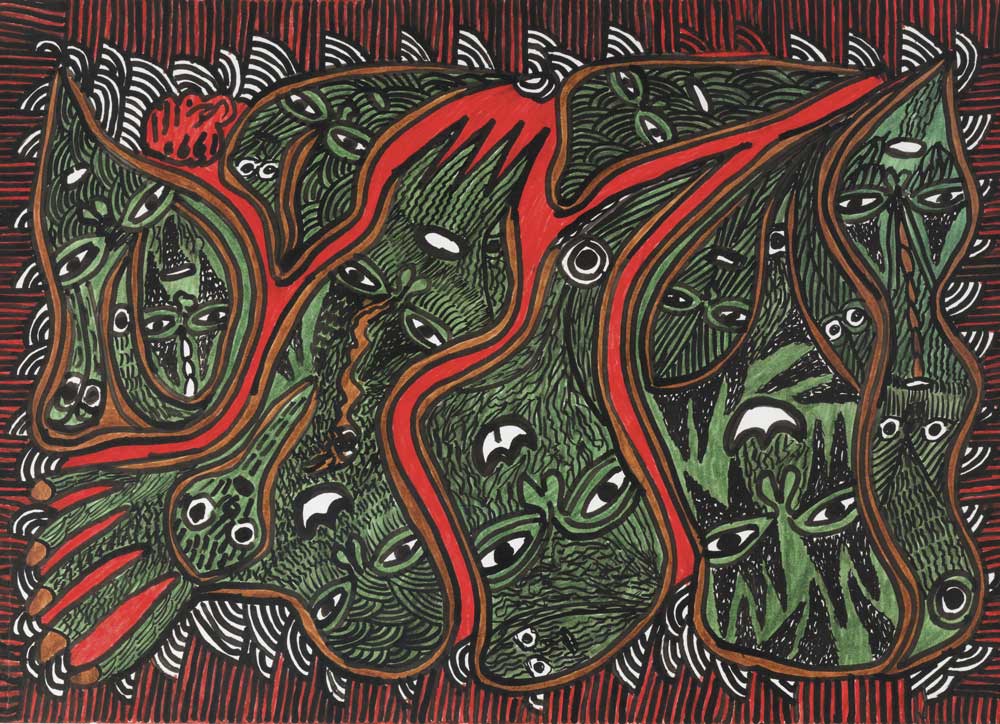
daté en bas à droite (mixed media on paper – signed and dated lower right),
35 × 43 cm. Courtesy Galerie Loeve&Co.
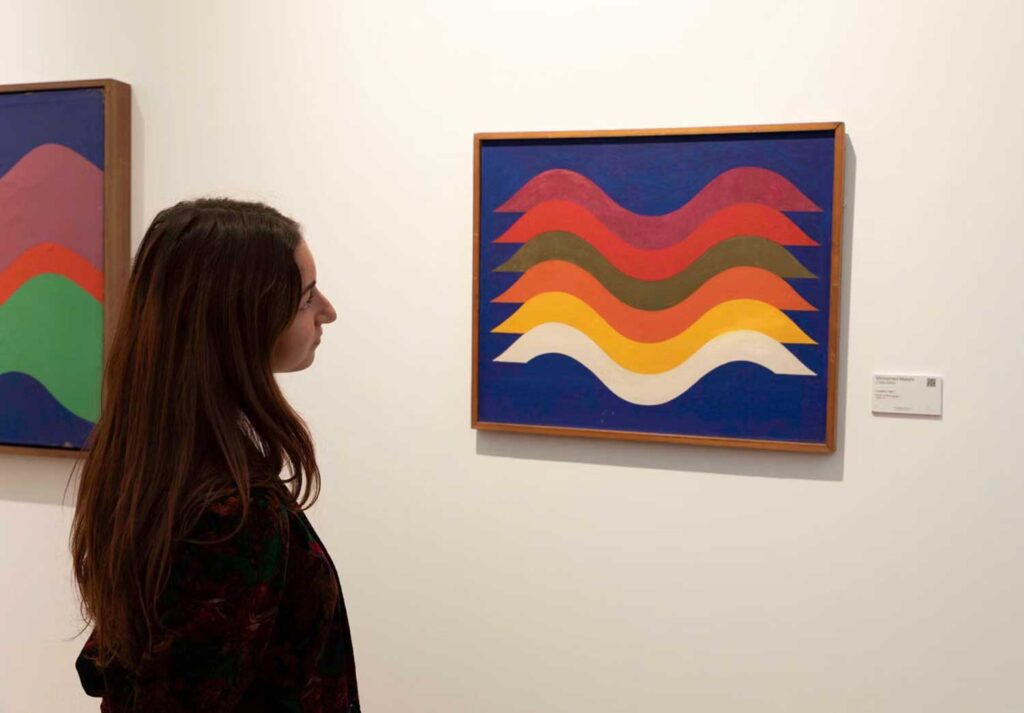
Mohammed Mrabet
Adoubé par la Beat Generation qu’il a côtoyée à Tanger, où il a vu le jour en 1936, Mohammed Mrabet est un conteur dont les livres ont été traduits dans le monde entier, mais aussi un peintre prolifique. Mélange de simplicité et de sophistication, ses œuvres figurent dans les collections du Guggenheim. Marqué par ses origines rifaines, son univers fantasmagorique peuplé de figures légendaires se situe à la croisée des cultures arabe, africaine et méditerranéenne.
Born in Tangier in 1936, Mohammed Mrabet forged close ties with the Beat Generation. A storyteller whose books have been translated worldwide, he is also a prolific painter. His work, balancing simplicity and refinement, is held in major collections including the Guggenheim. Shaped by his Rifian roots, his fantastical universe draws on Arab, African and Mediterranean cultures.
LOEVE&CO
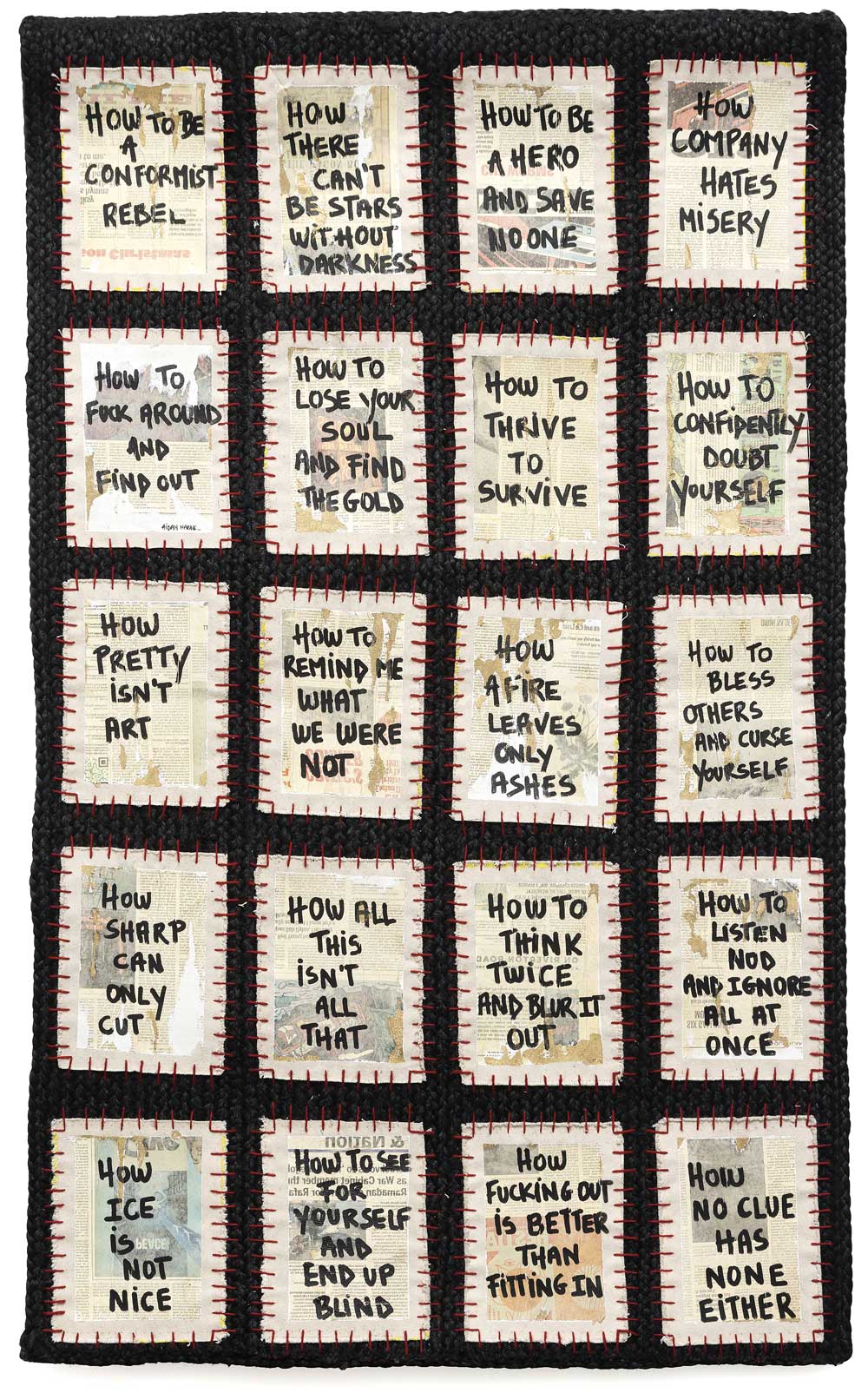
dorée et acrylique sur toile sur laine tissée (newspaper
collage, gold ink, acrylic on canvas on woven wool),
153 x 92 cm. Courtesy So Art Gallery
Aidan Marak
Artiste pluridisciplinaire marocaine, vivant entre Casablanca et Miami, Aidan Marak a étudié à l’École supérieure des arts appliqués de Paris. Elle prend plaisir à varier les supports et les médiums, utilisant aussi bien la peinture acrylique, le collage que le textile. L’œuvre Quotes présentée sur un support en laine tissée juxtapose une série de citations engagées révélant la malice de l’artiste.
A Moroccan multidisciplinary artist based between Casablanca and Miami, Aidan Marak studied at the École Supérieure des Arts Appliqués in Paris. Working across acrylic painting, collage, and textile, she embraces a fluid approach to materials. Quotes, presented on woven wool, juxtaposes a series of pointed statements that reflect the artist’s wit.
SO ART GALLERY
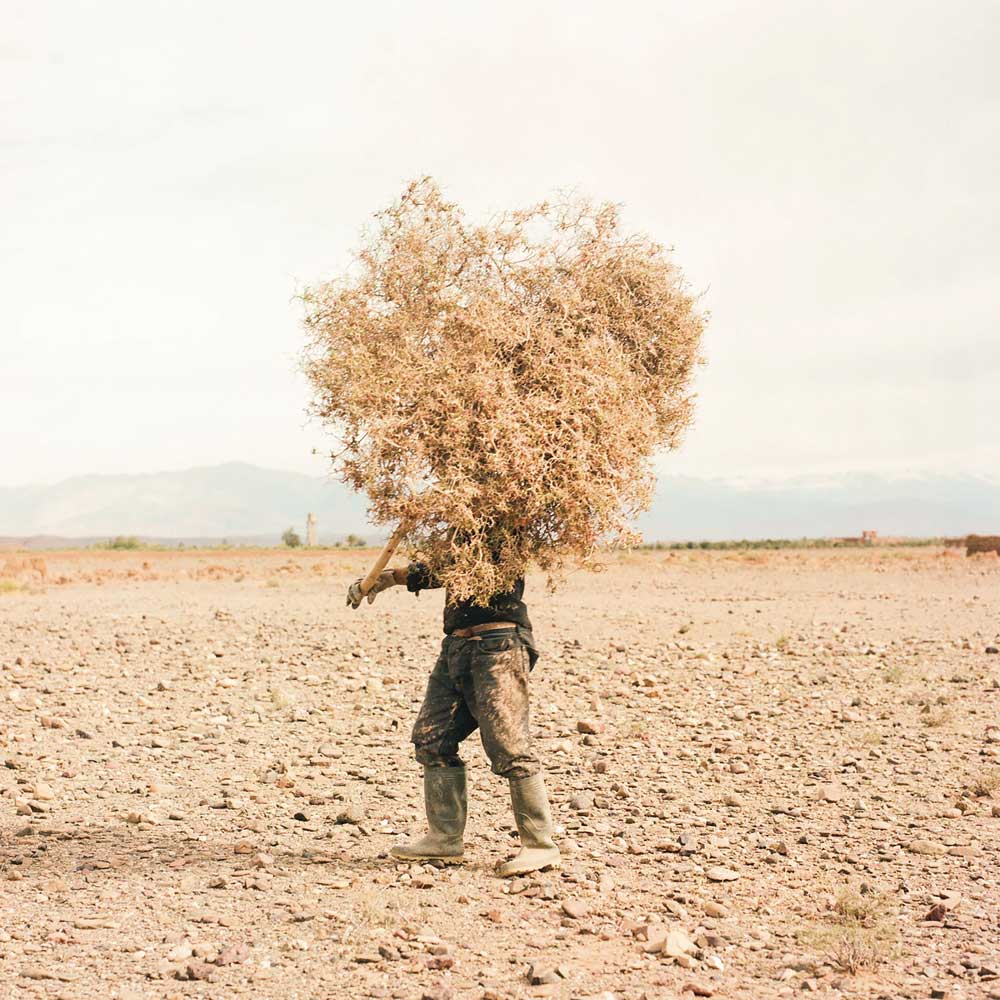
impression jet d’encre (Fine art print, inkjet print),
60 × 60 cm. Édition 3/5 + 2 EA (AP)
Courtesy Loft Art Gallery
M’hammed Kilito
Né en Ukraine en 1981, M’hammed Kilito est un photographe documentaire marocain. Cofondateur du collectif Koz, il explore les relations entre communautés et environnements menacés. Sa série Before It’s Gone documente les oasis fragilisées dans une approche épurée. Lauréat du Prix Louis Roederer pour le Développement Durable en 2023, il a récemment été désigné « explorateur National Geographic ».
Born in Ukraine in 1981, M’hammed Kilito is a Moroccan documentary photographer. Co-founder of the Koz collective, he focuses on the fragile relationships between communities and their environments. His series Before It’s Gone looks at threatened oasis ecosystems through a restrained visual approach. In 2023, he received the Louis Roederer Sustainability Award and was recently named a National Geographic Explorer.
LOFT ART GALLERY
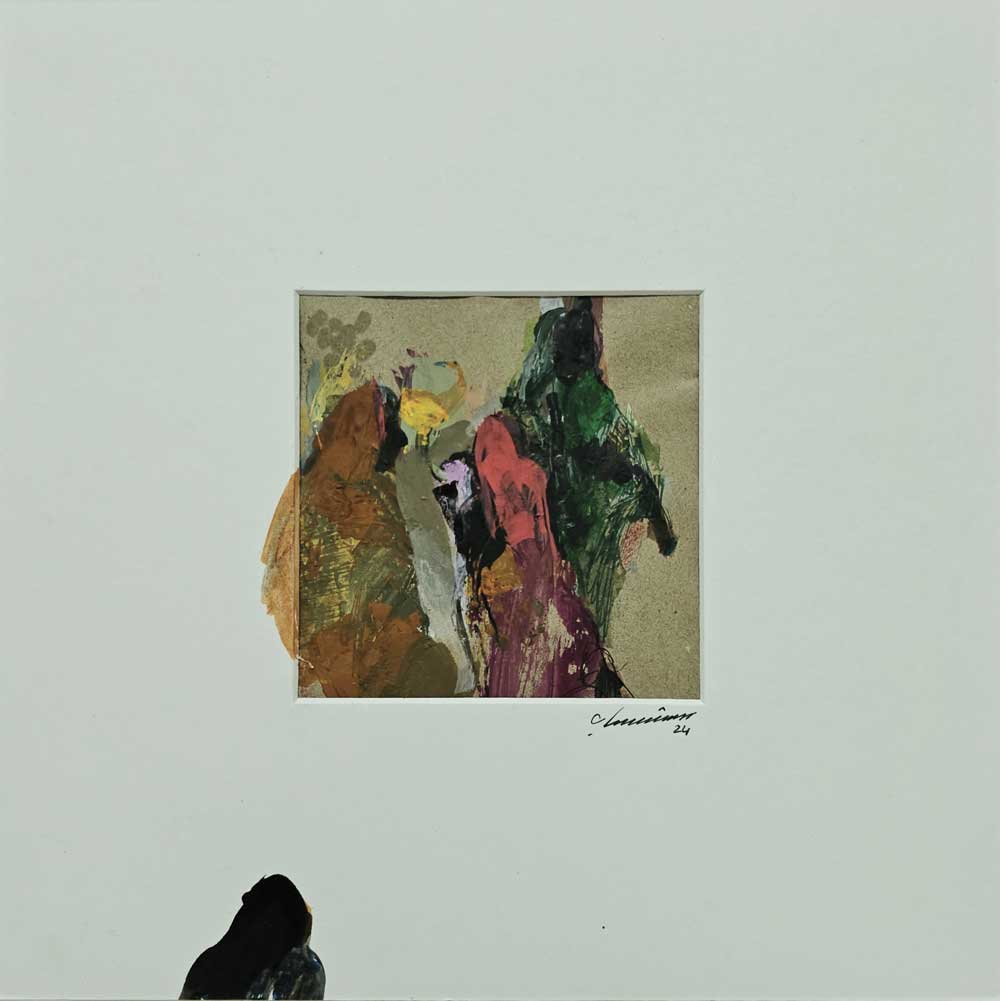
acrylic on paper), 27 x 27 cm. Courtesy LouiSimone Guirandou Gallery
Rashid Diab
Peintre soudanais né en 1957, Rashid Diab vit aujourd’hui en exil. Sa série Out of Focus repose sur des petits formats dans lesquels des silhouettes errantes, souvent drapées dans un toub traditionnel, sont autant de réminiscences de son pays natal. Il a exposé au Caire, à Londres, à Rabat ou à Khartoum. Ses œuvres ont rejoint les collections du Museum of Fine Arts d’Alexandrie ou de l’Institut du monde arabe à Paris.
Rashid Diab, a Sudanese painter born in 1957, is currently living in exile. His Out of Focus series presents small-scale works featuring wandering figures, often wrapped in a traditional toub, evoking memories of his native Sudan. His work is held in collections including the Museum of Fine Arts in Alexandria and the Institut du Monde Arabe in Paris.
LOUISIMONE GUIRANDOU GALLERY
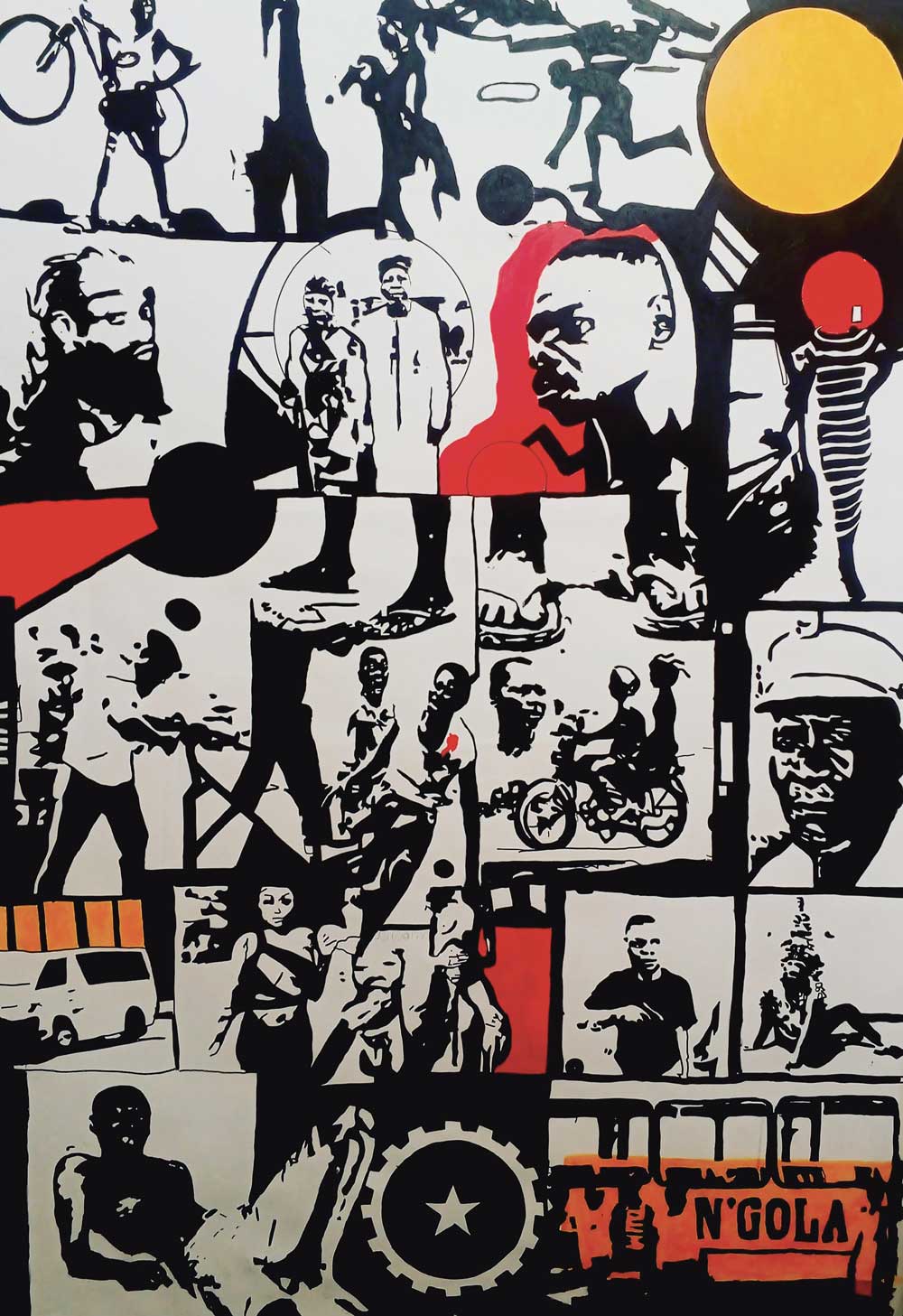
acrylique sur toile (acrylic on canvas),
150 x 200 cm. Courtesy The Art Affair Gallery
Evan Cláver
Superpositions de lignes et d’images, représentations chaotiques mais contrôlées de la vie urbaine, contradictions et absurdités de la société moderne dépeintes par une combinaison de pochoirs monochromes et d’éclatants aplats colorés… Disruptives, les œuvres de l’Angolais Evan Cláver agissent comme des protestations visuelles contre le pouvoir séducteur des images. Cláver a notamment exposé à la Triennale de Luanda (2004) et à l’AMREF ArtBall New York (2017).
Through layered lines and images, Angolan artist Evan Cláver depicts chaotic yet controlled visions of urban life, using monochrome stencils and bursts of vivid color to expose the contradictions of modern society. Disruptive by nature, his works operate as visual acts of protest, critically engaging with the seductive power of images. Cláver has notably exhibited at the Luanda Triennial in 2004 and at the AMREF ArtBall in New York in 2017.
THE ART AFFAIR
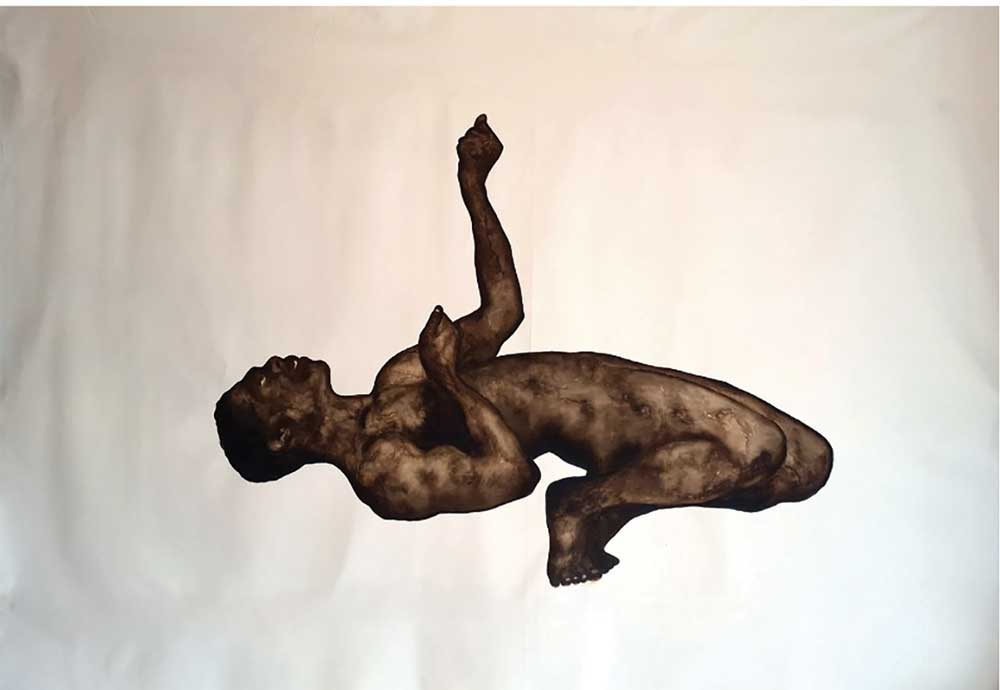
encre de Chine et poudre de charbon sur papier
(coffee, Chinese ink, charcoal powder on paper)
150
×
200 cm. Courtesy de l’artiste et Galerie 208
Yvanovitch Mbaya
Le dessin de silhouettes se détachant sur un lavis d’encre de Chine ou de marc de café est devenu la marque de fabrique du Congolais Yvanovitch Mbaya. Formé à l’École nationale des Beaux-Arts de Brazzaville, il a exposé dans plusieurs pays d’Europe, du Moyen-Orient et d’Afrique, notamment au Maroc où il a un temps vécu. À la fois minimalistes et profondes, ses compositions interrogent l’identité, les relations humaines et la mémoire collective.
Silhouetted figures emerging from washes of Chinese ink or coffee grounds have become the signature of Congolese artist Yvanovitch Mbaya. Trained at the National School of Fine Arts in Brazzaville, he was exhibited widely across Europe, the Middle East, and Africa, including in Morocco, where he lived for a time. Minimal yet emotionally charged, his compositions address questions of identity, human relationships, and collective memory.
GALERIE 208