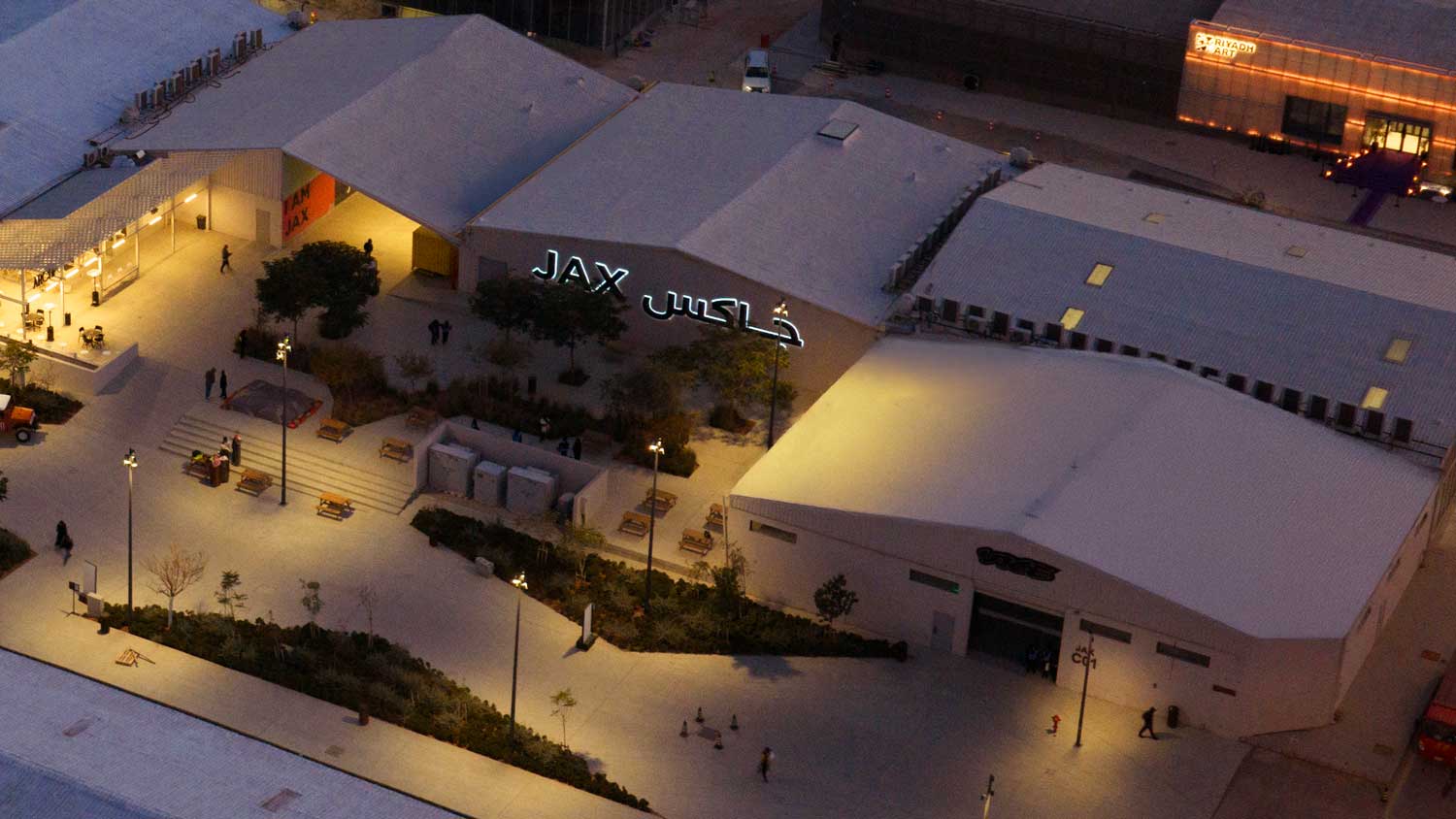
Explorant les liens entre paysage, mémoire et tradition, la Biennale de Diriyah incarne le rôle croissant de l’art contemporain dans la transformation culturelle et territoriale de l’Arabie saoudite. Elle offre un point d’observation privilégié sur le circuit culturel désormais resserré qui relie Diriyah, AlUla, Djeddah, Dubaï, Abu Dhabi et Doha, au sein d’un calendrier régional de plus en plus dense et interdépendant.Inaugurée en début d’année, la troisième Biennale d’art contemporain de Diriyah confirme son statut de jalon majeur dans la reconfiguration culturelle en cours en Arabie saoudite. Intitulée « In Interludes and Transitions », elle se déploie dans le quartier de JAX, à Diriyah, ville historique située aux portes de Riyad abritant le site d’At-Turaif, inscrit au patrimoine mondial de l’Unesco. En ancrant les pratiques contemporaines au sein d’un territoire emblématique de l’infrastructure culturelle du royaume, la biennale participe d’un mouvement institutionnel plus large, aligné sur la nouvelle mouture de la Vision 2030, qui conçoit la production artistique comme un levier de la stratégie de diversification économique et de repositionnement international. Alternant avec la Biennale des arts islamiques de Djeddah, l’événement instaure un rythme programmatique qui met en tension héritage et contemporain, tradition et expérimentation.
À l’instar d’Alserkal Avenue à Dubaï, de Msheireb Downtown à Doha ou de MiZa à Abu Dhabi, JAX appartient à cette nouvelle typologie de districts culturels soutenus par l’État dans le Golfe, où d’anciennes zones industrielles sont reconverties en écosystèmes créatifs. Ces espaces fonctionnent comme des instruments de redéploiement symbolique, articulant urbanisme, stratégie économique et diplomatie culturelle. Intégré à un plan de transformation territoriale plus vaste – auquel ont contribué des cabinets internationaux comme OMA/AMO, fondé par Rem Koolhaas – JAX incarne une société en transition, où la culture endosse un rôle structurel dans le récit post-pétrolier du pays. Dans ce contexte, la biennale investit les entrepôts de JAX comme autant de plateformes d’exposition ancrées dans le réel.
Une chorégraphie du monde
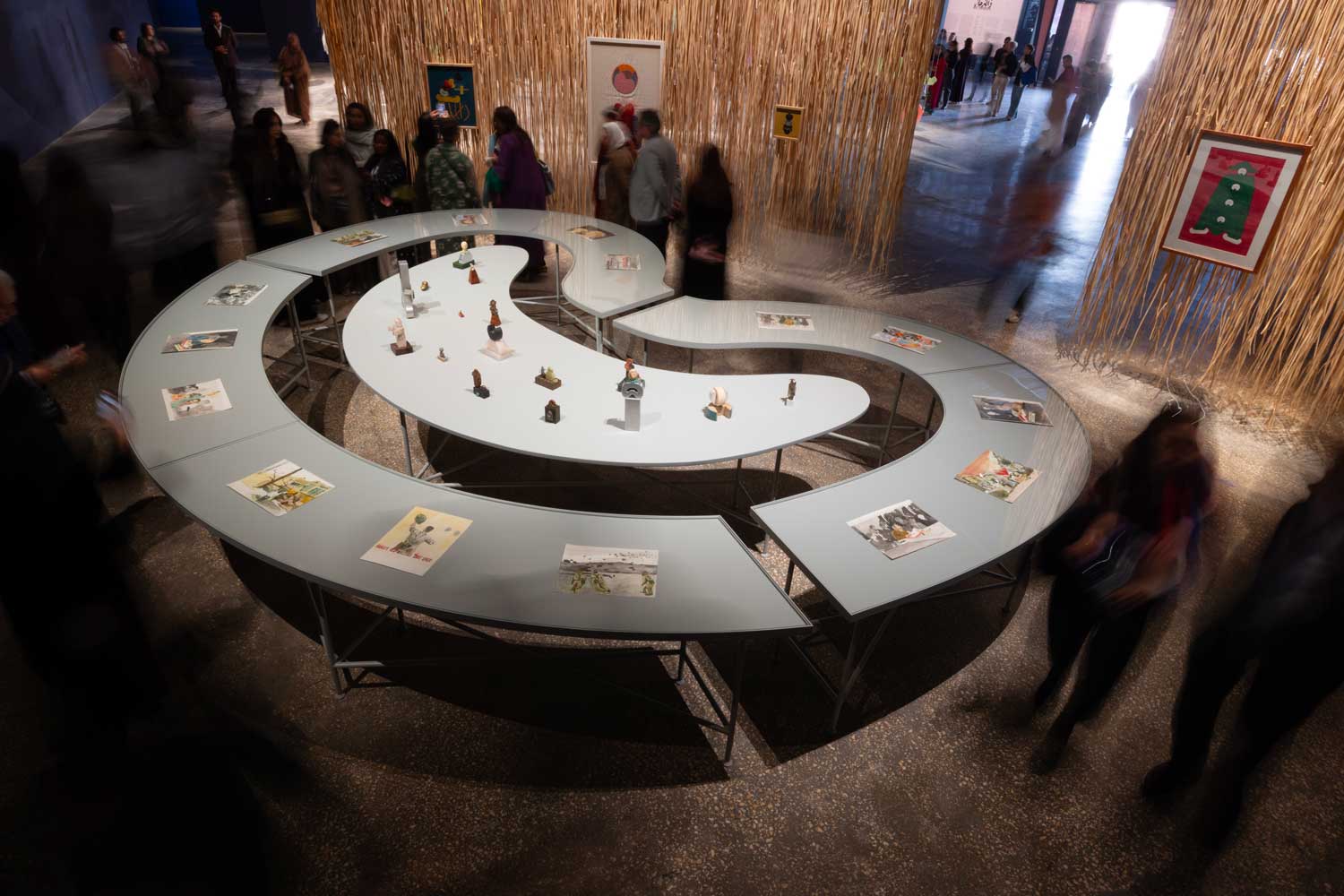
Les directeurs artistiques Nora Razian et Sabih Ahmed ont pensé l’exposition comme un espace de dialogue, structuré en cinq sections : « Disjointed Choreographies », « A Hall of Chants », « A Collective Observation », « Arena et A Forest of Echoes ». Il s’agit ici de comprendre le monde « non pas cartographiquement, mais chorégraphiquement », formule Sabih Ahmed. Ce parti pris irrigue la scénographie – conçue avec le studio Formafantasma – qui évite les cloisonnements rigides au profit de parois suspendues, de seuils perméables et d’atmosphères où sons et lumières circulent librement.
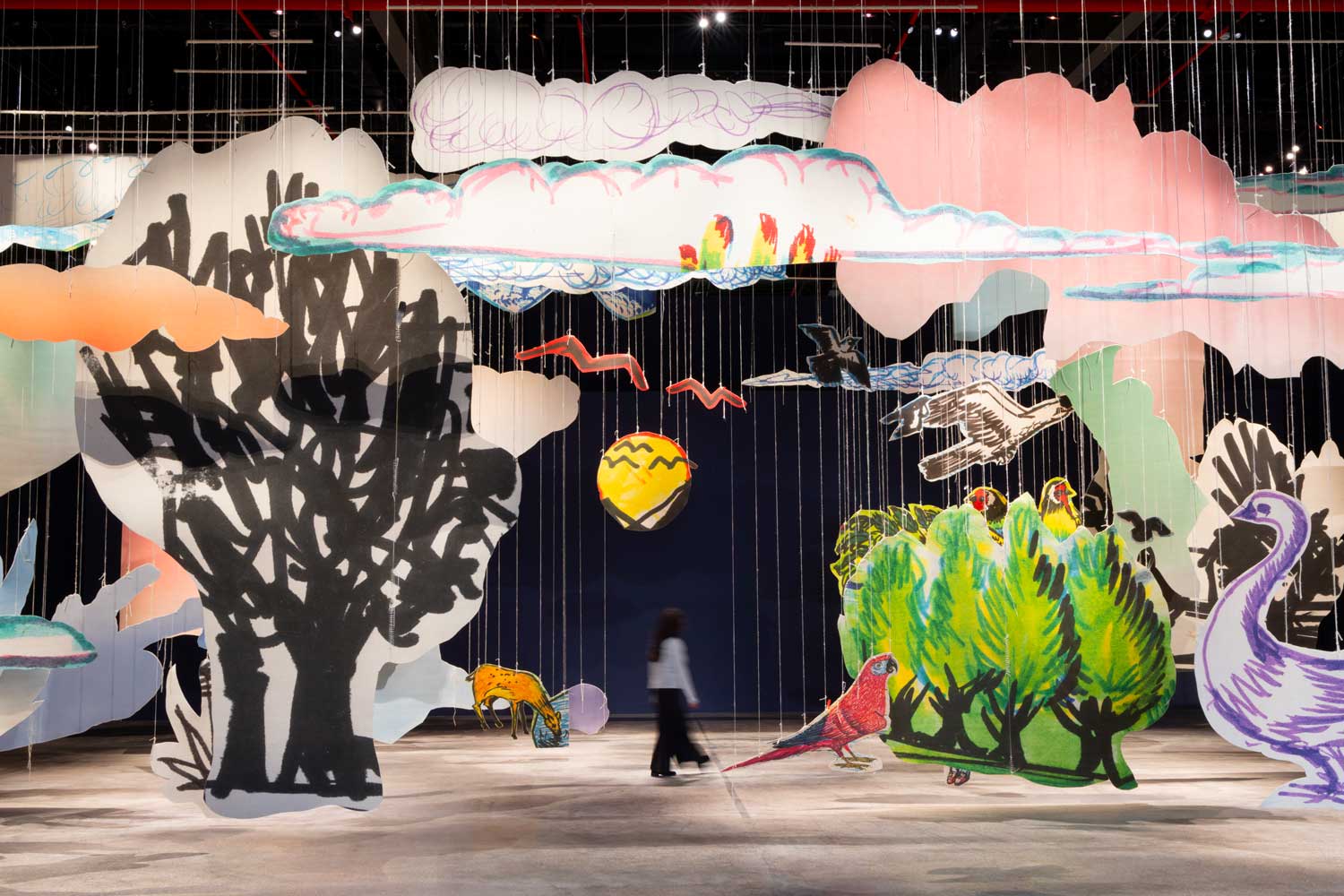
Cette fluidité constitue l’un des axes majeurs du récit curatorial, notamment dans les sections d’ouverture consacrées à la mémoire et à la survivance des images. L’installation de Petrit Halilaj, composée de dessins d’enfance agrandis et suspendus dans l’espace, en offre un exemple saisissant. Réalisés dans un camp de réfugiés durant la guerre du Kosovo puis réactivés des décennies plus tard, ces croquis fragiles deviennent des formes monumentales immersives, invitant le spectateur à habiter le passé de l’artiste.
À proximité, Thao Nguyen Phan prolonge cette réflexion sur la transmission et la continuité historique. Sa vidéo multicanal Reincarnations of Shadows (2025) et l’installation sculpturale No Jute Cloth for the Bones (2019-2026) dialoguent avec l’héritage de la sculptrice moderniste Điềm Phùng Thị (1920-2002), figure majeure de l’abstraction géométrique vietnamienne ayant longtemps vécu en France. En réactivant son vocabulaire formel et ses archives, Phan inscrit une filiation intergénérationnelle au cœur de sa propre pratique.
Inter
Plus loin dans le parcours, les artistes femmes occupent une place centrale. Leurs œuvres mettent en circulation des identités mouvantes, venant étayer l’affirmation curatoriale selon laquelle « être diasporique n’est pas l’exception mais la norme ». Les Asian Abstractions (1983–1992) de Pacita Abad en sont l’illustration : façonnée par l’expérience migratoire et la collaboration avec des artisans, sa pratique enrichit la surface picturale de broderie, couture, teinture et textile. De son côté, l’artiste marocaine Amina Saoudi Aït Khay transforme les traditions lainières d’Afrique du Nord en vastes champs abstraits. Par le biais de teintures naturelles et de la trame, le métier à tisser devient un instrument qui traduit un savoir artisanal en langage visuel dépassant toute assignation géographique.Aux sources de la tradition
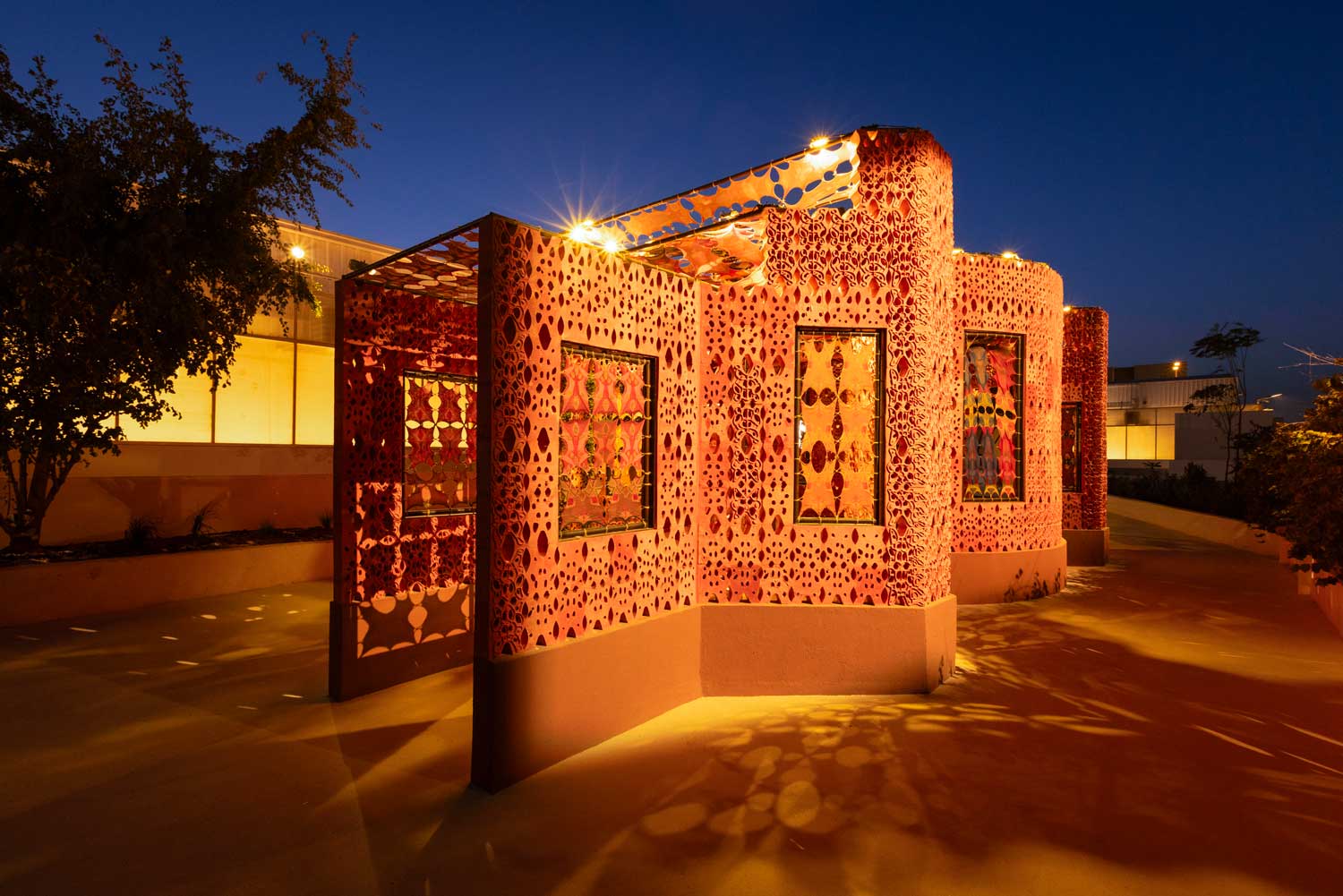
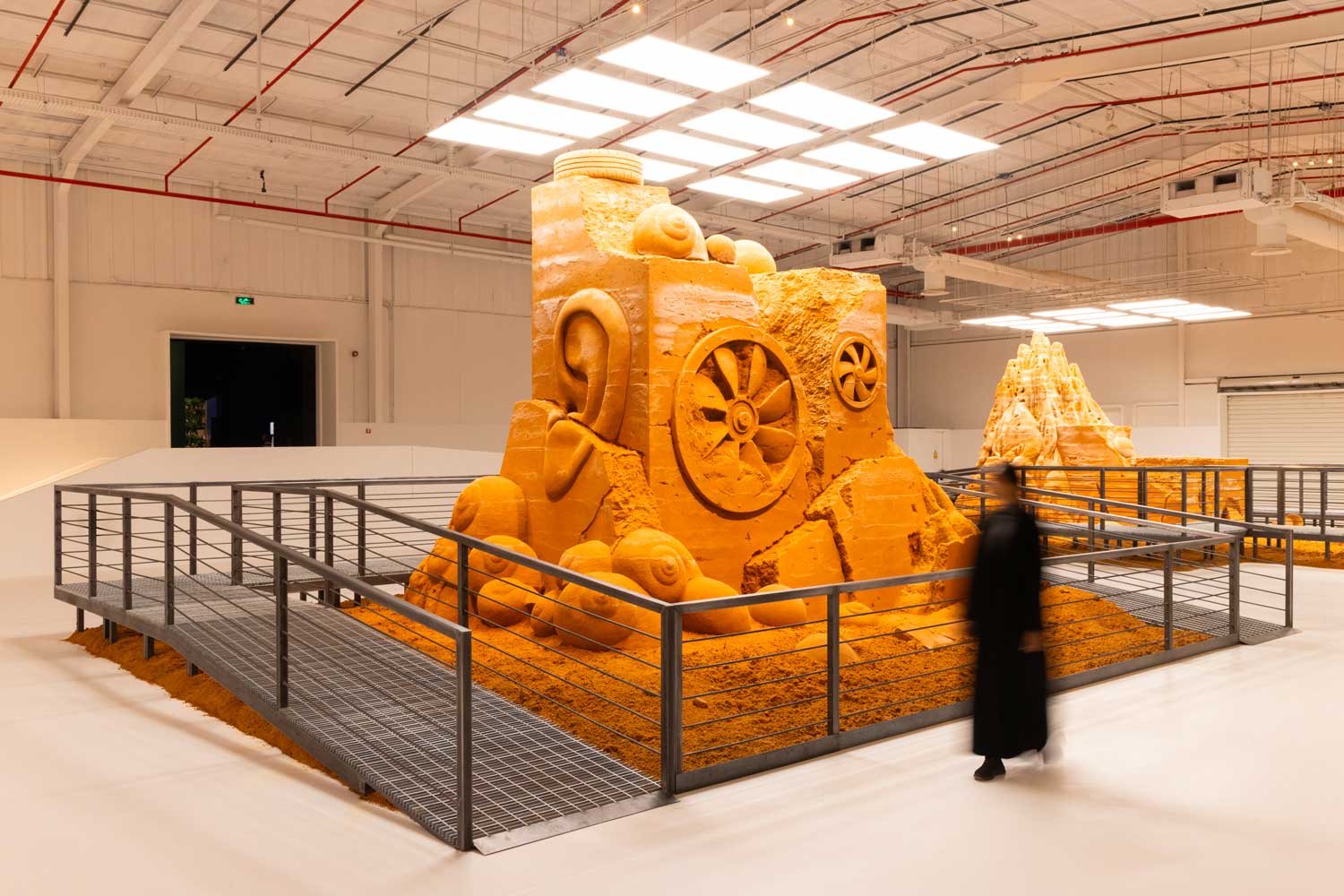
Plusieurs œuvres in situ soulignent la manière dont la biennale inscrit la création actuelle dans les strates locales de mémoire et de tradition. Un mouvement par ailleurs observable à l’échelle du pays, de Djeddah à AlUla. L’investissement public dans la production culturelle à grande échelle vise de plus en plus à articuler les pratiques traditionnelles et contemporaines dans une continuité opératoire. Dans The Source (2026), l’artiste argentine Agustina Woodgate présente une série de fontaines publiques issues de recherches menées dans la région d’Al Ahsa, qui abrite la plus vaste oasis continue du monde. En s’appuyant sur des systèmes d’irrigation gravitaires vieux de plus de deux mille ans et sur des technologies contemporaines d’extraction des eaux souterraines, l’œuvre rend visibles les tuyaux, vannes et mécanismes de circulation, transformant l’eau – ressource invisible – en élément central de l’infrastructure. De même, AGBA : 8 Stone Cave (2026) de Yussef Agbo-Ola prend appui sur le concept yoruba d’agba (la figure de l’ancien comme dépositaires du savoir), en dialogue avec l’Al-Qatt Al-Asiri, tradition murale féminine du sud saoudien. Développée entre Abha et Riyad, la structure associe une membrane textile légère à un squelette en briques d’argile inspiré des systèmes de ventilation du Golfe. Une logique matérielle analogue traverse House of Eternity (2026) de Théo Mercier. Conçue à partir de sable local et d’argile bentonite, l’installation transforme l’espace d’exposition en paysage ponctué de monolithes compactés, évoquant le désert comme scène et comme matière politique. Le sable – motif récurrent dans les récits artistiques du Golfe – devient ici dispositif scénographique, condensant un temps géologique qui excède toute échelle humaine. En écho au travail récent de l’artiste à Villa Hegra, résidence franco-saoudienne située à AlUla, cette installation rappelle combien le désert constitue à la fois un cadre conceptuel et un levier stratégique.
Entre concurrence et coopération
La récurrence de la production d’œuvres in situ, à Diriyah comme à AlUla – notamment lors des dernières éditions de Desert X –, dessine un fil rouge au sein des initiatives culturelles saoudiennes. La création contemporaine est appelée à dialoguer étroitement avec le paysage, l’histoire et la tradition. Géographie et récit national deviennent des ressources à part entière, permettant au développement culturel et territorial d’avancer de concert. Mais cette dynamique dépasse l’échelle nationale. Nombre de visiteurs passés par Diriyah ont poursuivi vers AlUla ou Doha, suivant un calendrier régional désormais saturé et observant les ambitions convergentes qui animent les différentes initiatives du Golfe. Pour reprendre le concept curatoriel de « chorégraphie » avancé par Nora Razian et Sabih Ahmed, la Biennale de Diriyah s’inscrit dans un mouvement plus large où coopération et concurrence coexistent. Si la circulation est posée comme principe esthétique, elle opère aussi concrètement : par le déplacement des œuvres, des artistes, des publics et des capitaux symboliques.
Par Sabrina Moura
Biennale de Diriyah, « In Interludes and Transitions », JAX, Diriyah, jusqu’au 2 mai 2026.
Opened earlier this year, the third Diriyah Biennale of Contemporary Art consolidates its position as a key waypoint in Saudi Arabia’s expanding cultural reconfiguration. Titled In Interludes and Transitions, the Biennale unfolds in the JAX district in Diriyah — the historic city on the outskirts of Riyadh that houses the UNESCO World Heritage site of At-Turaif — inserting contemporary practices into a territory now positioned as a cornerstone of the Kingdom’s cultural infrastructure. Its presence forms part of a broader institutional shift aligned with the reframed Vision 2030, in which artistic production functions as an instrument of economic diversification and international positioning. Alternating with the Islamic Arts Biennale in Jeddah, the event establishes a programmatic rhythm that balances heritage and contemporaneity, tradition and experimentation.
JAX, much like Alserkal Avenue in Dubai, Msheireb Downtown in Doha, or MiZa in Abu Dhabi, belongs to a growing typology in the Gulf of state-supported cultural districts in which former industrial zones are remodeled as creative ecosystems. These districts operate as instruments of symbolic repositioning, aligning urban planning, economic strategy, and cultural diplomacy. Integrated into a broader territorial transformation plan — shaped in part by international consultancies such as OMA/AMO, founded by Rem Koolhaas — JAX exemplifies a society in transition, where culture assumes a structural role in the country’s post-oil narrative.
Within this context, the Biennale occupies JAX’s warehouse spaces as platforms of grounded projection, offering a vantage point from which to observe the tightening cultural circuit linking Diriyah, AlUla, Jeddah, Dubai, Abu Dhabi, and Doha within an increasingly dense and interdependent regional calendar.
For In Interludes and Transitions, artistic directors Nora Razian and Sabih Ahmed structure the exhibition through a relational framework articulated across five sections — Disjointed Choreographies, A Hall of Chants, A Collective Observation, Arena, and A Forest of Echoes. As Sabih suggests, the Biennale proposes understanding the world “not cartographically, but choreographically.” This premise informs the exhibition design developed with Formafantasma, whose scenography avoids rigid partitions in favor of suspended walls, permeable thresholds, and atmospheres in which sound and light circulate across galleries.
This approach proves central to the curatorial narrative, particularly in the opening sections anchored in works addressing memory and the afterlives of images. Petrit Halilaj’s installation of enlarged childhood drawings suspended in space offers a striking example. Originally produced while living in a refugee camp during the Kosovo war and revisited decades later, the fragile sketches are transformed into immersive monumental forms that invite viewers to inhabit the artist’s past. Nearby, Thao Nguyen Phan extends this reflection on transmission and historical continuity. Her multi-channel video Reincarnations of Shadows (2025) and the sculptural installation No Jute Cloth for the Bones (2019–ongoing) engage the legacy of modernist sculptor Điềm Phùng Thị (1920–2002), a key figure in Vietnamese geometric abstraction who spent decades in France. By reactivating her formal vocabulary and archive, Phan situates an intergenerational lineage of artists within the framework of her own practice.