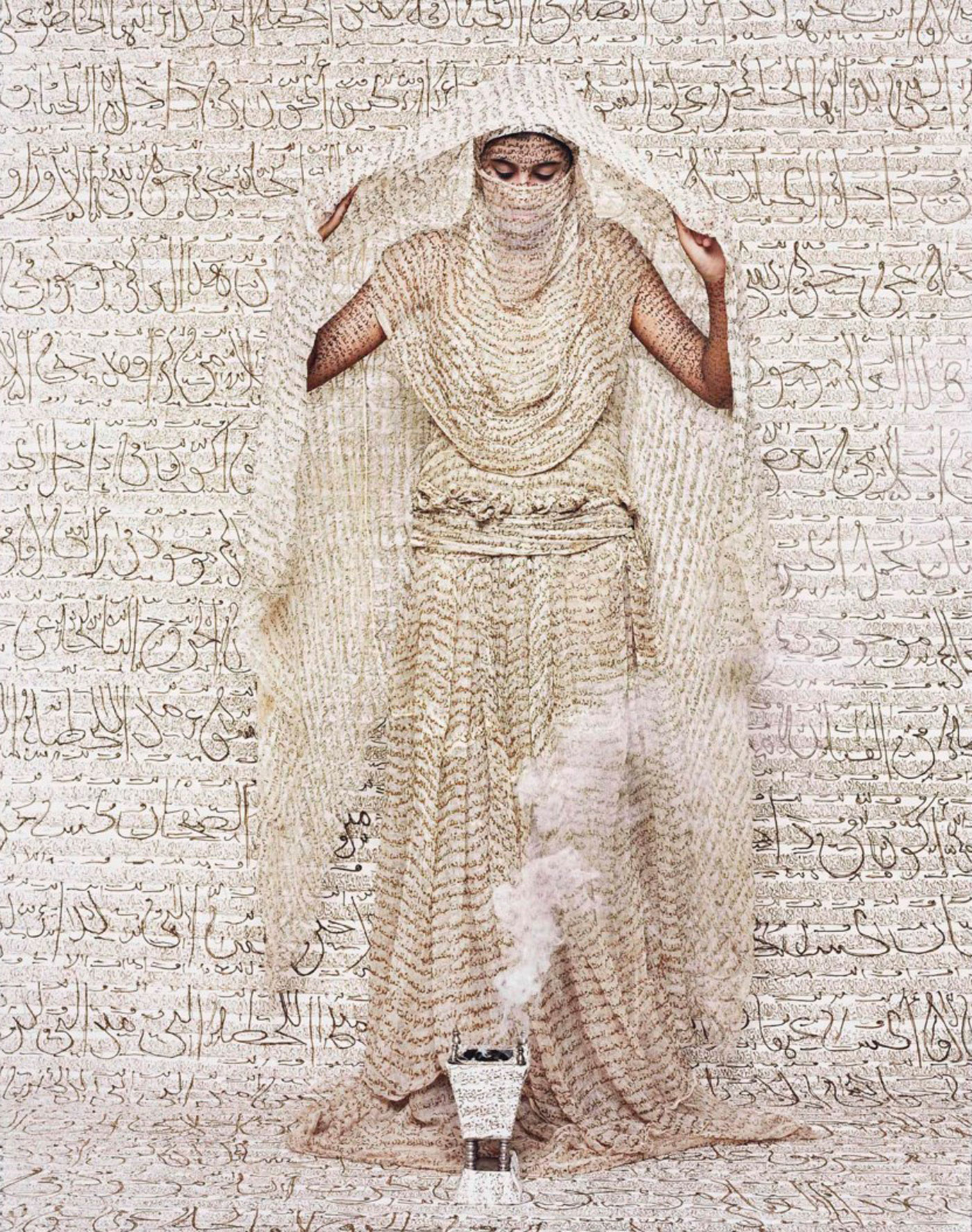
Having reclaimed a part of herself through writing, the artist makes obsessive use of calligraphy, blurring the lines between her characters and their architectural surroundings in a constant exploration of women’s place in Eastern society.
By Katia Feltrin
Published in 2009 in the first issue of Diptyk.
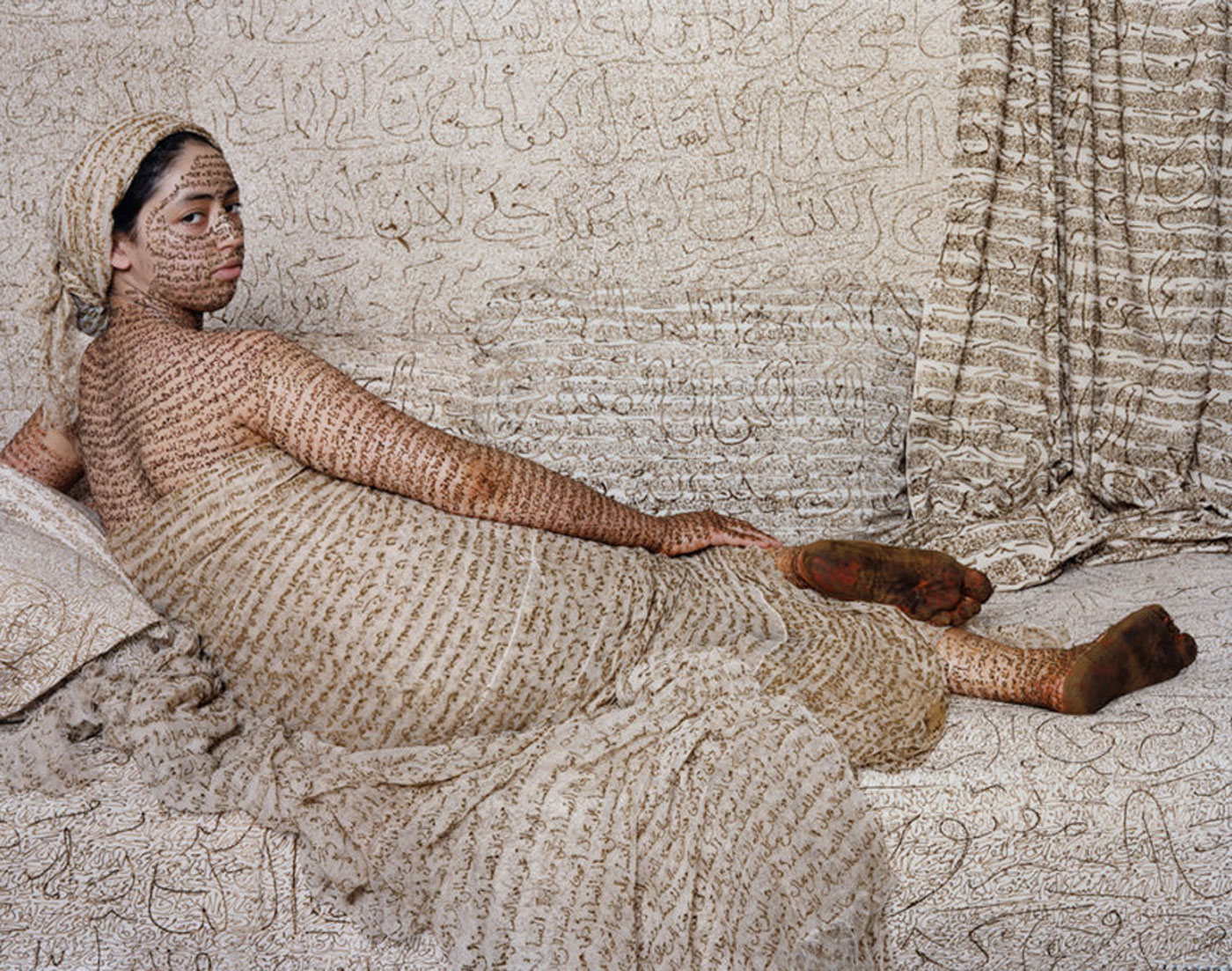
A native of the Tamanslouht zaouia, Lalla Essaydi was born in 1960. Now based in New York, the photographer reinterprets images associated with Orientalism (odalisques, harems, veiled women, etc.) by playing with the motifs. The photographer regularly returns to Morocco, to her childhood home, to create new series of photographs. She explores both her past and her reflections on the role of women in a male-dominated society. This childhood home allows the artist to tap into her inner world: “I will always carry that home within me, but my current life has added new dimensions to it. There is this very different space that I inhabit in the Western world—a space of independence and mobility. It is from this vantage point that I can return to the landscapes of my childhood in Morocco and reconsider them with detachment and a new understanding.”
Words Written in Henna
In this sense, it echoes Gaston Bachelard’s The Poetics of Space, which emphasizes this dialectic between the inside and the outside to construct a topography of the inner self: “Our unconscious is ‘housed.’ Our soul is a dwelling. By remembering ‘houses’ and rooms, we learn to ‘dwell’ within ourselves.”
Arabic calligraphy fills the entire frame of her photographs, blending the bodies of her models with the architecture of this abandoned traditional Moroccan home. The woman and the space are thus highlighted by words written in henna. Associated with the major milestones in a Moroccan woman’s life and all rites of passage, henna—a temporary tattoo—marks the transition from childhood to puberty, engagements, the birth of the first child…
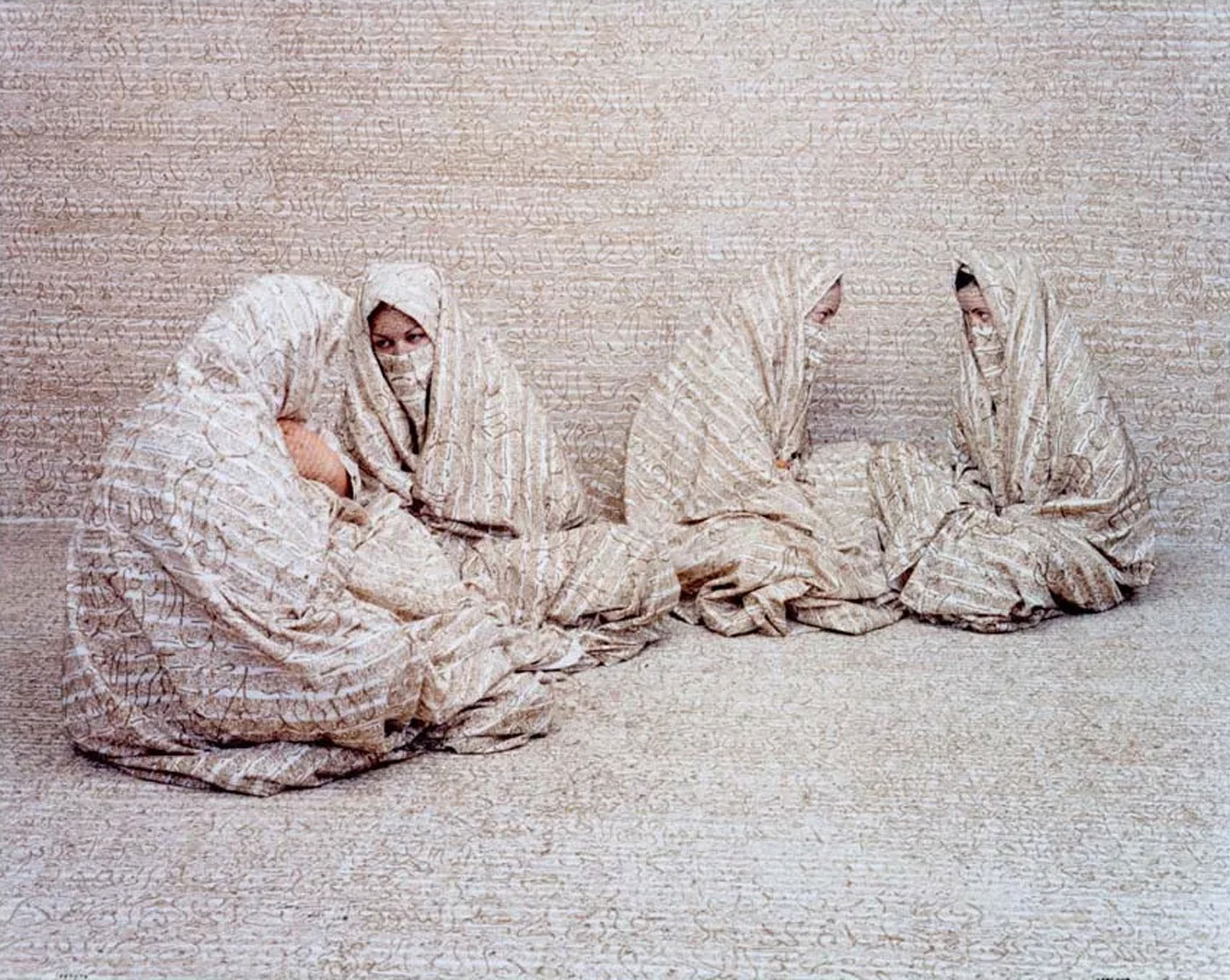
For Lalla Essaydi, creating these photographs is a performative act. It takes her more than nine hours to complete her meticulous calligraphic works on her models’ bodies and the surrounding architectural space. However, the use of Arabic calligraphy—a sacred Islamic art form—is normally reserved for men. Beneath the apparent gentleness, almost decorative in nature, that these genre scenes evoke for a Western audience, Lalla Essaydi’s work is intended to be subversive. The images she recreates and the inevitable suffering of her models—forced to remain motionless for hours on end—draw their inspiration from the memory of the punished woman, silenced for disobedience. This enforced silence is countered by an obsessive written word that invades the entire architectural space, taking its revenge—but not only that. A few lines are missing from this writing, which, as Lalla Essaydi tells us, is not truly legible and yet tells the story of her life (she was illiterate at the time of her early marriage; she reclaimed a part of herself by gaining access to writing, which she employs in a sort of overdetermination…) The space is indeed seized by a hallucinatory vertigo in which the word—sacred in its formal appearance, ironic and cruel in its linguistic content—spreads out, blurring all boundaries, all distinctions between the walls, the woman, her body, and her clothes.
At the same time, these images offer a strong (albeit inverted) echo in the West of the iconography conveyed by Ingres or Delacroix, by taking up the theme of the odalisque, for example—a term which, as Lalla Essaydi points out, literally means in Turkish: “one who belongs to a chamber.”
This translation was generated using AI. For the original text, please see the French version of this article.