

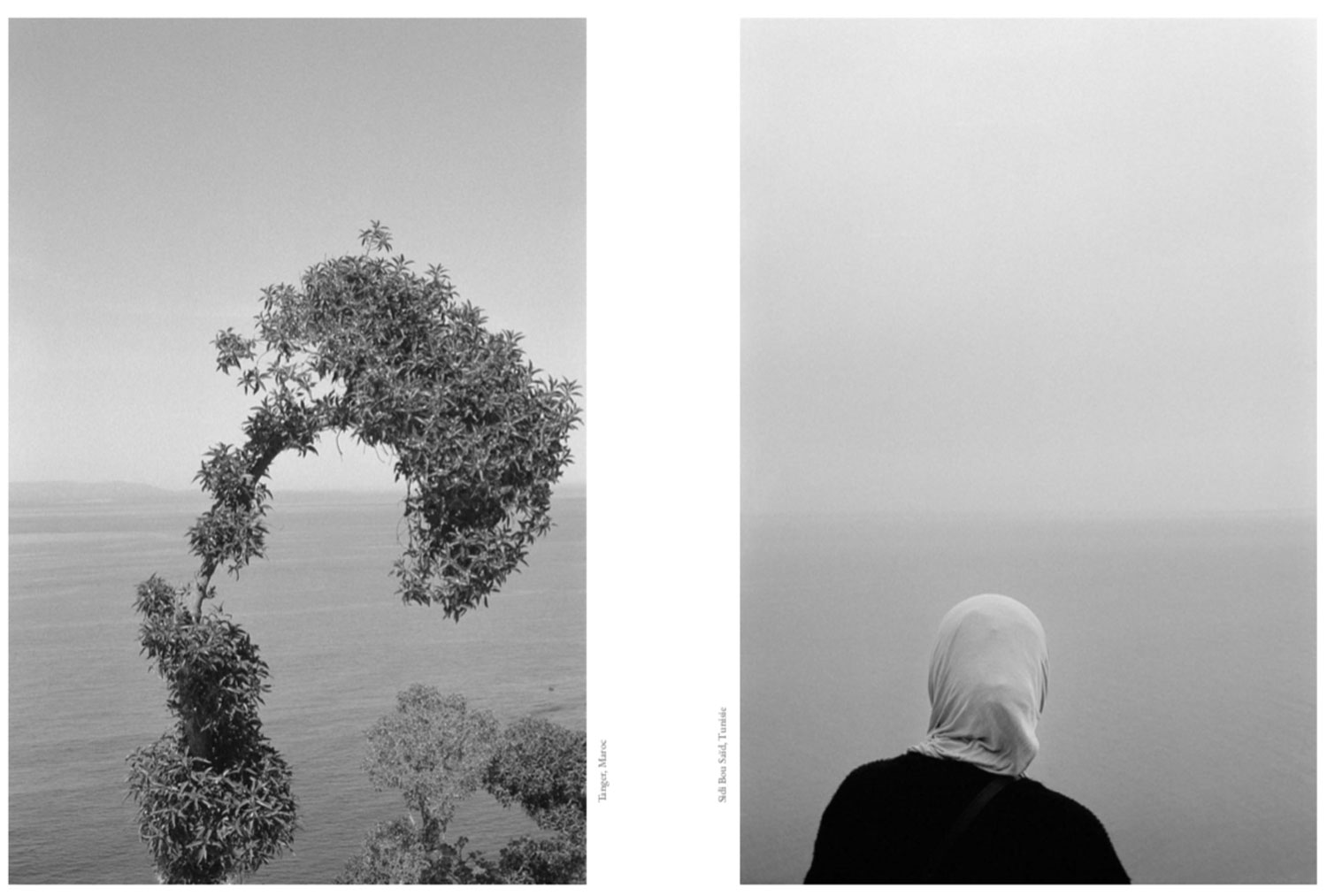
"Tangier (Morocco)" / "Sidi Bou Saïd (Tunisia)", 2017–2026, Anne-Lise Broyer, silver print.
Two black-and-white film photographs are displayed side by side. The one on the right, taken in Sidi Bou Saïd, Tunisia, shows a woman seen from behind gazing at the sea on the horizon. The one on the left, taken in Tangier, features a shrub in the foreground—likely a Mediterranean species—bent in an unusual way, as if an evil spirit had tried to twist it. In the distance, the same maritime horizon can be seen. Between the two lies an absence, an unspoken truth. The shrub—is it in bloom?—takes on the shape of a funeral wreath. Could a mother be mourning her son? The word harraga would sound out of place here. We’re talking about a son or a brother, a loved one who has become so distant. Perhaps a child, whose absence the photographic montage has the decency to keep silent. The Mediterranean is also a tomb, and these two photographs from Anne-Lise Broyer’s exhibition and eponymous book, *Méditerranée, Est-ce là que l’on habitait?*, speak to what is most beautiful and tragic about humanity: its capacity for contemplation, amid the gray of the sea and the silence of atoms that continue to decay like so many grains, lending these images their full aura.
This translation was generated using AI. For the original text, please see the French version of this article.
