
For its 18th edition, the Lyon Biennale draws on artist Robert Filliou’s concept of a “poetic economy” to explore what gives value to materials, labor, and relationships. From the Grandes Locos to the Musée des Tissus, via the macLYON, curator Catherine Nichols has crafted an itinerary in which the works bring gestures, memories, and narratives to life. This approach comes into its own when the connections are experienced rather than merely conceived.
By Najat Saidi
At Les Grandes Locos, the artworks take on the scale of the former railway shed. Monumental installations interact with one another throughout the building, while its volumes and industrial traces become part of their interpretation. The tour begins with an exploration of scale: that of the machines, materials, and infrastructure that shape our lives. This grandeur gives the 18th Lyon Biennale a striking presence. As visitors move through the exhibition, it also raises a question: how is the value of a work constructed, beyond its dimensions and the resources it employs?
For “Moving from One Dream to Another,” Catherine Nichols, the Australian curator of the Biennale, draws draws in particular on Lyon’s traboules, which are linked to the history of silk. These passageways, which connect streets, courtyards, and workplaces, serve as a framework for conceiving the exhibition. The curator also draws upon the Principles of Poetic Economy by Robert Filliou. For him, inventing an alternative theory of value requires transforming economic structures and modes of exchange. Nichols thus broadens the concept of economy to encompass all the processes through which we produce, transmit, and share what sustains our lives. Three interrelated themes—designed to intersect—structure the exhibition itinerary: the industrial at Les Grandes Locos, the relational at the Musée des Tissus, and the existential at macLYON. Their significance lies less in their ability to categorize the works than in the connections they forge between them.
When the Exceptional Becomes the Norm
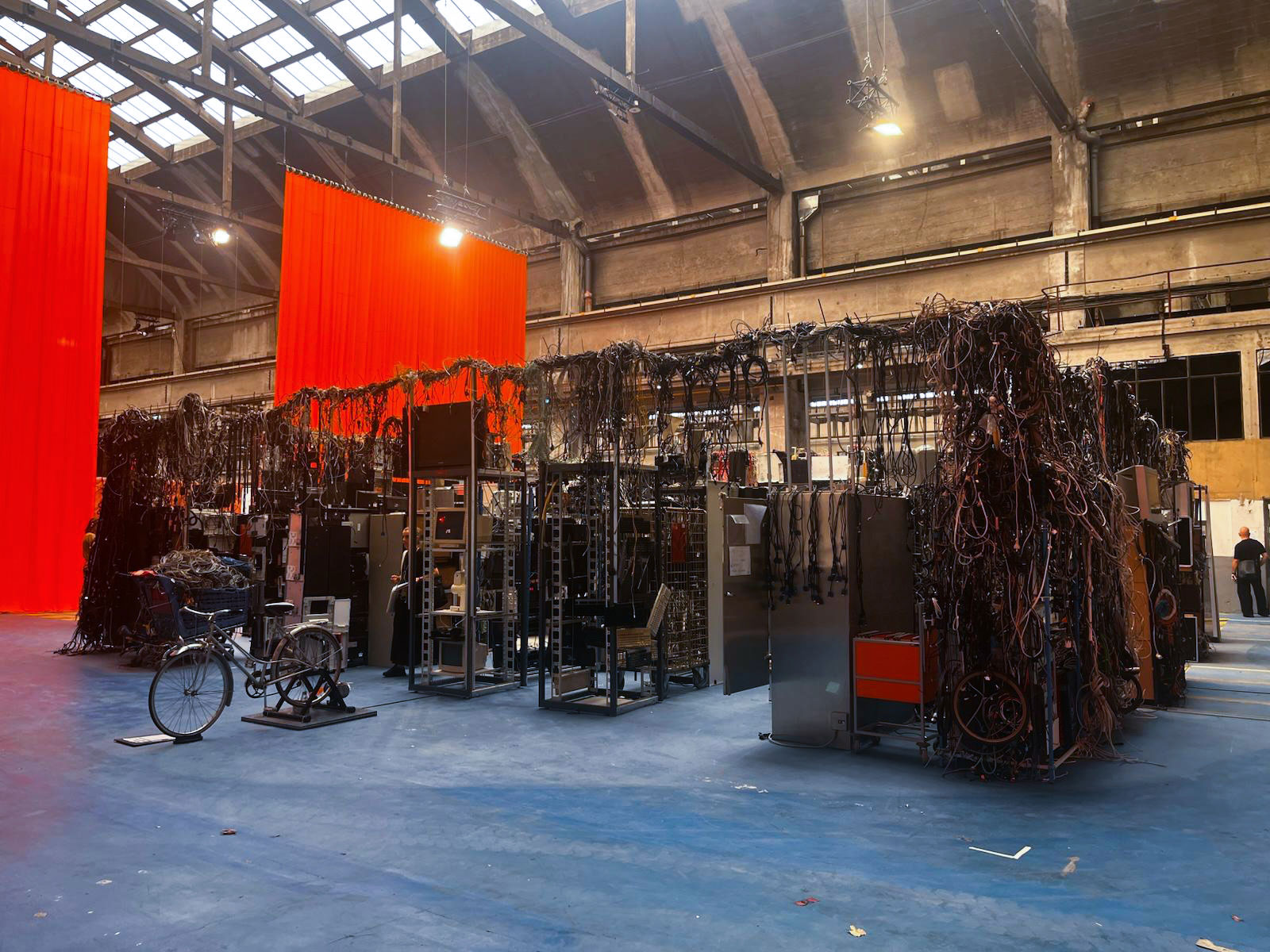
At Les Grandes Locos, Akwasi Bediako Afrane gives tangible form to the flip side of our digital habits. Discarded electronic equipment forms a mass of machines, cables, and materials that have become useless. A bicycle powered by the audience introduces physical effort into this world that interfaces present to us as immaterial. The installation reveals the resources required to manufacture screens, the discarded objects, and the physical components on which technology depends. The architecture of the hall is no longer merely a backdrop; it plays a role in our understanding of the work.
This exhibition demonstrates what poetic economy can bring to the viewer’s experience. It does not turn the installation into an illustration of a thesis on extraction; rather, it allows us to perceive matter, energy, and gesture as a unified whole. At Les Grandes Locos, where large-scale works are numerous, not all of them benefit from such a precise relationship to the space. Some engage in a dialogue from a distance, while others coexist more than they respond to one another. This restraint stems less from the size of the pieces than from the rhythm of their succession: when the exceptional becomes the norm, the viewer has fewer opportunities to discern what distinguishes each one.
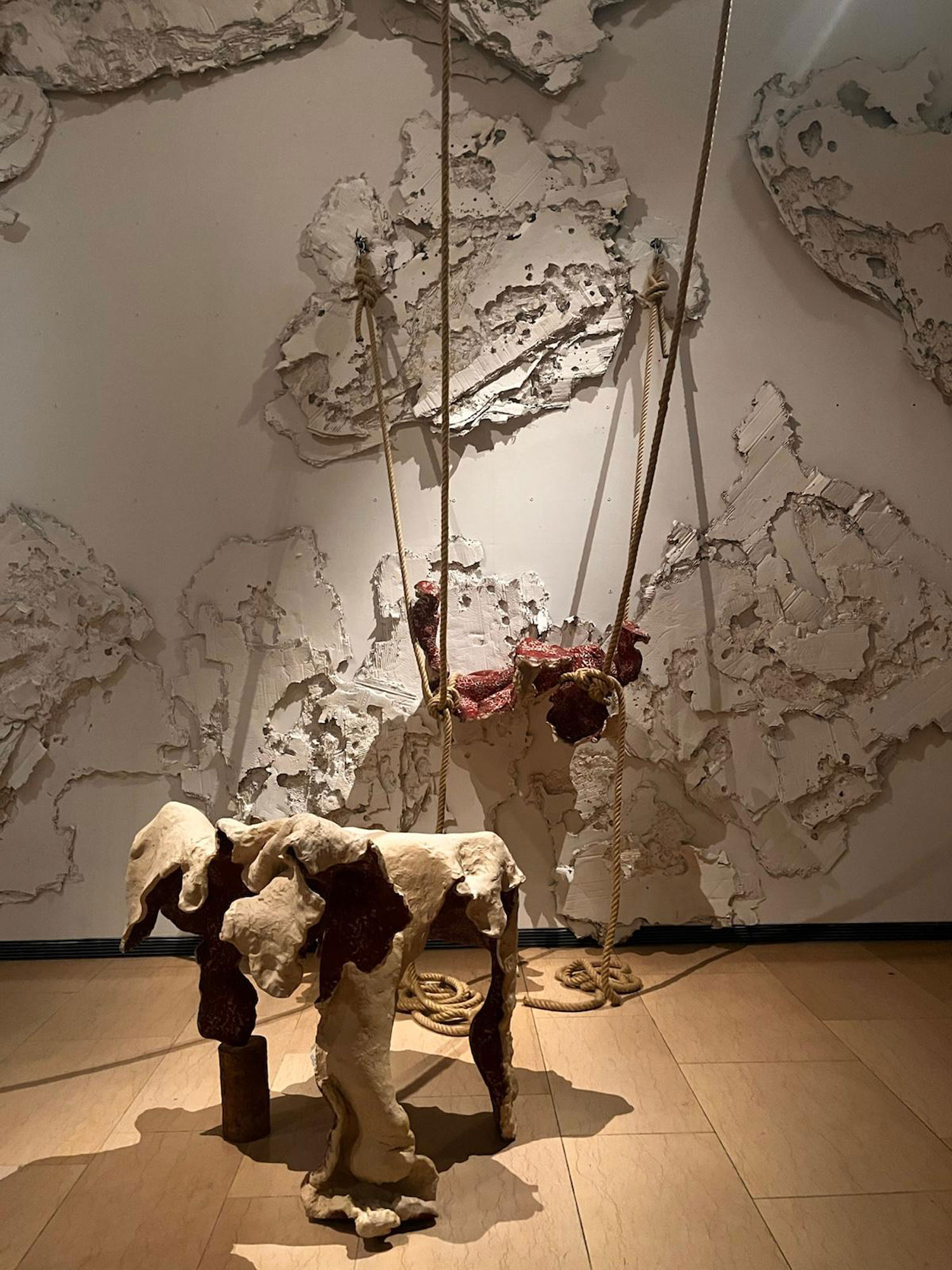
The Musée des Tissus offers a different pace. The variations in scale, the thresholds, and the succession of rooms invite visitors to slow down, to get closer, and then to step back. After the expansive space of the Grandes Locos, this more intimate experience highlights the relationships between the works. These connections arise not only from the subjects addressed by the artists, but also from the way the works are encountered, the attention the space devotes to them, and the time they require.
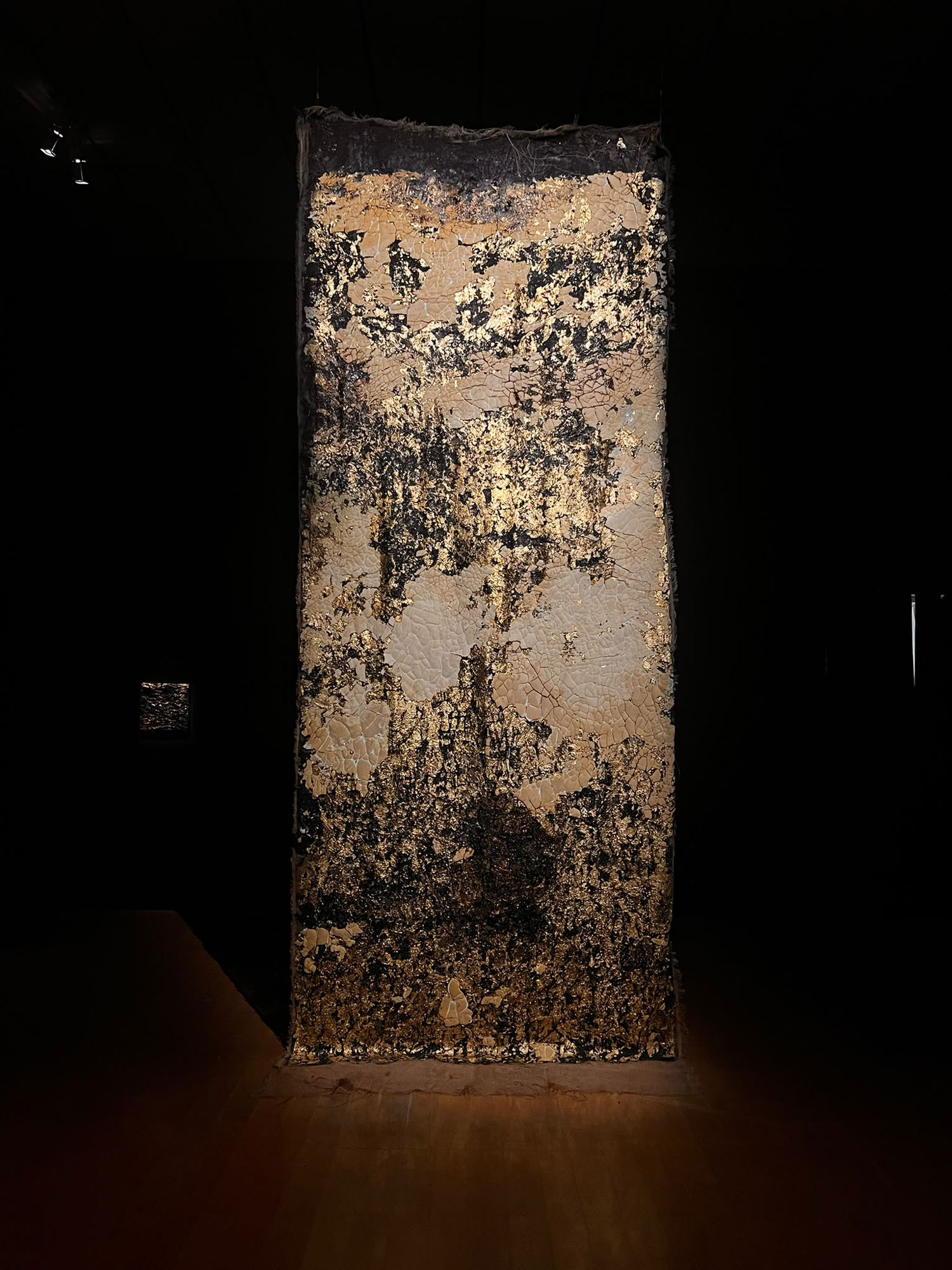
Kokou Ferdinand Makouvia’s installation brings together two walls blackened by fire, clay forms, and suspended copper elements. The smell of burning engages the body. Created with students, technical crews, and passersby, the work will extend beyond the museum: some participants will take home the clay pieces they have shaped. The sense of circulation so dear to Nichols takes on a concrete form here, from shared labor to the future of the materials. The poetic economy becomes a way of doing as much as it is a way of seeing.
A Never-Ending Party
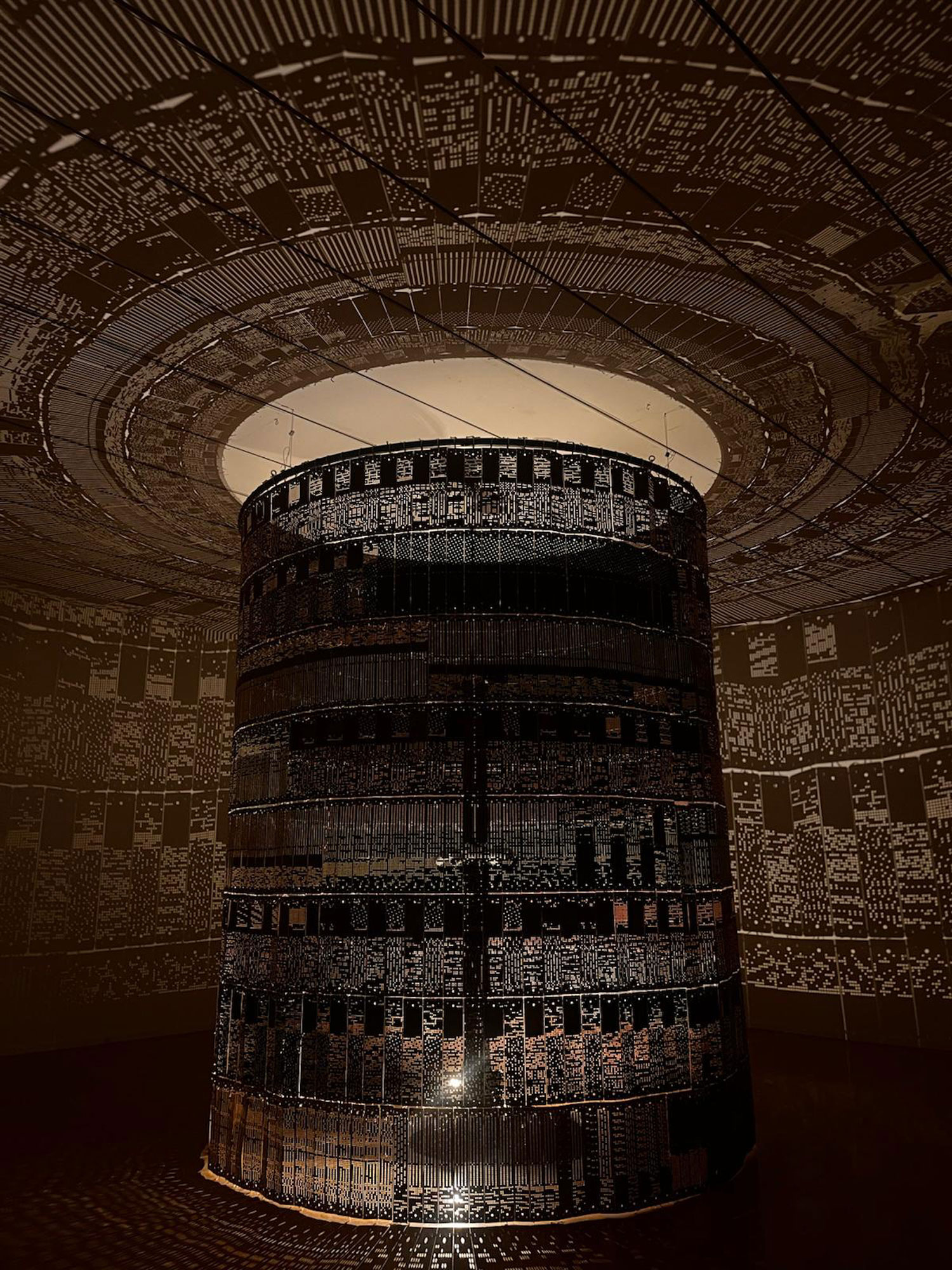
At macLYON, the dialogue between Ouassila Arras and Manfred Paul emerges from the exhibition layout. In Family Photos, Arras arranges on the floor rugs given to her by loved ones, which she unraveled thread by thread over the course of a year and a half. The green walls evoke a living room from her childhood in France. Facing Paul’s photographs, the viewer’s gaze moves from the floor to the wall, between two approaches to intimacy.
These rugs also carry the memory of labor: as a teenager, Arras’s mother wove them in workshops in Algeria, where the repetitive motions took a toll on their bodies but allowed the women to find solace in one another. By unraveling the rugs, the artist experiences the physical strain of the task and retraces the thread of a Franco-Algerian history woven from stories and silences. The home thus emerges as a place of both sharing and unspoken truths. Work, family relationships, and memory intertwine: the three themes of the biennial converge in a single work.
This focus on modes of transmission is further reflected in the prominence given to works from Oceania, whose presentation highlights their uniqueness. At the opening of macLYON, traditional New Zealand songs lent this presence a particularly moving collective dimension. Voices and bodies filled the museum space, transforming the encounter into a lived experience rather than a mere curatorial intention. For the duration of the ceremony, the idea of a “permanent celebration”—borrowed from Filliou—took on a tangible form, where art is shared as much as it is viewed.
The breadth of Nichols’s proposal allows for comparisons, provided we do not expect all the works to confirm the same idea. In *A Disappearance Is Not a Death*, Joyce Joumaa examines the construction of a hero based on Youssef Bey Karam, a figure in Lebanese history whose image is missing. After addressing Lebanon’s economic collapse in the first installment of her trilogy, she explores here how a country represents and narrates its past. Her work thus demonstrates that poetic economy can shed light on a work without exhausting its meaning.
It is in this freedom that “Moving from One Dream to Another” finds its strength. The Biennale is most compelling when its framework allows visitors to discover what connects disparate artistic practices. It is less effective when the profusion of works—or simply their proximity—leaves it up to the narrative to establish those connections. But its most striking moments show that a poetic economy does not consist of forcing everything into a single definition of value. It can also create the conditions for an encounter, and then let each work continue its own narrative.
18th Lyon Biennale of Contemporary Art, “From One Dream to Another,” September 19–December 13, 2026.

