

From the Blue Nile to galleries around the world, Sudanese painter Salah Elmur has made a name for himself with his melancholic, structured, and unforgettable figurative style. His market is gaining momentum, and his recognition is growing rapidly.
By Céline Moine, Artmarket by Artprice.com
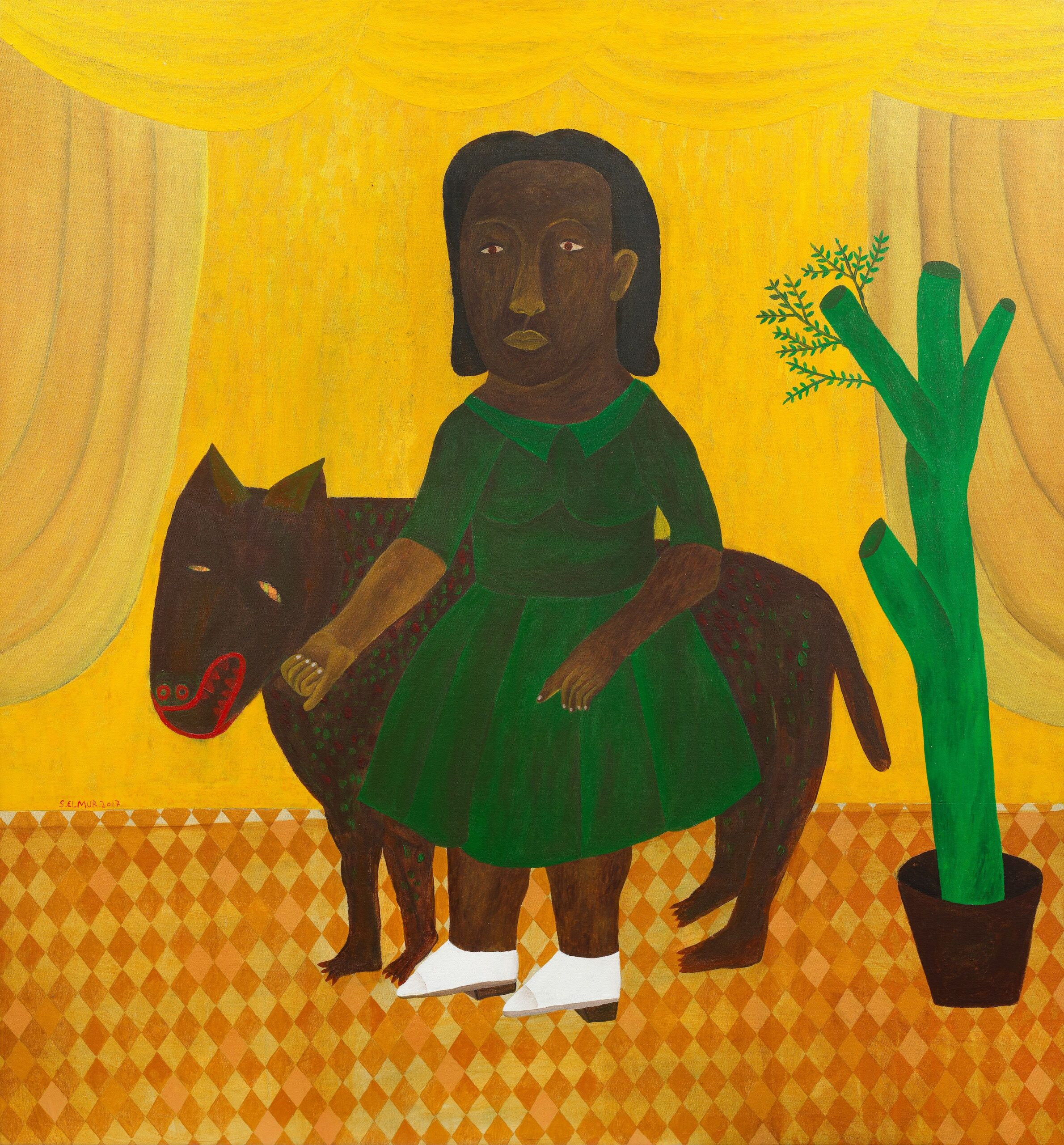
Salah Elmur, *The White Shoes*, 2017, acrylic on canvas, 140 x 128.5 cm © Bonhams
There is something in Salah Elmur’s paintings that resembles a memory frozen in time. The figures are depicted head-on, static, gazing straight ahead as if a photograph had just been taken. Enlarged hands, massive feet, and a flattened perspective lend each scene an almost Byzantine solemnity. And yet, there is nothing cold about these paintings. Everything exudes the warmth of the ancient forests of Sunut, picnics along the Nile, and weddings that last until dawn. Elmur does not paint what he sees. He paints what he nearly lost.
Born in 1966 in Khartoum, in a village on the west bank of the Blue Nile, he grew up with a mother who was an artisan and a father who was an engineer with a passion for photography. This dual heritage—the hand that shapes and the eye that observes—permeates his entire body of work. After earning a degree in graphic design from the University of Sudan in 1989, he became a prolific illustrator (with numerous children’s books published in several languages) before establishing himself as a painter, photographer, and filmmaker. This multidisciplinary approach is no detour: it explains the narrative clarity of his compositions, as well as their keen sense of framing and scene.
His style, which he himself calls “abstract figuration,” is a direct descendant of the Khartoum School, the modernist movement founded in the 1960s by Ibrahim El-Salahi and Ahmed Shibrain, which sought to blend Arabic calligraphy with African motifs. Elmur inherits this pride in identity but veers toward narrative. His palette—at times bold like that of a Fauvist, at other times soft like antique sepia—is reminiscent of Le Douanier Rousseau, whose “learned naivety” conceals genuine sophistication. His characters do not pose: they bear witness.
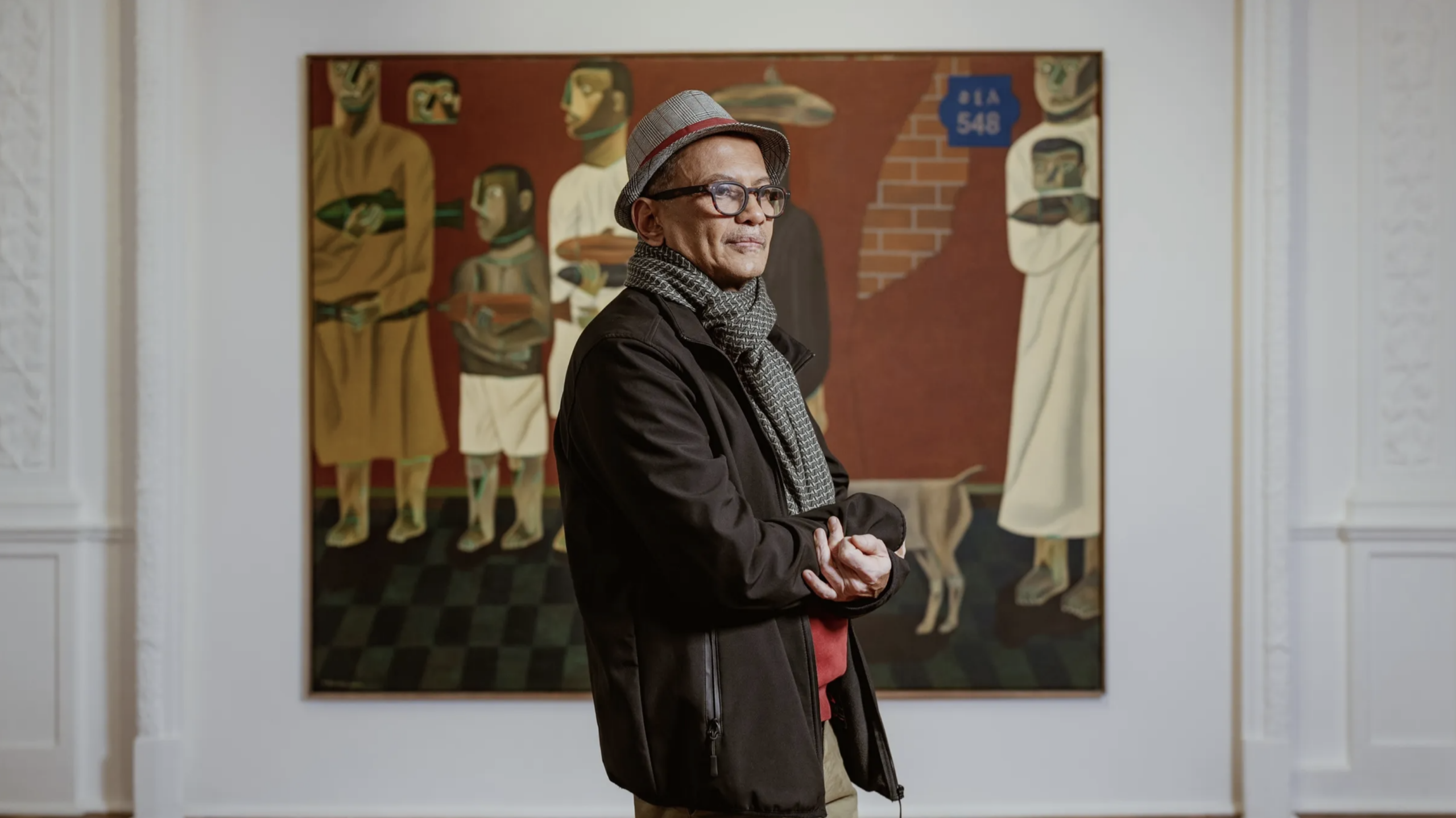
Artist Portrait of Salah Elmur, 2025. Photo by Alejandro Zaras. Courtesy of the artist and Mariane Ibrahim.
A Market Taking Shape
Long unknown outside the Arab world, Elmur began to attract international attention in the late 2010s, with a retrospective at the Sharjah Art Museum and participation in a group exhibition at the Saatchi Gallery in London. His works have been acquired by prestigious collections, including the MACAAL in Marrakech, the Sharjah Art Foundation, the Centre Pompidou, the MoMA, and the Smithsonian National Museum of African Art. The real turning point came in 2024 when he signed with Mariane Ibrahim, a leading gallery for African and diaspora artists, whose name alone helped elevate his market value. His first solo exhibition, “The Land of the Suné,” presented in Mexico City in early 2025, marked his sensational debut on the American art scene. Zona Maco, Dubai in November 2026: the schedule speaks for itself. At auction, the signs are becoming even more telling. A painting, The White Shoes (2017), which sold for $19,100 at Sotheby’s London in 2021, soared to $46,400 at Bonhams in 2025—a 143% increase in four years. Let’s not read this as speculation, but rather as confirmation that a work is finally finding the audience it deserves.
Salah Elmur does not chase after modernity. He draws upon it from within a collective memory that is fading away—that of Sudan before urbanization, before chaos. And it is precisely this quiet fidelity—this rejection of the picturesque and of contrived exoticism—that makes his work so necessary. In a market often hungry for novelty, he reminds us that painting can also be an act of gentle resistance.
This translation was generated using AI. For the original text, please see the French version of this article.
