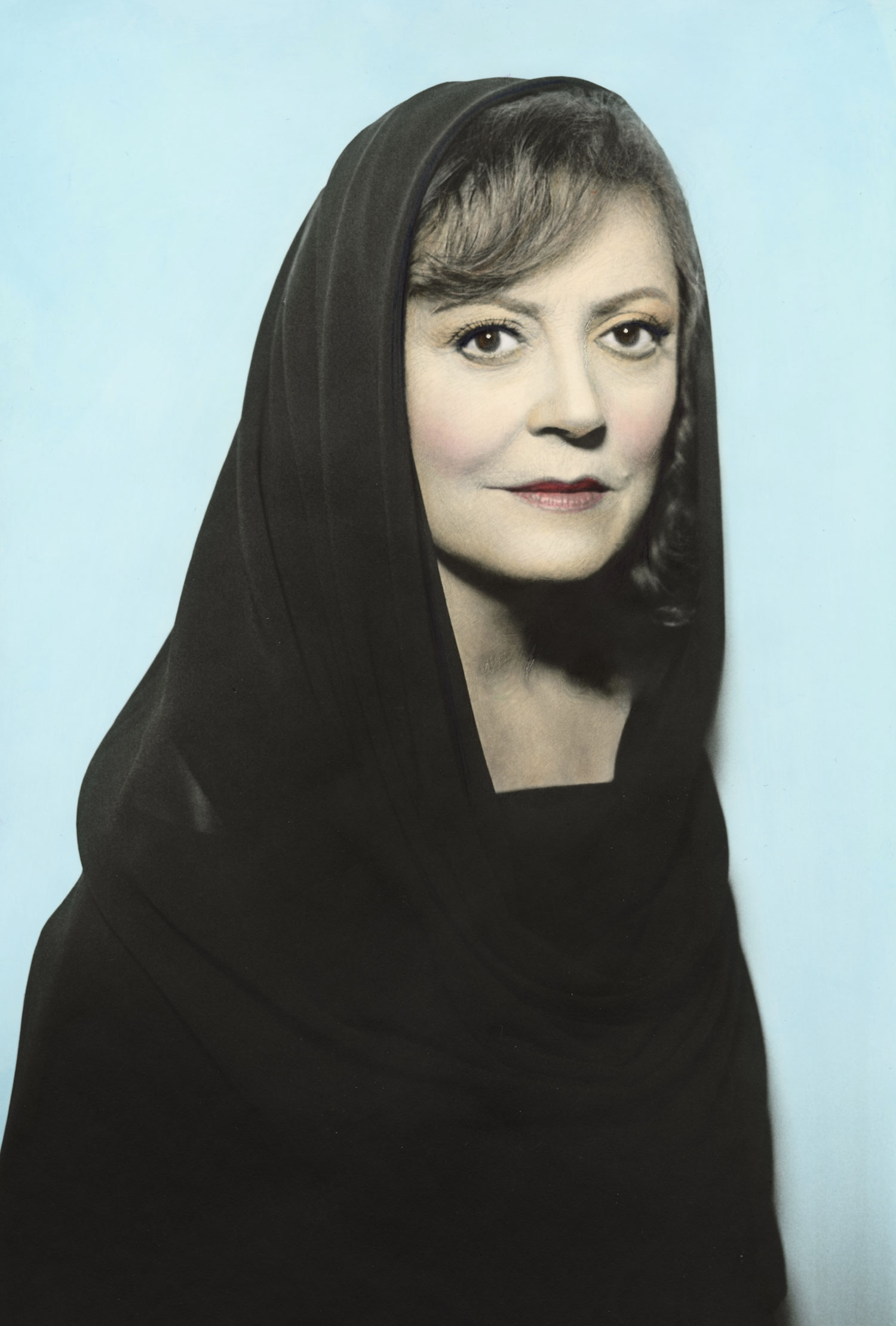

By taking over the Orsay Museum’s Orientalist galleries, Youssef Nabil does much more than simply exhibit his photographs: he shifts the viewer’s perspective. Blending cinematic nostalgia, memories of exile, and the subversion of stereotypes, his work both reimagines and deconstructs the history of a fantasized Orient.
By Rym Abouker
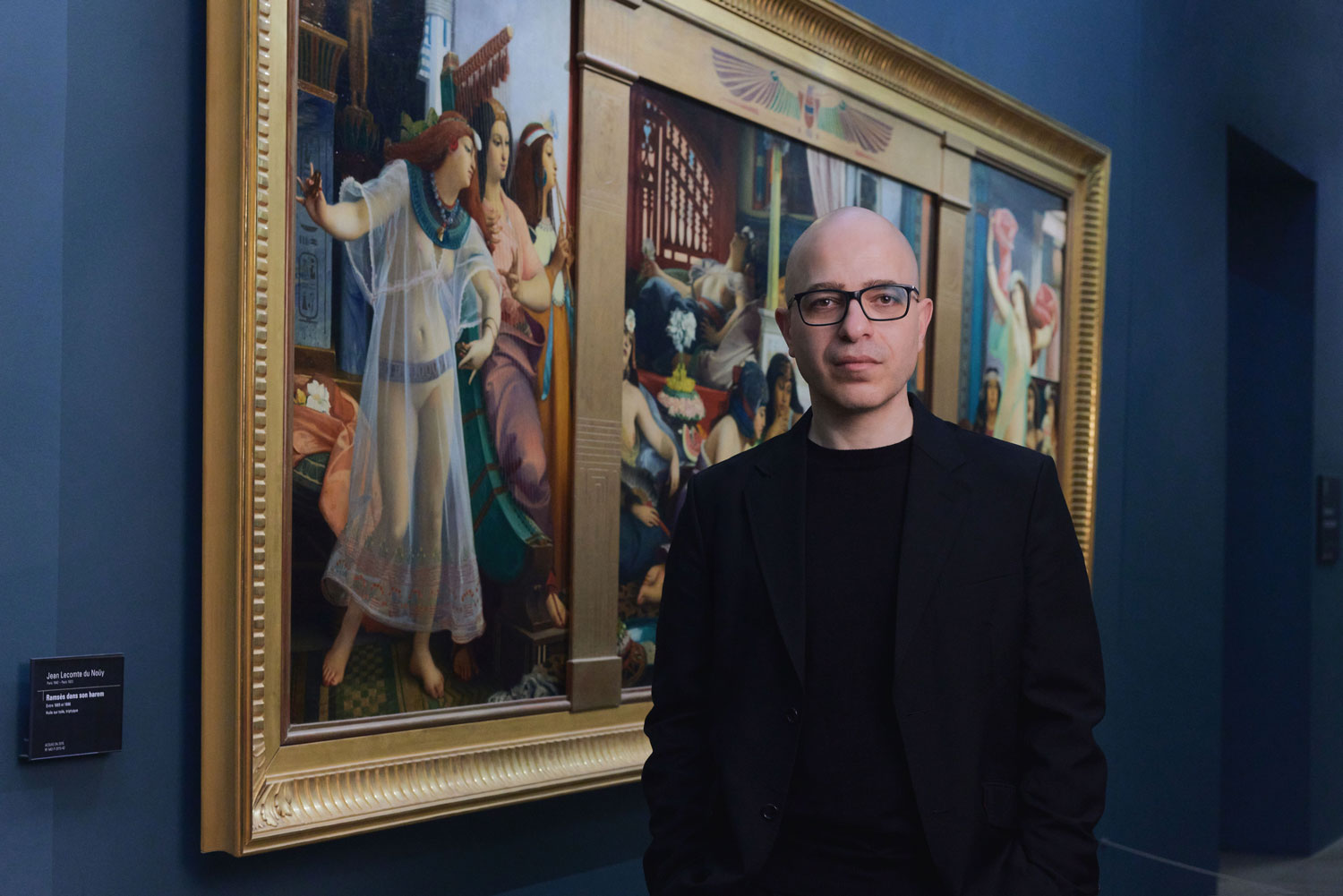
Youssef Nabil as Ramses in Jean Lecomte du Nouÿ’s *His Harem* © Photo: Alex Kostromin
It’s a wonderful story: in 1992, Youssef Nabil discovered the Musée d’Orsay and emerged from it a changed man. Some thirty years later, the Egyptian photographer is the first contemporary artist invited to take over the museum’s Orientalist galleries, now renamed “Artists in North Africa .” His works engage in a dialogue with the Symbolist heart of the collection: Puvis de Chavannes, Odilon Redon… A cycle that deserves to be interpreted in two ways.
For Youssef Nabil, communicating through images is, above all, a matter of vital importance. When he was born in Cairo in 1972, the golden age of Egyptian cinema was already in decline. A film buff and devoted fan of those old black-and-white movies he watched after school, he fell in love with actors who had already passed away. This first awareness of death had a lasting impact on his relationship with images: “J I decided that I would make photography my career and that I would photograph the people I love before I die and before they die. ” From cinema, he drew inspiration from poses, theatricality, and an eclectic eroticism. In 1991, a storefront in downtown Cairo definitively shaped his artistic practice: the studio of Van Leo, the last defender of glamorous black-and-white portraiture in a Cairo that had embraced color. Nabil inherited this vision: to sublimate, to turn the subject into a star, and to transcend their identity. Technically, he also carries on the tradition of manual colorization from Egyptian studios: his silver gelatin prints are painted with watercolors, enhanced with pencil, and retouched with a brush. Each image is a unique print that makes no claim to documentary objectivity, imbued with a faded, melancholic atmosphere, somewhere between memory and fiction—a time that never quite existed.
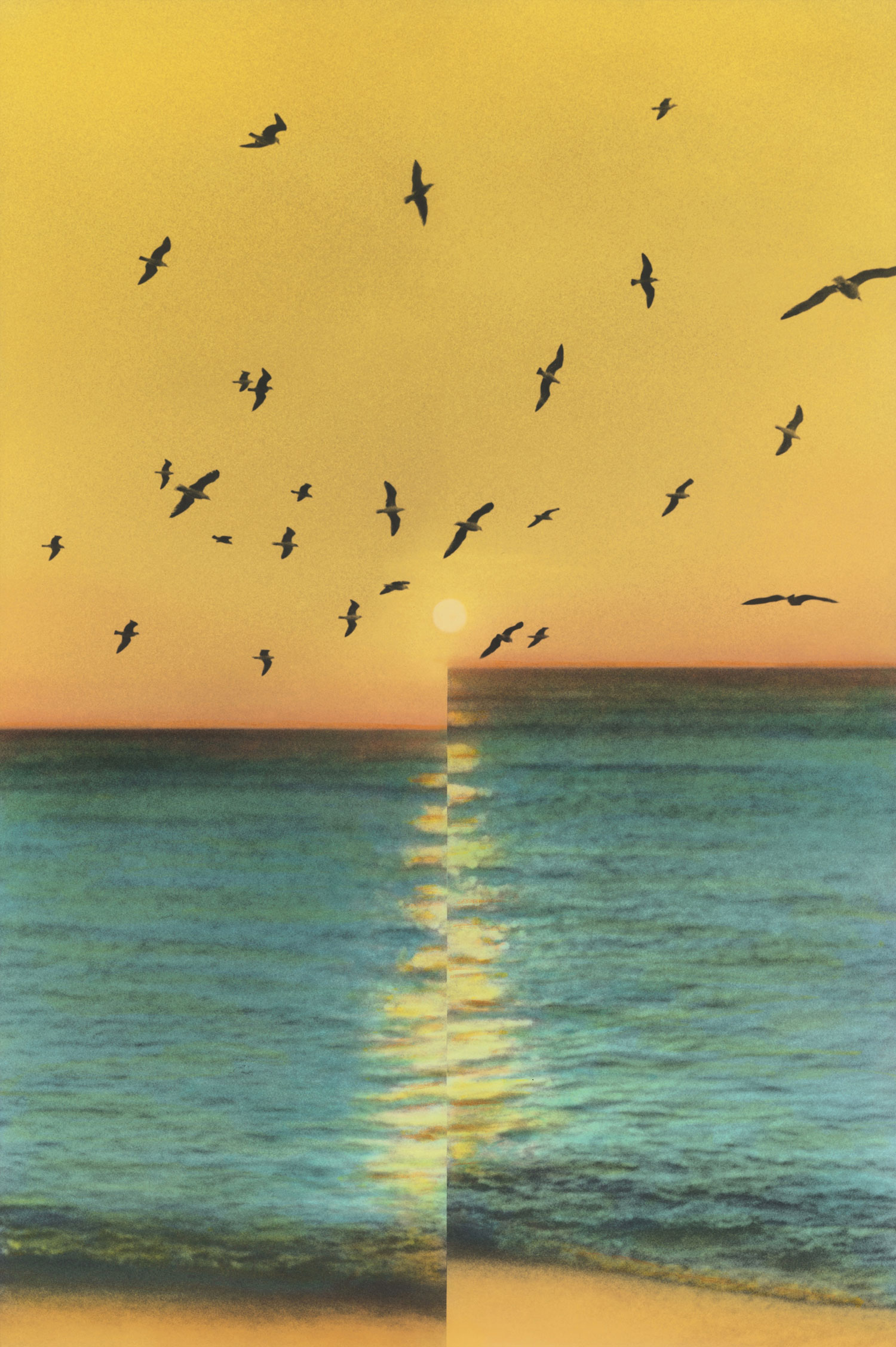
Youssef Nabil, *No one knows but the sky*, 2019, hand-colored silver gelatin print, 115 x 75 cm. Private collection © Youssef Nabil
Creating Images as Memories
Youssef Nabil left Egypt in 2003. For him, exile functions as an aesthetic condition: viewing his country from a distance means mentally reconstructing it and mythologizing it. *Self-portrait with Roots* (2008), in which he photographs himself nestled among enormous roots in Los Angeles, expresses exactly that: what remains rooted when the body departs. This is the act Nabil performs with every colorization, with every reenacted scene: creating images-as-memories for what the official archive has failed to preserve.
Her portraits function as counter-narratives: Ghada Amer, known for her pornographic works, appears veiled; Natacha Atlas poses like a smoking odalisque with a hookah. These choices play with clichés about the Arab world and subvert them. The closed or averted gaze removes the model from any direct confrontation; she becomes less of a psychological subject and more of a memory-evoking apparition. Nabil explores the enduring power of stereotypes, as well as their paradoxically alluring dimension, without claiming to escape them entirely. He reveals their complexity by working from within.
Two Djellabas (2007) takes this gesture a step further. The rolled-up djellaba, stripped of its function, becomes an image: two panels of fabric, one black, the other white, frame four hairy thighs intertwined on a pink floral couch, the hose of a hookah slithering like a snake into the frame. The tight cropping strips the bodies of all identifying features: face, hands, torso. Gender assignment is suspended, and the off-screen space is saturated with possibilities. The deepest subversion lies not in scandal, but in the banality of a scene that we have long refused to depict. I Saved My Belly Dancer (2015) completes this reversal: opposite the passive, melancholic man, the dancer stands upright and active; she is the one in control. In the Orientalist tradition, the dancer is offered up to the male gaze. Here, she is the one who lifts the man up.
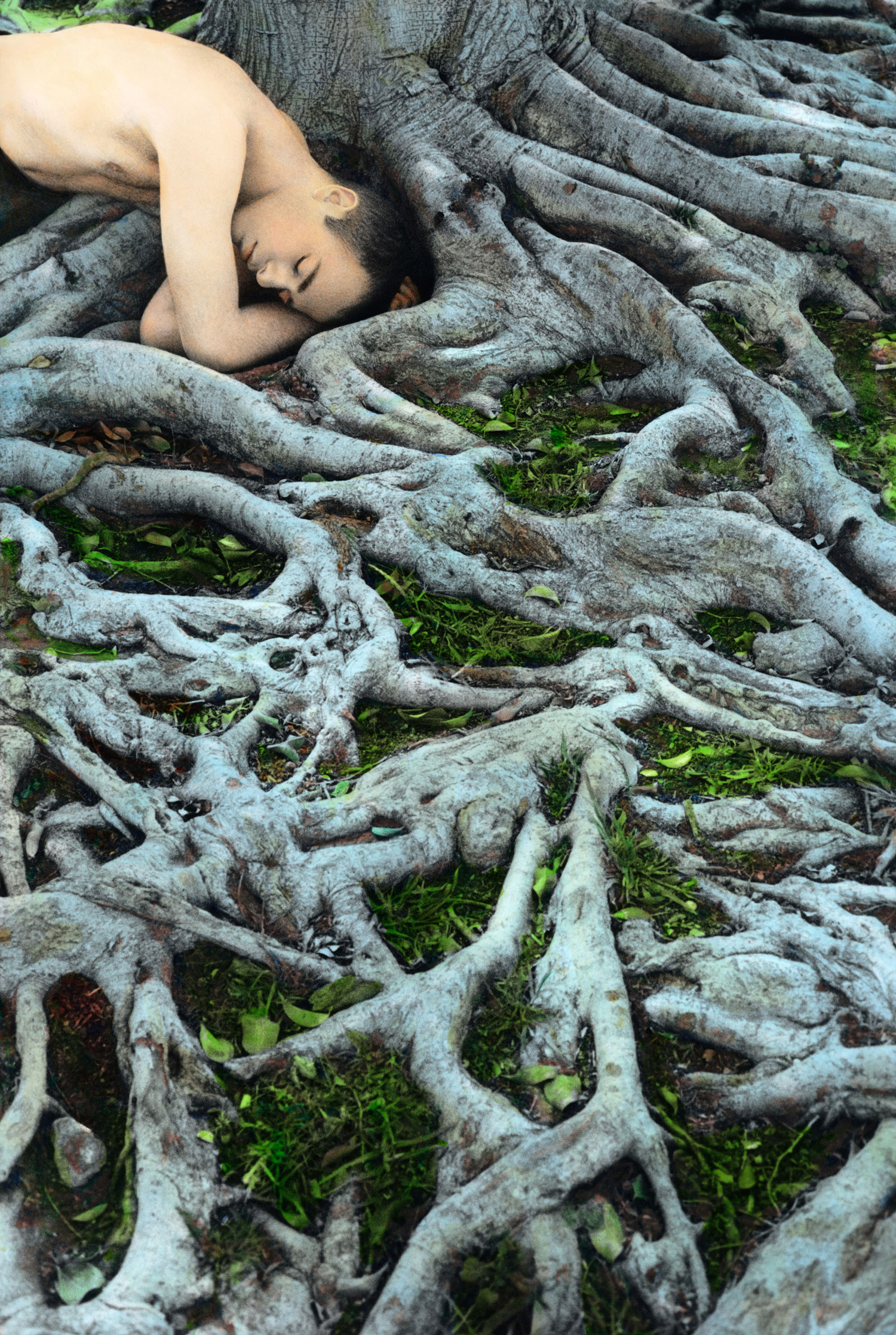
Youssef Nabil, *Self-portrait with Roots*, Los Angeles, 2008, hand-colored silver gelatin print, printed in 2014, 115x75 cm. Pinault Collection © Youssef Nabil
What a difference it makes to be in Orsay
Featuring an Egyptian artist in these galleries represents a powerful symbolic reversal: where these walls have long legitimized the Western view of the East, they now welcome a perspective from within. Nabil does not shy away from this. In the exhibition “Orsay as Seen by Youssef Nabil,” he comments on a painting by Alexandre Cabanel: “ This painting draws on a dark episode from biblical mythology, which the painter sets here in an imaginary Orient to justify his depiction of the sensuality of the reclining nude. ” He adds: “ In my works, women are portrayed as confident, proud, and liberated. ” The third gallery brings this dialogue to life by placing Natacha Atlas, Cairo alongside a painting by Léopold de Moulignon: the submissive odalisque facing Natacha, who is smoking a hookah.
For Nabil, the dream functions as both an aesthetic force and a survival strategy: it suspends the narrative in a floating, melancholic, almost unreal temporality. But at the Musée d’Orsay, in the very rooms where Orientalism was legitimized as great Western art, this dream takes on a different character. It no longer resists from the margins: it is embraced, curated, institutionalized. Is this the victory of a postcolonial artist who subverts the institution’s codes within its own walls? Or is it confirmation that the West tolerates only what it has always wanted to see in the East: beauty, dreams—nothing that causes pain?
This translation was generated using AI. For the original text, please see the French version of this article.