The Arab World Institute in Paris is hosting a retrospective on Mehdi Qotbi through January 5, 2025. Although he is known to the Moroccan public as president of the National Museum Foundation, it was painting that marked the beginning of his career. An interview.
Interview by Olivier Rachet
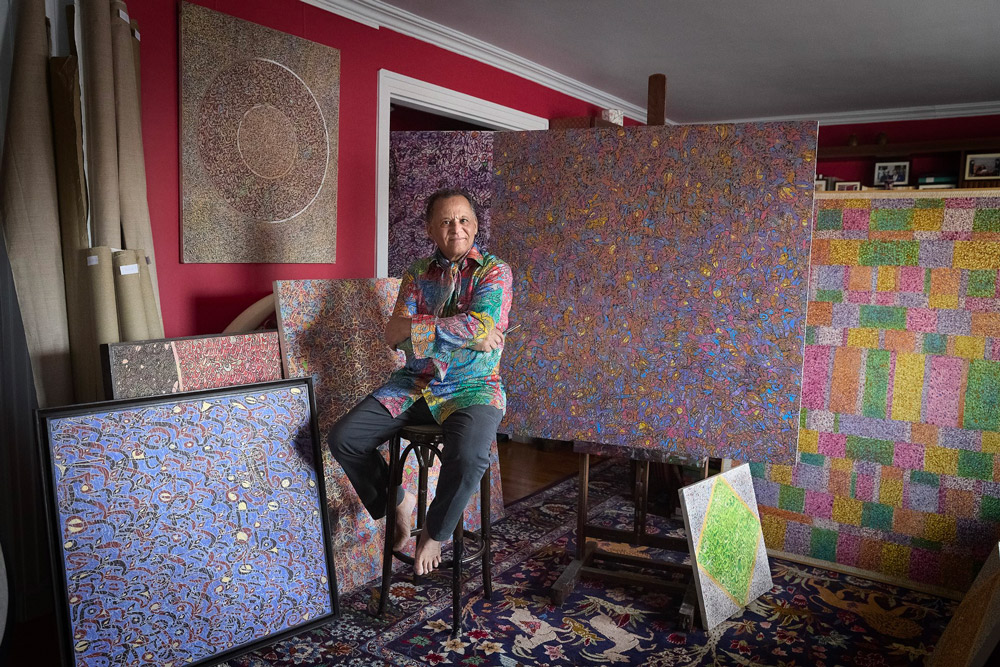
How did your calling as a painter come about?
I would say that it was painting—the colors that came to me—that saved me and shaped the course of my life. It was this tiger that I painted in the Scout club at the military high school in Kenitra—the club was called “Les Tigres”—that contributed to my rebirth. We had been asked to set ourselves apart from the other clubs by decorating our clubhouse. At that moment, no one dared to pick up a paintbrush, and it was this desire to live—to win the affection of others—that drove me to take up the brush. I drew a tiger ready to pounce with surprising spontaneity, and from that day on, the way my classmates looked at me changed, and I began to truly exist. When politician Pierre Bérégovoy presented me with my first award in 1990, he humorously pointed out in his speech that I had not only talent but also nerve.
How did you find the encouragement you needed to pursue your passion for painting?
In 1967, I wanted to become a journalism apprentice, even though I could barely read or write French at the time. I was heading to the newsroom of the Petit Marocain where the Count, the editor-in-chief, would often give me invitations to cultural events. I remember going to the French Cultural Center to visit an exhibition of lithographs by Schneider, a painter of lyrical abstraction. Among the people present, I noticed a very elegant man wearing a bow tie—it was Jilali Gharbaoui. I introduced myself to him as a painter, and he suggested that I bring him my work—even though I had hardly ever painted anything. I had spent the night creating my first works on paper. He invited me to lunch, at a time when I couldn’t even afford to eat. He was accompanied by two lawyers—his collectors—whom he ordered to buy my works for 20 dirhams each. It was the first time I’d ever had that much money. That allowed me to buy paper and paintbrushes so I could keep working.
What were you painting back then?
Above all, I was trying, rather clumsily, to reproduce works that spoke to me and that I loved. I found the third or fourth drawing I had made and given to Ms. Aziza Bennani (former Minister of Culture and Morocco’s representative to UNESCO)—paintings that she later returned to me and that are now on display at the IMA. In this work, we see figurative forms, but also early signs of my artistic development. These signs and words represent the desire I’ve always had to communicate and reach out to others.
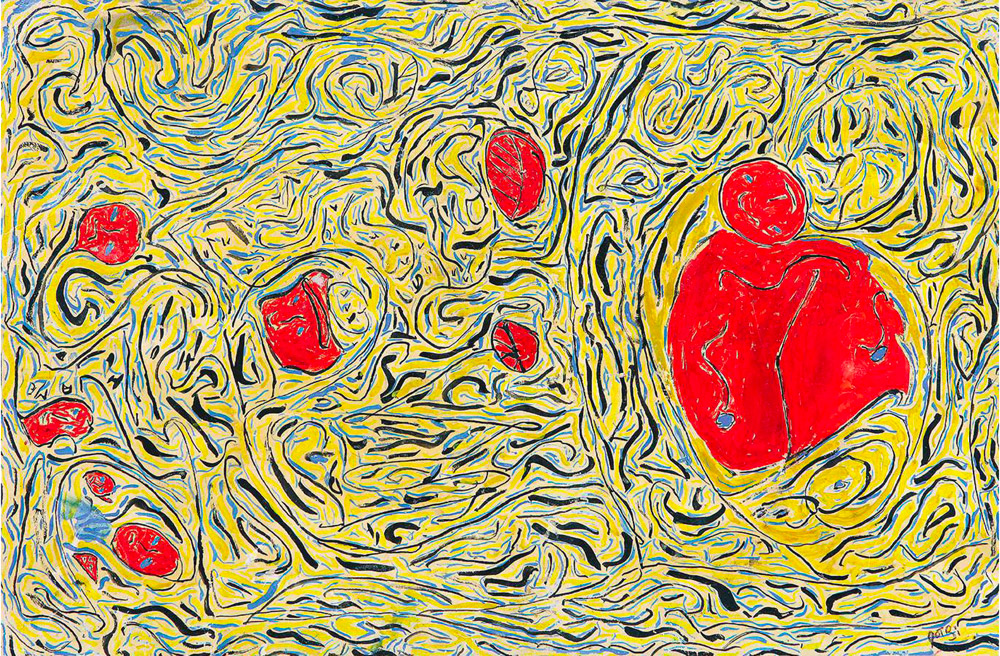
You then studied at the School of Fine Arts in Rabat, and later went to France to study at the Schools of Fine Arts in Toulouse and Paris.
I went to visit Mr. Alerini, who was the director of the School of Fine Arts in Rabat. I told him about my desire to paint despite my lack of financial means. That allowed me to meet several people in those studios, particularly art lovers. But the desire to leave Morocco was always there. My desire to go to Paris was understandable, since it was then the cultural capital—a place where all the artists I admired had stayed or lived. The first city to welcome me was Toulouse. I loved that city and its people, who didn’t ask me where I was from or about my social background, and who opened their doors and their hearts to me. That was a blessed time, a true rebirth. There, I learned to paint and mastered the basics of drawing.
Was it during this period that your artistic style began to take shape, along with your particular interest in words?
I began writing after I earned my national degree in Fine Arts, with the support of my professor, Mr. Daniel Schintone, who gave me the money to travel to the exams, which were then being held in Bordeaux. He was like a father to me, a confidant who allowed me to develop my skills without pressure. It was then that the lettering on the storefronts in the Takkadoum neighborhood—where I had spent my entire childhood—caught my eye once again. When I went shopping for my mother, I would look at these inscriptions, which were often accompanied by drawings. From there, something extraordinary emerged: every shop blared music at full volume. It was a breath of fresh air every time I went shopping. I then realized, following my teacher’s advice, that the strong connection to my roots could only be this Arabic script—which I must also “unwrite” in order to be reborn anew.
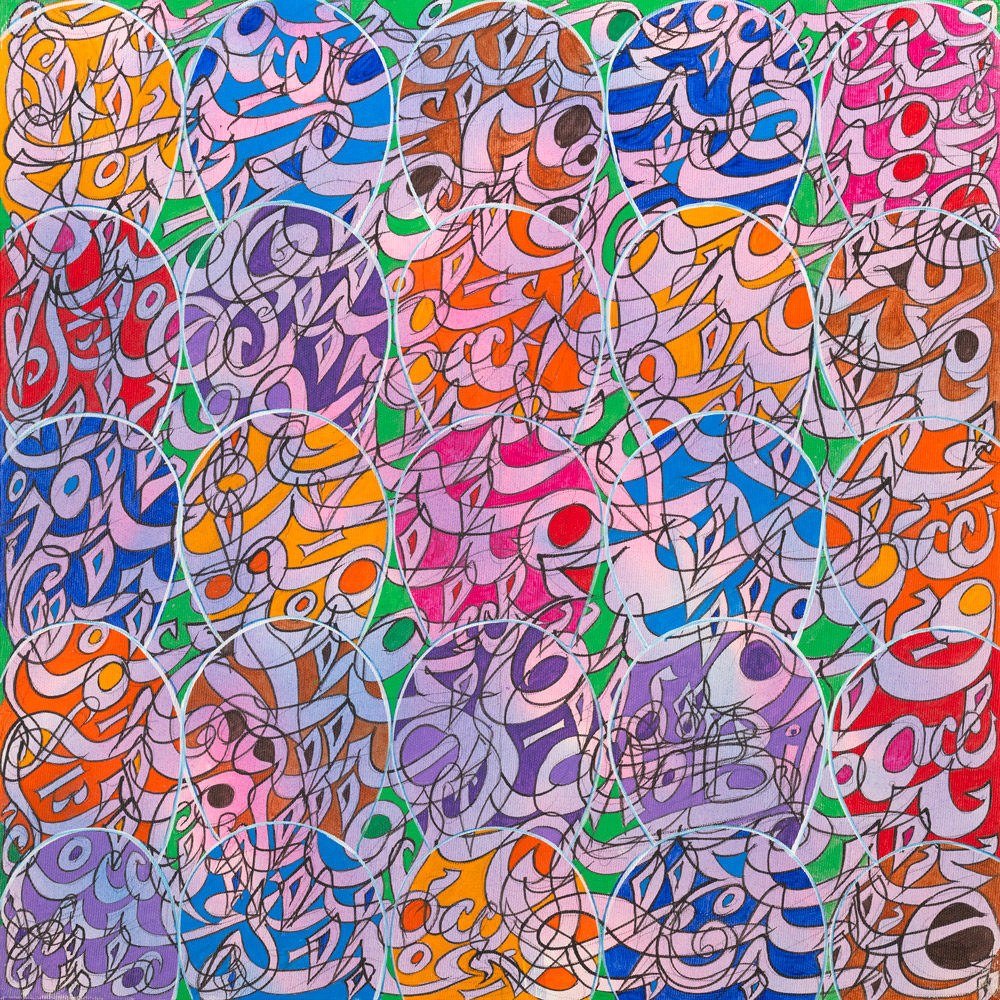
Was it a matter of inventing or weaving your own language through painting, by incorporating this musical dimension you just mentioned?
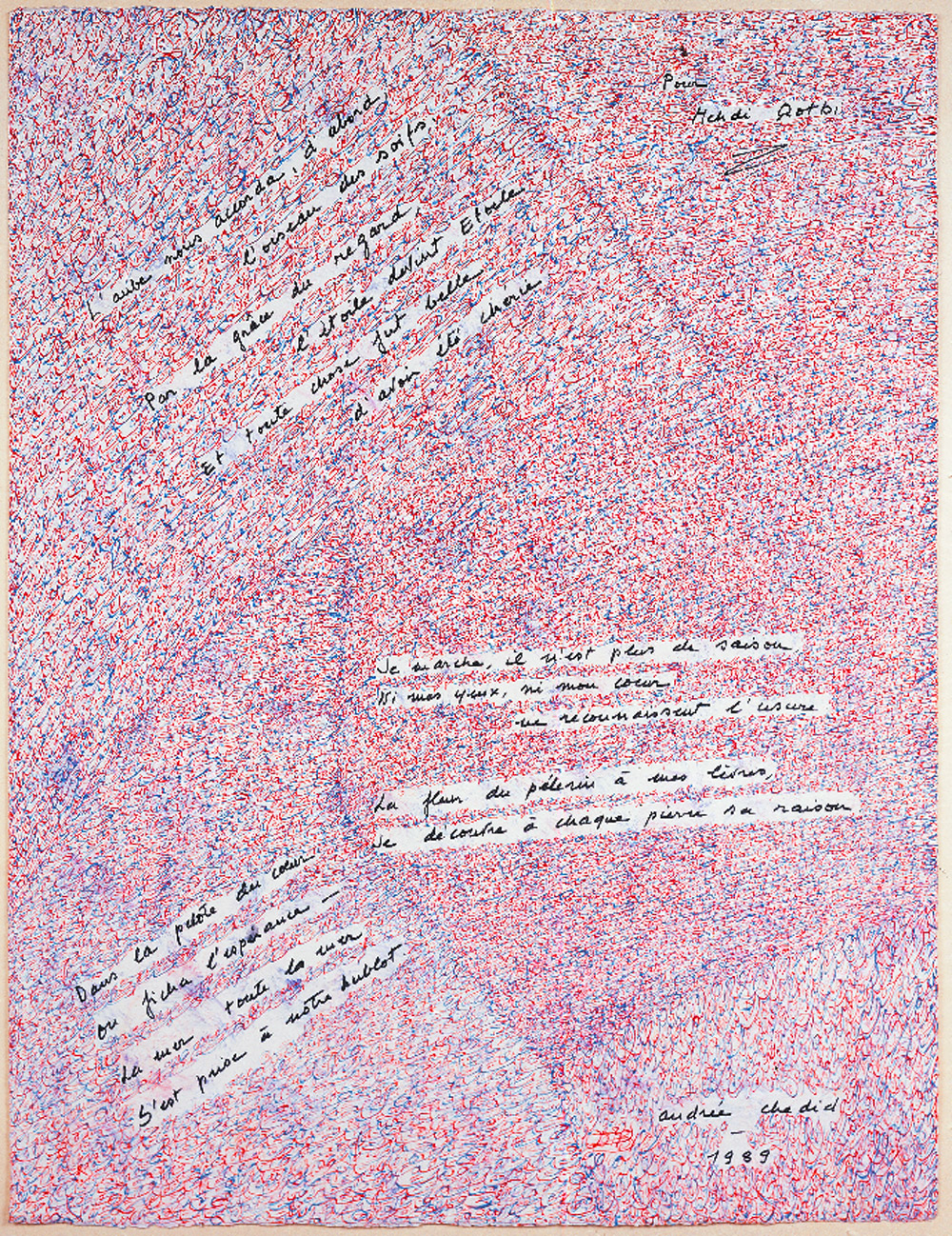
You’ve summed up my entire creative journey in just a few words. Music, weaving, “unwriting,” and love—these are indeed what define my work. There’s this desire to break away from my origins, while also acknowledging my connection to Morocco. As for writing, I didn’t want to do calligraphy. I’m not a calligrapher, contrary to what is sometimes said about my work. In calligraphy, you respect the meaning of what you write. I start from the premise that my hands are guided by the beating of my heart—by the passion and emotion I feel when listening to music, meeting someone, or reading a poem. That’s how things are born and transformed. I wanted to rediscover my own voice. It reminds me of that visit by Dominique Bozo (art historian and former President of the Centre Pompidou, ed.) to my studio, when he told me that when you step back from my works, they resemble a form of abstract minimalism, but when you get closer, one often discovers a style behind which lie both culture and modernity.
Your painting has a poetic dimension that may explain the many collaborations you have also forged with renowned writers.
The first meeting I was given the opportunity to have was with Michel Butor. I went to visit him in Nice, through a composer friend. He asked me to create a space in which he could engage in dialogue with me. I found myself faced with something fascinating that I had been searching for for years: the sayable and the unsayable. This unreadability that I brought to the table became legible through Butor’s words, and later through those of Aimé Césaire, Léopold Sédar Senghor, Nathalie Sarraute, Édouard Glissant, Jacques Derrida, and Václav Havel. These human encounters evolved into a shared understanding online or on paper, and then into deep friendships. I am grateful to God for giving me this exceptional opportunity to grow alongside these great figures who have left their mark on human history.
CDid these encounters lead to the publication of art books?
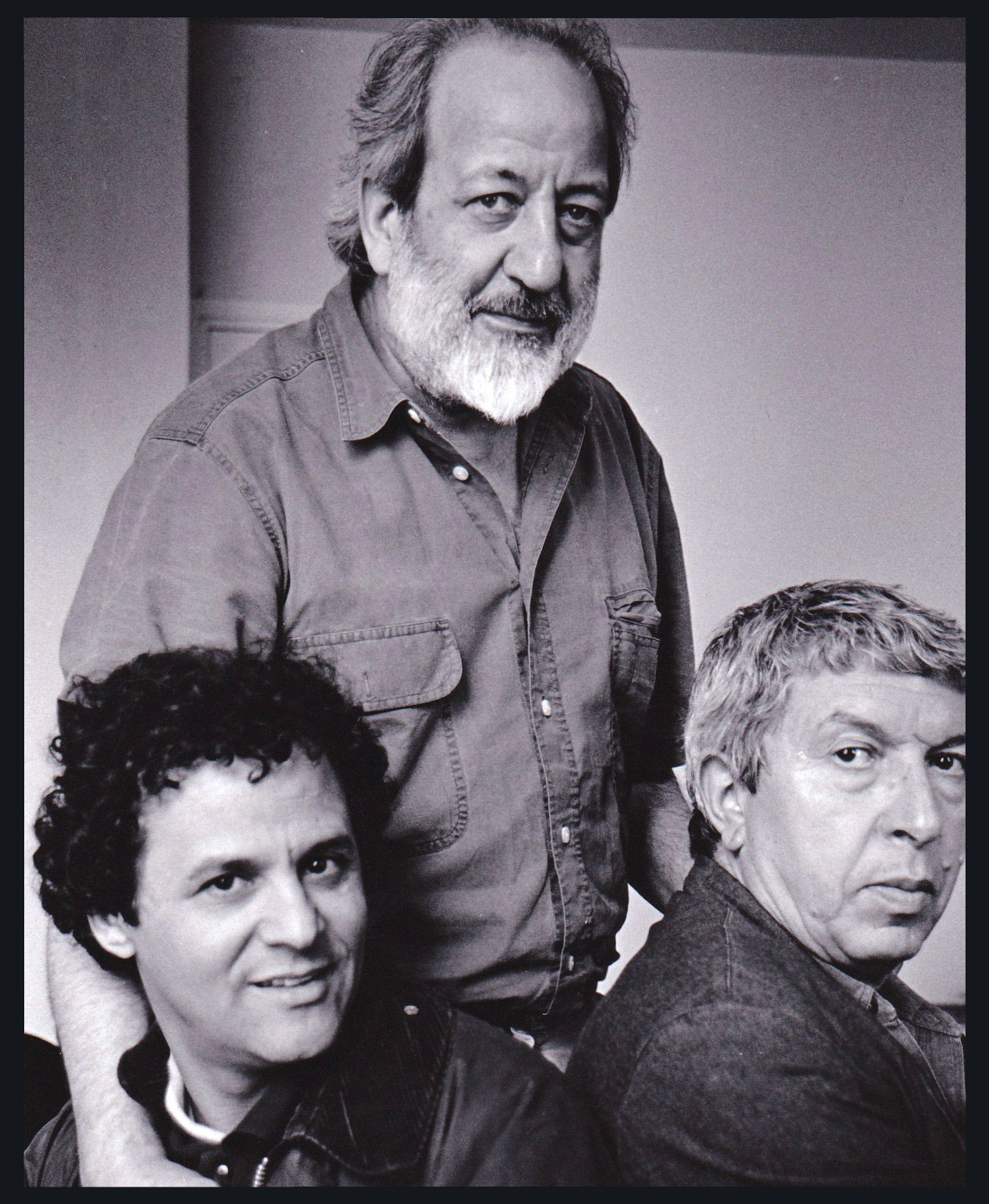
Absolutely—that’s what I’ve called “written encounters.” They’ve given rise to moments of profound happiness. Sometimes I wonder what century I’m living in when I realize I’ve been lucky enough to rub shoulders with Aragon and to work with Yves Bonnefoy, whose influence was pivotal. We produced two books together. He introduced me to his artist friends—Zao Wou-Ki, Antoni Tàpies, and Cartier-Bresson. He was a man of extraordinary generosity toward me. I also remember another great poet, André Pierre de Mandiargues, who wrote a six-page poem that became a book published by Fata Morgana. I can still hear his words telling me: “Your work is like a field where you simply sow seeds that grow on their own. Just by looking at your work, my sentences and words flow freely to accompany them.” Whenyou were in France teaching, on what occasions was your work exhibited?Life was very different back then. Very few Arab artists were exhibited in France. On the advice of a major Parisian gallery and the critic Jean Clair, I had briefly established a connection with the Rodolphe Stadler Gallery on Rue de Seine in Paris. It was one of the few galleries to exhibit written works. In the 1970s, the Iranian painter Charles Hossein Zenderoudi was exhibited there. Rodolphe Stadler advised me to meet the Lettrists. They were completely out of this world at the time; I found their discourse surprising. I should mention that during my first years in Paris, after studying at the Beaux-Arts in Toulouse, I didn’t paint because I felt my work lacked maturity. Then, I received offers to exhibit at art fairs. In 1981, I went to see Tessa Herold’s Galerie de Seine—I knew her—and proposed organizing an exhibition on writing. Bernard Quentin and Jean-Clarence Lambert helped me bring this project to life. I had already exhibited in several galleries and art fairs in Toulouse. Another exhibition was very important to me. It was in 1984, after the Left came to power and Jack Lang took office; it was called “La rime et la raison.” It showcased works from the collections of Madame Dominique de Ménil at the Grand Palais. On that occasion, I met the renowned art dealer Alexandre Yolas, who introduced me to Madame de Ménil. She visited me in my studio and purchased several of my works: gouaches and works on paper. She also introduced me to her sister, Sylvie Boissonnas, one of the major donors to the Centre Pompidou, who organized a major exhibition for me at the Flaine Art Center. She later invited me to the opening of her museum in Houston, where I met the most prominent architects, artists, and art dealers of the time. There you have it—life really is beautiful! I’m so happy to share this story with you.
What connection do you still have to painting today, given that you’re also the president of the FNM?
Painting remains my daily source of life. With our team at the FNM, if we succeed in our mission, it’s thanks to this shared passion. Painting has made me who I am today. These colors and these forms flow through my veins, my blood, and my heart. I’ve found a way to find inner balance so I can continue to serve and work. I’m dedicated to a cause I’m passionate about. I still have that passion for sharing. You can’t move forward if you don’t have a passion for success. If we’ve been able to exhibit Picasso, Matisse, and the Impressionists today, it’s also because my reputation as a serious artist lends me credibility with the people I collaborate with on all the exhibitions still to come. Art will never leave me.
Mehdi Qotbi Retrospective, Arab World Institute, Paris, October 15, 2024, through January 5, 2025.