At the Musée d’Art Contemporain (MAC) in Marseille, Louisa Babari brings together photomontages, archaeological artifacts, a slideshow, and a sound installation exploring ancient North Africa. Is this an attempt to recover a lost past? The exhibition “AFRICA” does something even stranger: it pieces together a past that was never whole, thereby shifting the question our times put to images.
By Basma Mansour
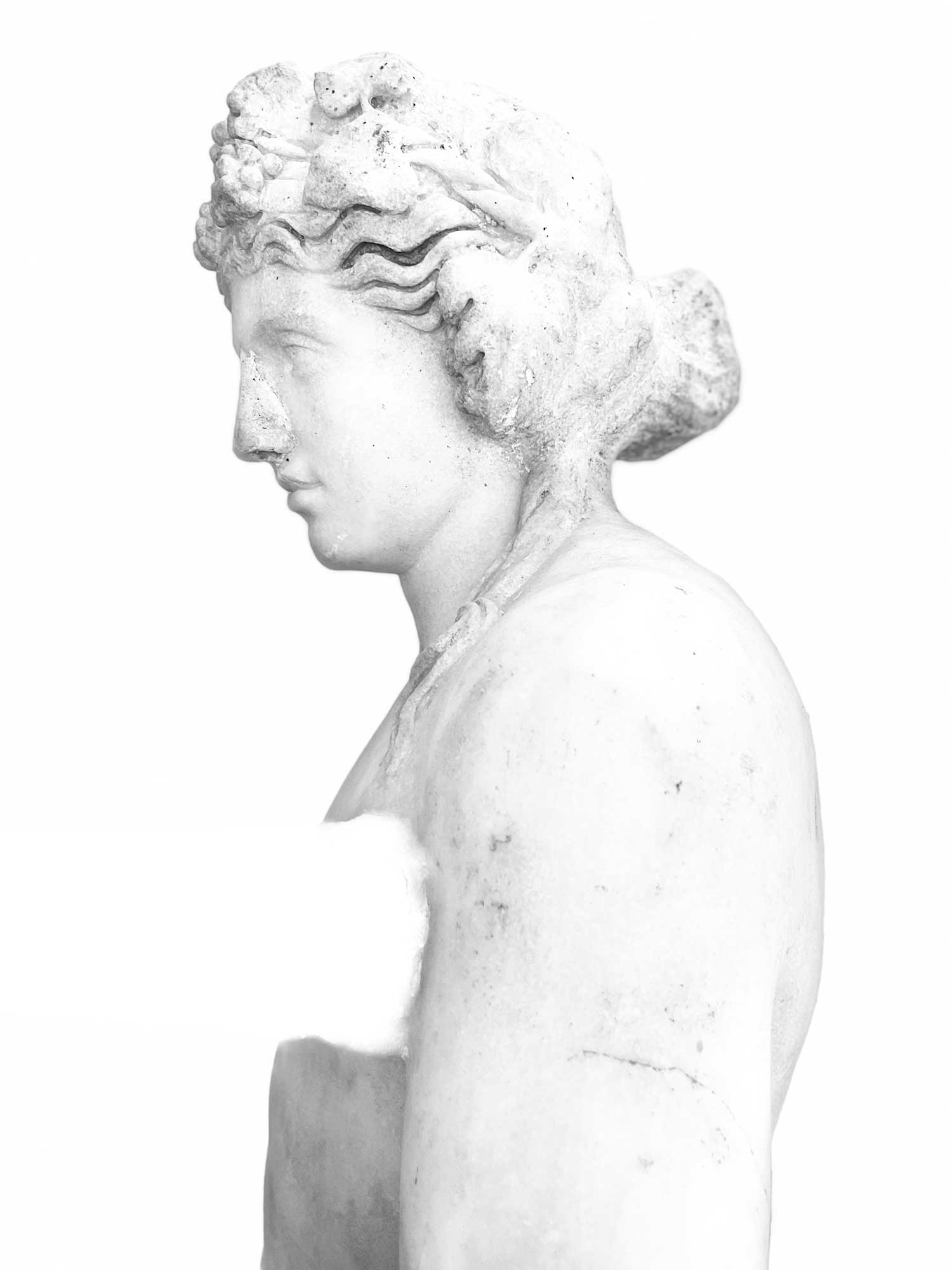
It all begins with the smallest historical unit there is: a proper name. Of Russian and Algerian descent, French artist Louisa Babari discovers, through the work of archaeologist Ahmed M’Charek, that her surname is an ethnonym attested in North Africa since antiquity, linked to the Numidian kingdom. From this personal discovery, the exhibition traces the connection step by step—from the name to the genealogy, from the genealogy to the archaeological evidence, from the evidence to Roman Africa, and from the province to the goddess Ifri or Ifru, whose name would eventually come to designate a continent. There is no “original” Africa beneath the accumulated meanings. Territories, empires, fantasies, and political geographies have settled upon the word like layers. The exhibition’s title is, in itself, already a collage.
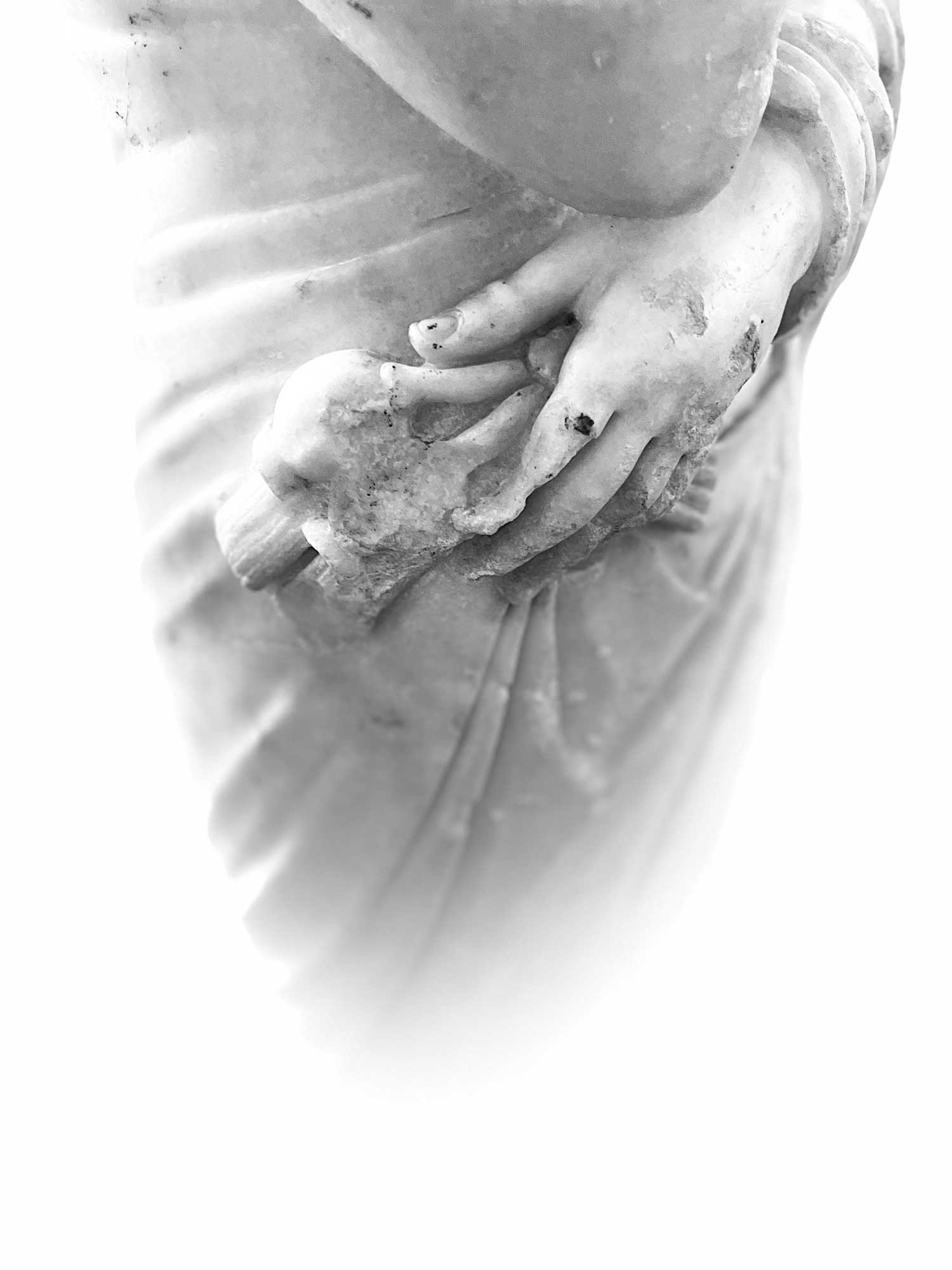
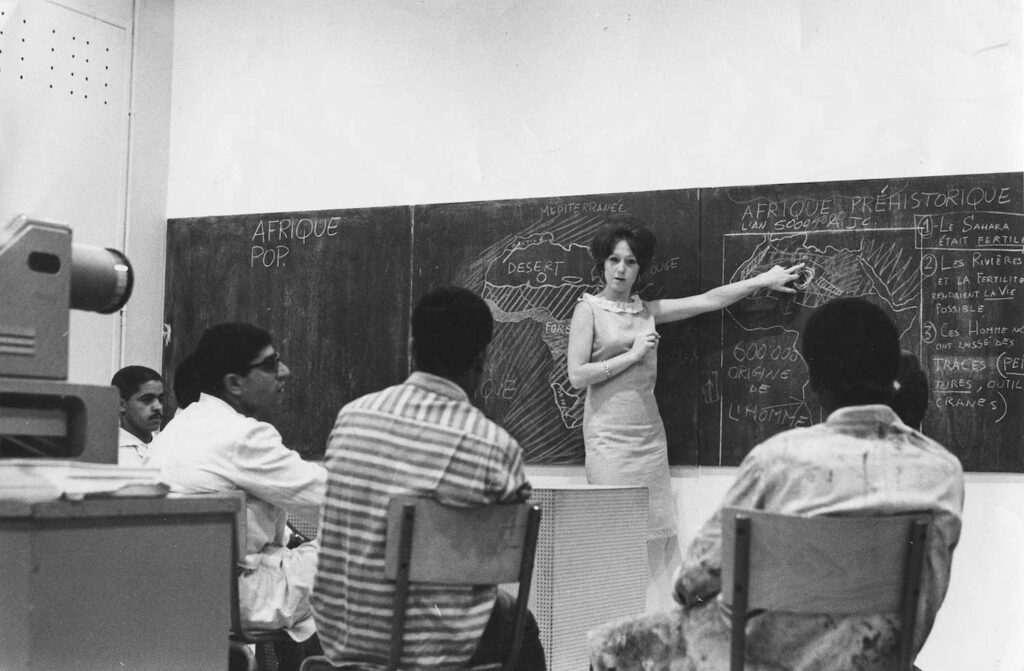
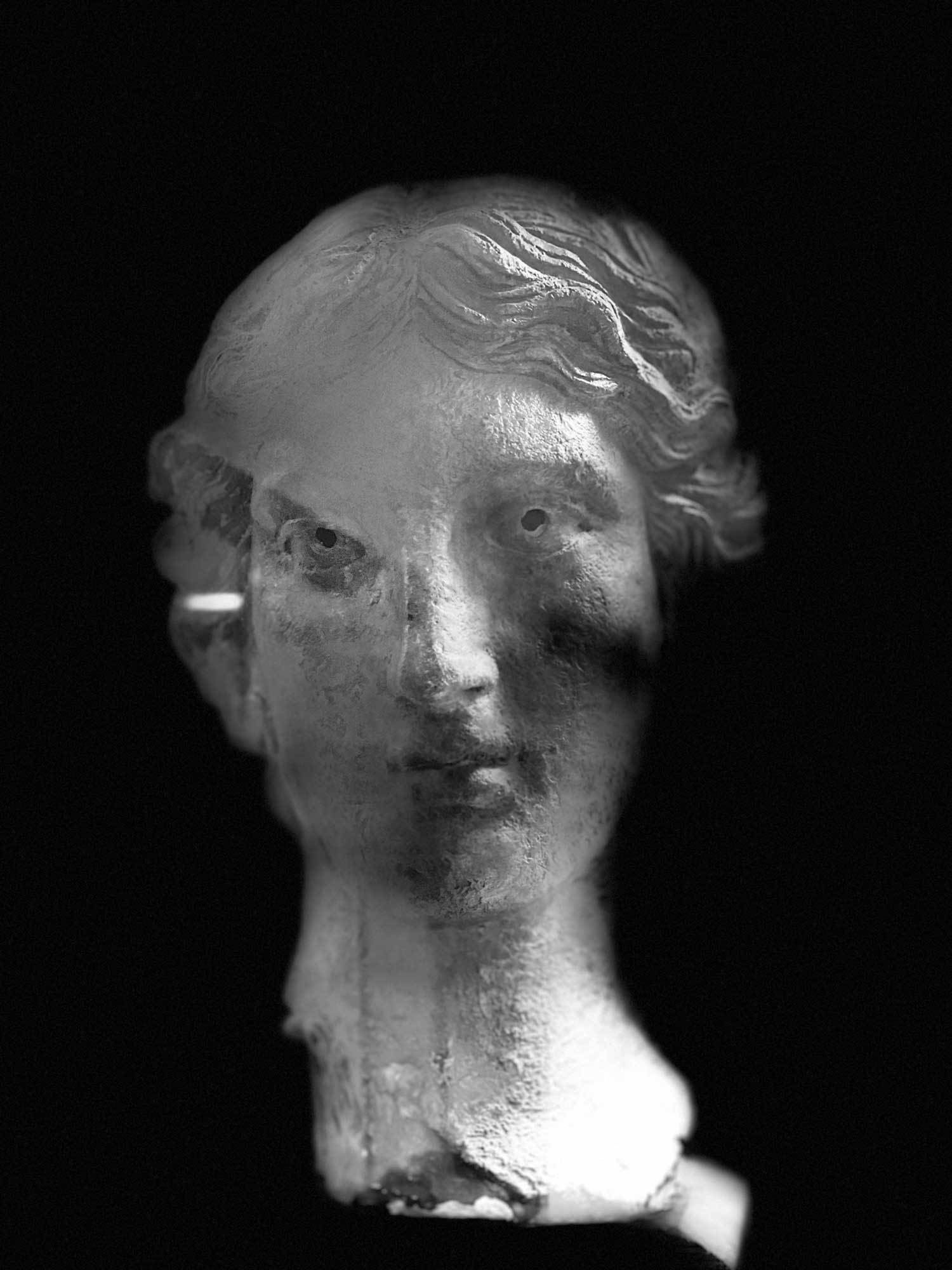
The room brings two systems of historical knowledge face to face. In a brightly lit vestibule stand the exhibits, each labeled with its provenance and inventory number: a stele of Saturn unearthed in Skikda, a Punic glass pendant, a Roman spearhead, and, on a screen, an animated reproduction of a 3rd-century inscription in which the name “Africa” appears. Then we move into the darkness, where eight enlarged photomontages on tarps pierce the gloom with their white halos, between two broken columns, a slideshow, and a twenty-five-minute electroacoustic composition that entirely invents a sonic Numidia. The stele asserts that it was once there. The collage responds that we are no longer quite sure what that means. For these images bring together fragments of statuary cut out from old scholarly journals, Chaouia women photographed in the 20th century, contemporary silhouettes, horses, and ruins. There is no chronological purity, no reconstruction. The artist speaks of “possible visions,” assembled as intuitively as they are well-researched—a way of “roughing up” the archive and introducing accidents into it—an approach that led the philosopher and art critic Florian Gaité to describe her, in the monograph published by Éditions AA, as an “anarchivist.”
This is where the exhibition diverges from a narrative that has become dominant. Much of today’s practice operates according to a logic of recovery: something has been erased, we find it, we make it visible, we restore continuity. The political value of this act is real; colonization destroyed and reorganized entire bodies of knowledge. The danger lies elsewhere—in the aestheticization of loss itself—when the precolonial era becomes a sanctuary of integrity, an alternative origin, desirable precisely because it is imagined as intact. Babari cuts this temptation short through the very form of her images, which lay bare their own construction. Her collage stems from the observation that the image has never been whole—just as the name “Africa” survived antiquity only as recorded by its adversaries. Instead of restoring, it orchestrates co-presences: a ruin set against a contemporary body. The rupture between past and present remains visible; it merely ceases to be definitive.
Rejecting Nostalgia
Yet a contradiction runs through the exhibition; it is its very lifeblood. Babari warns against nostalgia and says she wants to accept Algeria “as it is today, with its ambiguities and contradictions.” Yet “AFRICA” methodically creates the visual conditions of a longing for the past: darkness, depth, lions and horsemen, mineral matter, the longue durée. Can an exhibition reject nostalgia while still crafting its own atmosphere? The answer may lie in the slideshow. The artist describes her photographs of statues as portraits captured in the mirror of those who gazed upon them two thousand years ago. The idea is beautiful and unstable; looking at the same object does not establish any genealogical continuity. But this is precisely what the montage assumes: continuity is not rediscovered by the work; it is produced by it. The collage creates the conditions under which a lineage becomes imaginable and demonstrates it.
It remains to be understood why collage functions here as a method rather than as ornamentation. An image can present itself as a window; in that case, it reveals a state of the world and is judged by its resemblance to it. It can also present itself as a device, and what it produces is an arrangement of fragments whose relationships become perceptible. The Russian avant-garde made this second definition its program, in the wake of a historic rupture, when the task was to create forms capable of fostering a new consciousness. In this context, photomontage embraces its cuts and dispenses with any illusion of continuity.
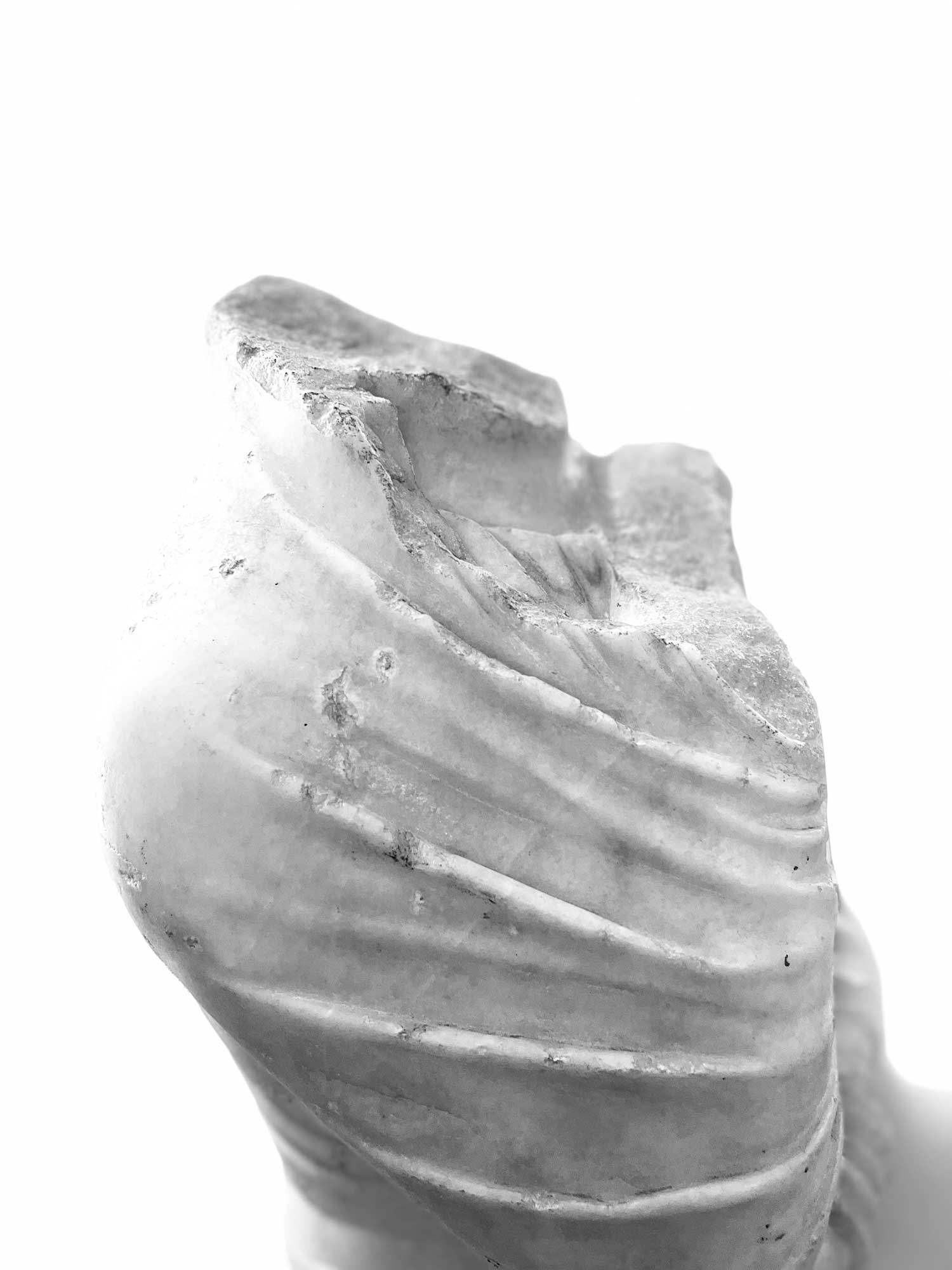
This connection does not imply any claimed lineage. It stems from the vocabulary that Babari uses spontaneously. Born in Moscow and trained in Russian studies and film, she describes her collages as matrices similar to film stock, conceived in terms of shots and editing, and her Journal d’un étudiant algérien à Moscou [Diary of an Algerian Student in Moscow], acquired by the MAC, traces the movements of Algerian students throughout the Eastern Bloc after independence. The rupture she inherits is colonial, prolonged by independence and by dispersion. In both situations, the image ceases to be a container of information and becomes an instrument of reorganization. Archaeology uncovers fragments, the archive classifies them, montage rearranges them, and history emerges as an effect of their arrangement. “AFRICA” thus composes an “image-Africa” rather than an “image of Africa”—a field where heterogeneous temporalities coexist without reconciling. This is what allows the exhibition to produce the past without claiming to reconstruct it.
Finally, it would be too simplistic to separate the exhibition from the venue hosting it. The stele of Saturn was transported from Skikda to France in the 19th century; the acknowledgments list the Louvre alongside the museums of Algiers and Constantine; and the entire event is part of the Mediterranean Season, the Grand Arles Express, and the bicentennial of photography. A second collage thus operates at the institutional level, bringing together Algeria, France, Antiquity, cultural diplomacy, and heritage—all brought together under the banner of “Africa.” Whether it involves displacement, restitution, reconciliation, or simply an institutional arrangement, the question deserves to remain open, and the exhibition—which so effectively demonstrates how arrangements shape narratives—provides visitors with the means to ask it for themselves. One leaves with a different question in mind. It is no longer a matter of knowing what “authentic Africa” was, but rather what becomes of the images when we stop asking them to recreate the past.
— Louisa Babari, “AFRICA,” Musée d’Art Contemporain (MAC), Marseille, through January 3, 2027.