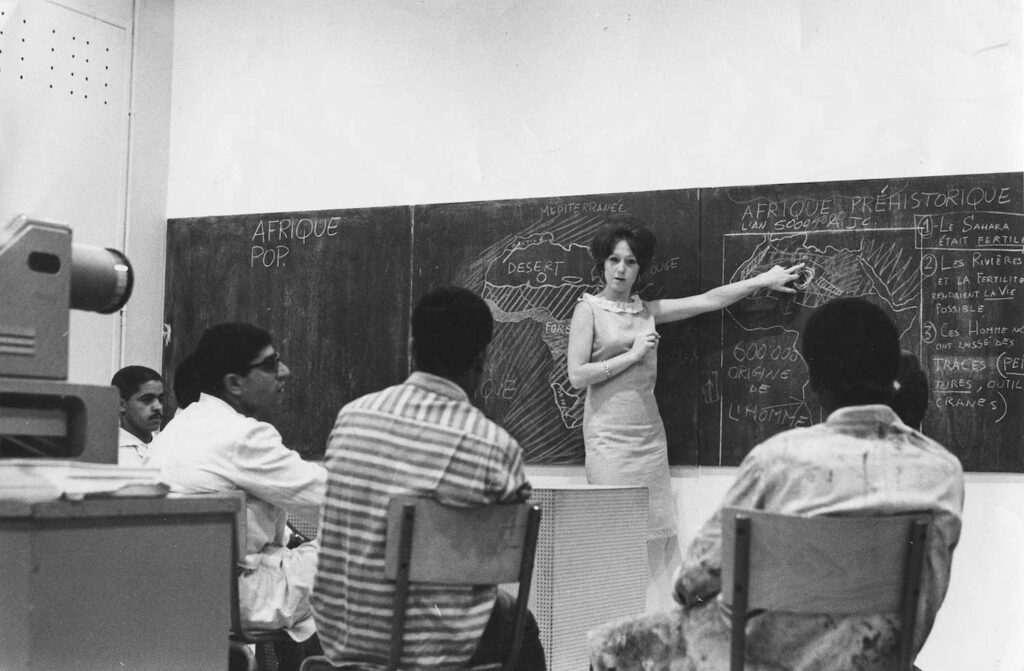
Three years after it opened, the National Institute of Fine Arts in Agadir saw its first graduating class. As a branch of the INBA in Tetouan, this young school embodies the ambition to develop higher education in the arts in Morocco, despite the many challenges that remain.
By Olivier Rachet
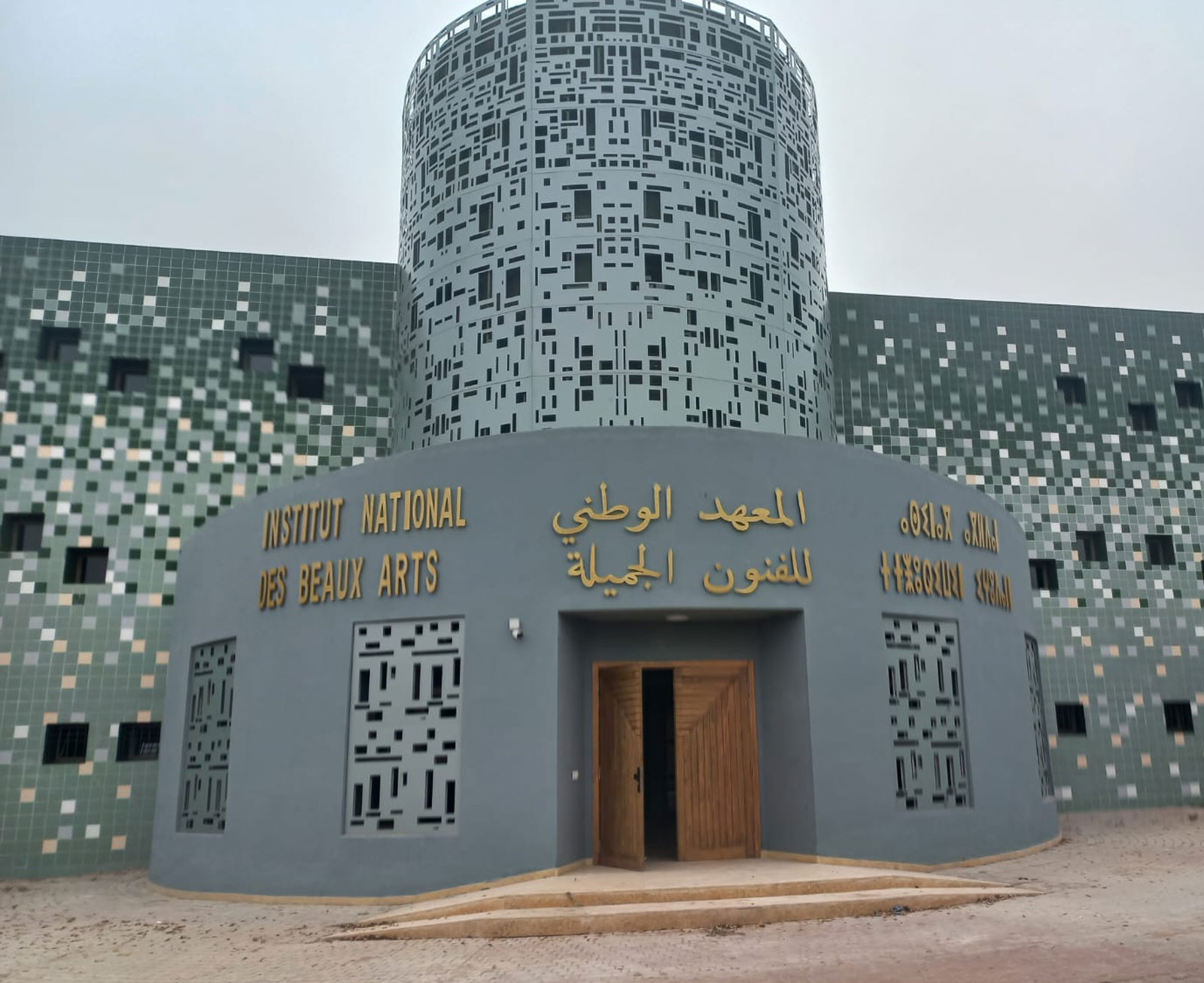
Photo credit: Abdelwahed Imzilen
The new Agadir Institute of Fine Arts certainly has plenty to offer. Located in a former municipal cultural center, in the heart of the university district—home to the faculties of humanities, economics, and sciences, as well as the National School of Architecture—the fully renovated building stands at the entrance to one of the city’s many vast, lush parks.
Located on the outskirts of downtown, the school is situated in a region that remains artistically isolated. Despite the opening of the Agadir Art Museum in 2023, the city has neither an independent art center nor any galleries—a fact lamented by Abdelwahed Imzilen, director of the branch, and artist-teachers Abderrahim Nidalha and Ismaïl Ahendouz, all three of whom are graduates of the INBA in Tetouan.
Training Teachers
The school offers three bachelor’s degree programs, accredited by the higher education authorities, covering three specializations: Design and Society, Visual Narrative Arts, and Visual Arts. After a first year of core courses, students choose a specialization and receive a combination of theoretical and practical instruction. Workshops in painting, academic drawing, and sculpture are complemented by several modules focused on sociology, aesthetics, and the philosophy of art. “In the first year, the most important thing is to start by learning academic techniques,” emphasizes Abdelwahed Imzilen. “At the same time, students must reach a stage where they deconstruct and move beyond these rules. We don’t want everyone to fit into a single mold.”
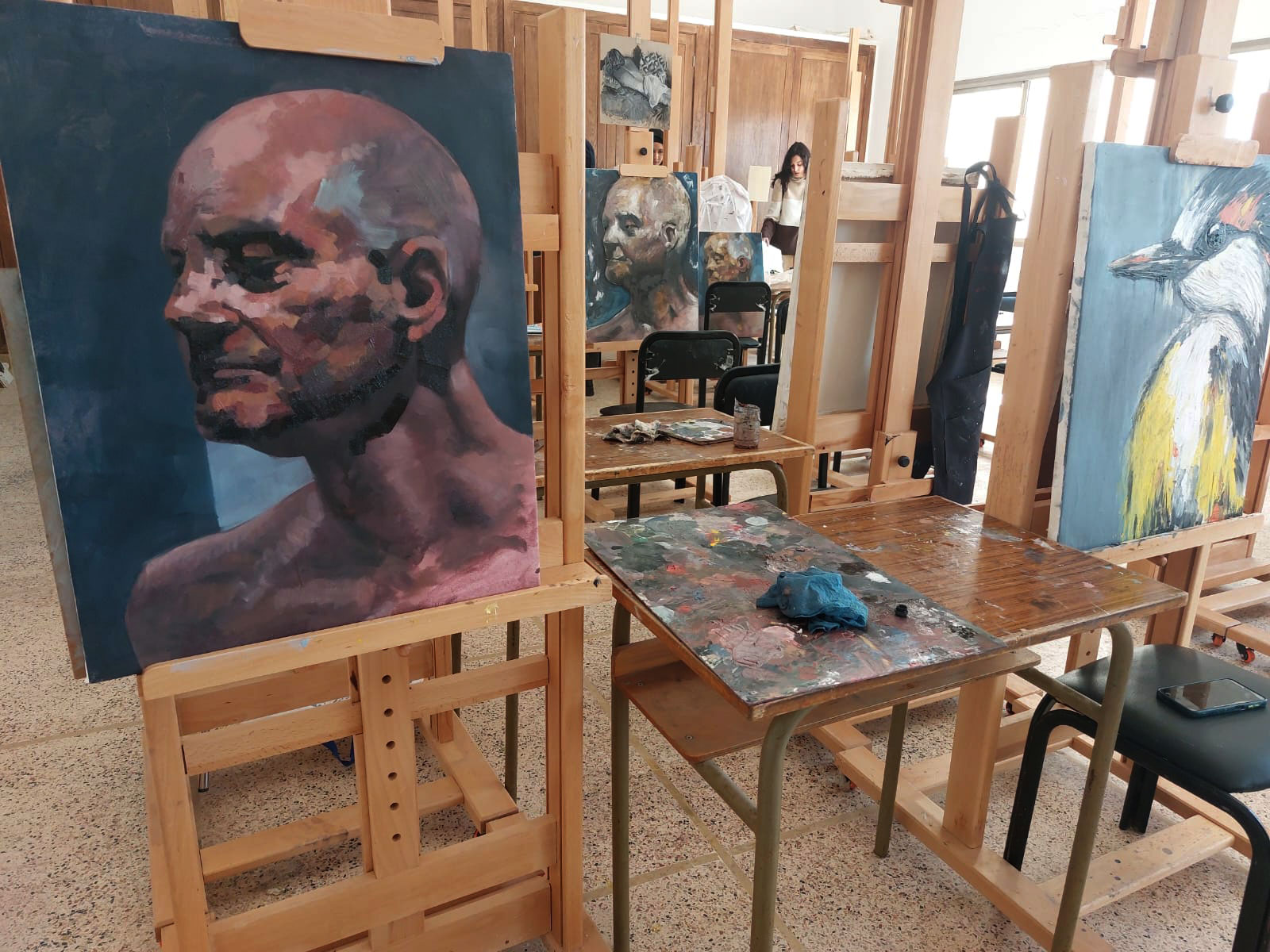
INBA, painting workshop, Agadir. Photo credit: Abdelwahed Imzilen
While classes are taught in Darija, French, or English to best prepare future graduates for careers with international opportunities, faculty members like to remind students of their local roots, which they are constantly encouraged to draw upon. “We need to encourage them to embrace their cultural heritage as a foundation for creativity,” acknowledges Abderrahim Nidalha. “Rather than falling into the trap of imitating international artistic trends, they must learn to translate their Moroccan roots into a universal contemporary artistic language.” “For artists, Agadir is already a studio in itself and a place of creation,” adds the school’s director.
Until it gains administrative autonomy, the school still faces several challenges, including building a better-stocked library and strengthening teacher training, even as the Teacher Training Centers have closed their doors and visual arts and music education have been eliminated from secondary schools since 2011. “While the current ecosystem seems to have been built primarily around the art market, leaving arts education behind, the training of artists in Morocco can no longer lag behind,” notes Abderrahim Nidalha. “The question that arises today remains: how can we revitalize training at the INBA to ensure that graduates are up to the challenge of the art market’s effervescence—and not the art of the market?”
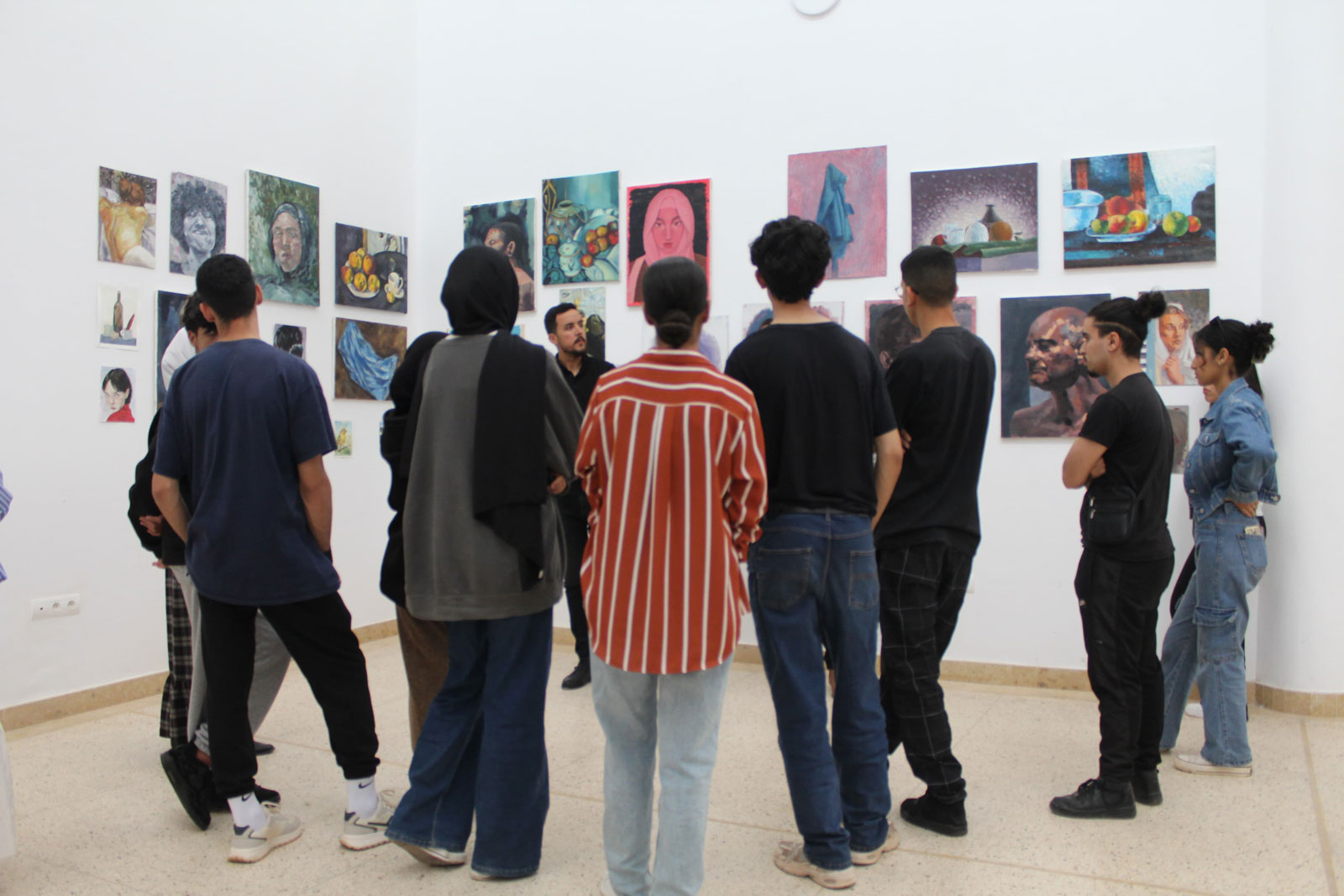
INBA, Agadir. Photo credit: Abdelwahed Imzilen
What Do Young Artists Dream Of?
As for the first graduating class in visual arts, which just received its degrees in June, the focus seems less on imparting disciplinary expertise than on exposing students to the diversity of contemporary practices. Guided by a team of 26 faculty members, they are encouraged to view painting, sculpture, and performance as fluid, interrelated fields. “I try to teach them not to limit themselves to a single medium,” explains Ismaïl Ahendouz, who leads the contemporary painting module. “And to be able to create painting-sculpture or sculpture-performance.” In Abderrahim Nidalha’s class, students reflect on how to reconcile a local cultural foundation with a universal visual language. Hailing from various regions around Agadir (Taroudant, Essaouira, Tiznit, Guelmim, and Marrakech), they approach this reflection drawing on diverse references and experiences.
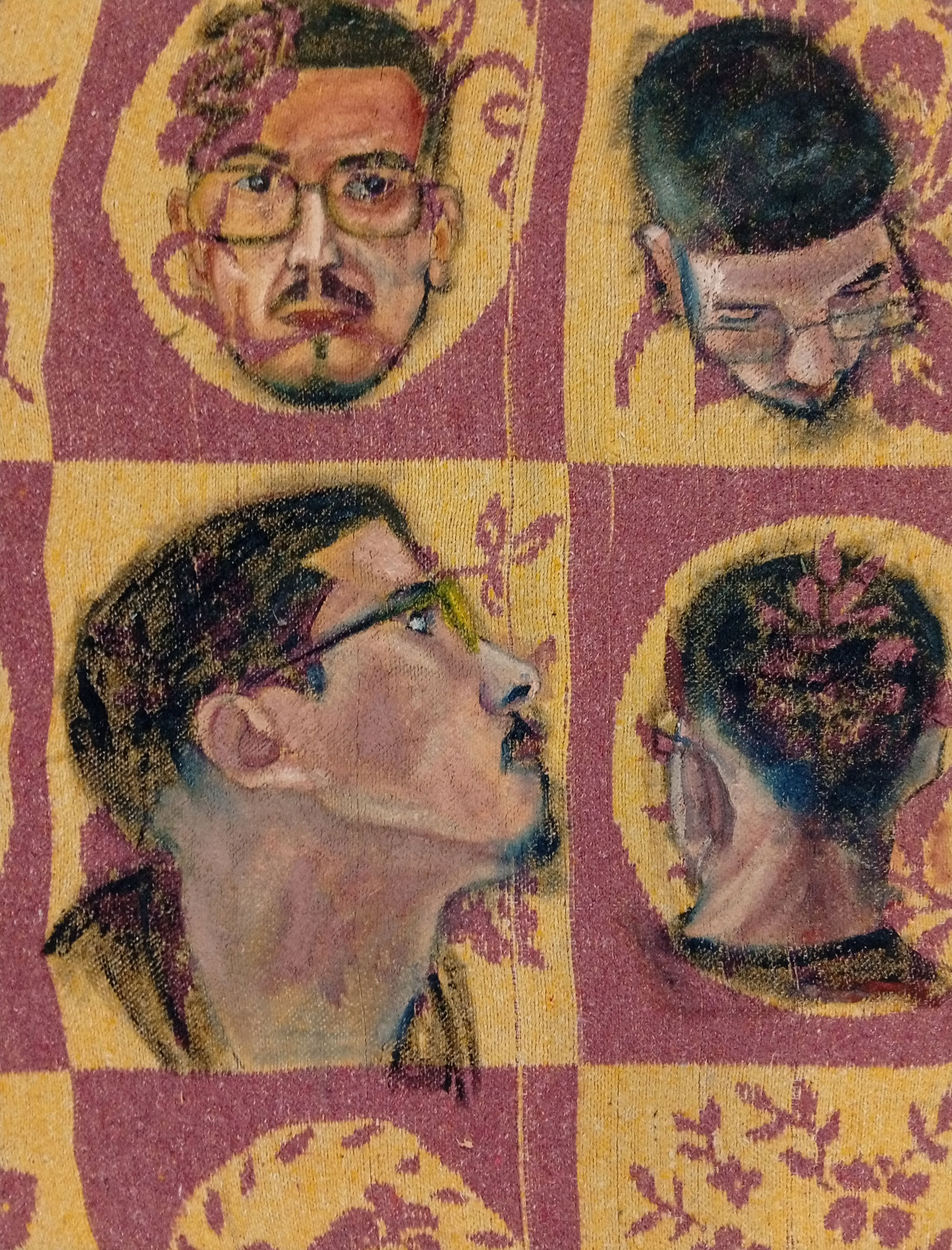
Hamza Zallouly is thus drawn to the theme of ornamentation; he works on a textile surface featuring melancholic self-portraits in which the motifs reveal themselves just as much as they conceal themselves. Hamza Bouzanbou, fascinated by the pictorial world of Abbès Saladi, focuses on the motif of the eye and its symbolism, painting scenes of an unsettling surrealist beauty on polystyrene surfaces, whose fragility he explores. These are echoed by the canvases of Hanaa Bahri, inspired by Saladi and Giorgio de Chirico, who seeks to explore—in her own words—a “chromatic bipolarity.” Painting is favored by the majority of students, who also explore its limits and transformative potential. Ilham Oumensour questions the repetition of motifs by using media such as embroidery and plant-based dyes. Focusing her research on the theme of detachment, Asma Fala’s painting—in the tradition of abstract expressionism—explores the potential of charcoal, oil, acrylic, pastel, and watercolor in large, intense formats.
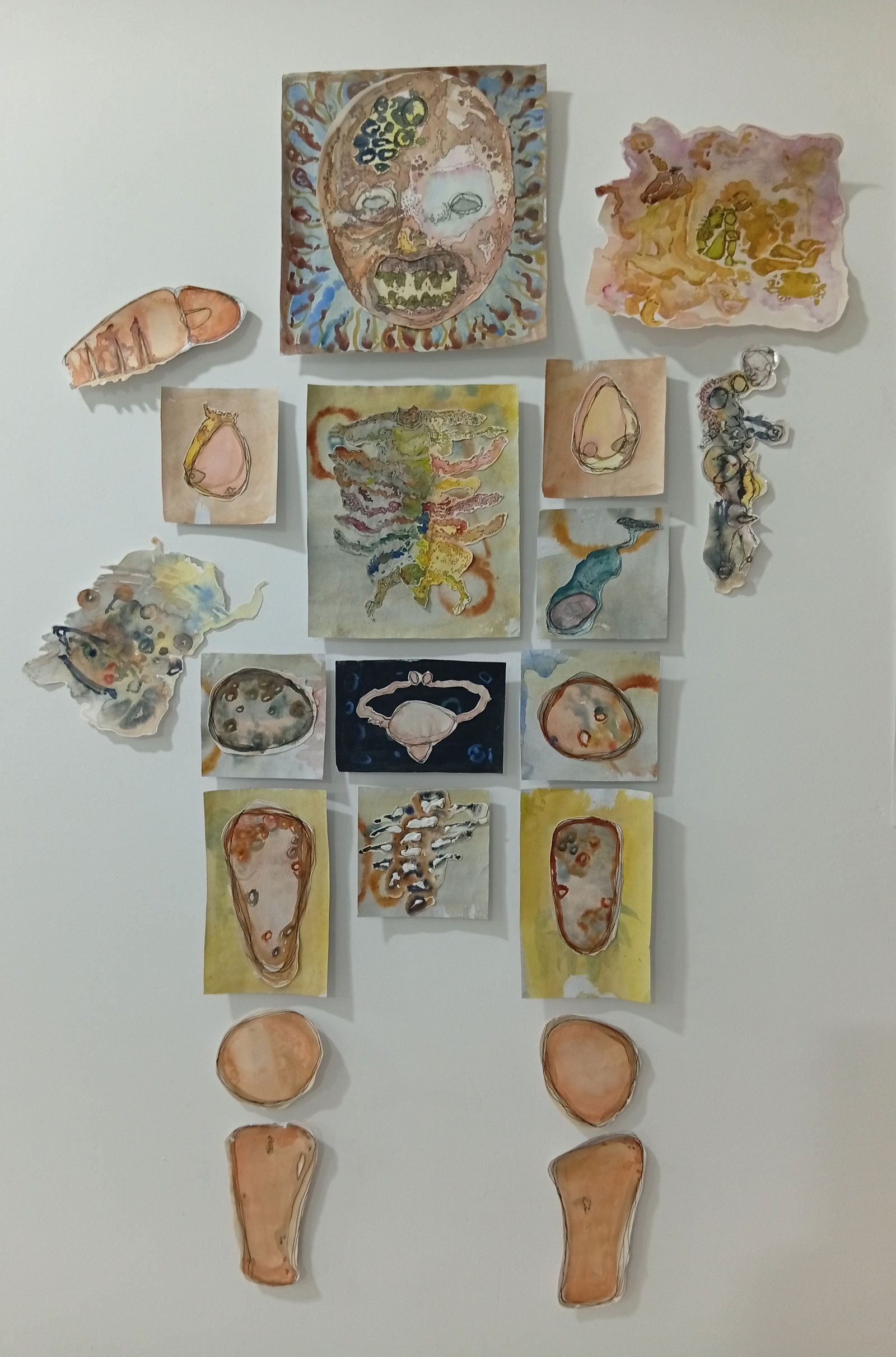
Work by Lina Anajjar, Agadir, April 2026.
Photo credit: Olivier Rachet
A native of Essaouira, Saïd Fahmi focuses his research on the themes of displacement and wandering, in search of a permanent place to call home. An installation of canvases supported by a wooden frame evokes a nomadic tent open to the four winds, within which human figures appear to be struggling against forces one imagines to be cosmic. “Learning to break free from social norms,” adds Asma Fala. For her part, Lina Anajjar explores the theme of disorder by employing a variety of techniques and mediums—ranging from painting to crochet to clay—from which a kaleidoscopic body is reconstituted in a striking installation: is it imagined or endured? Finally, Abdellah Oulachgar explores the notions of borders and boundaries through a masterful body of work centered on the fragmentation of motifs and representational frameworks. Clearly, this new generation of artists reminds us that art—and painting in particular—remains, now and always, cosa mentale.
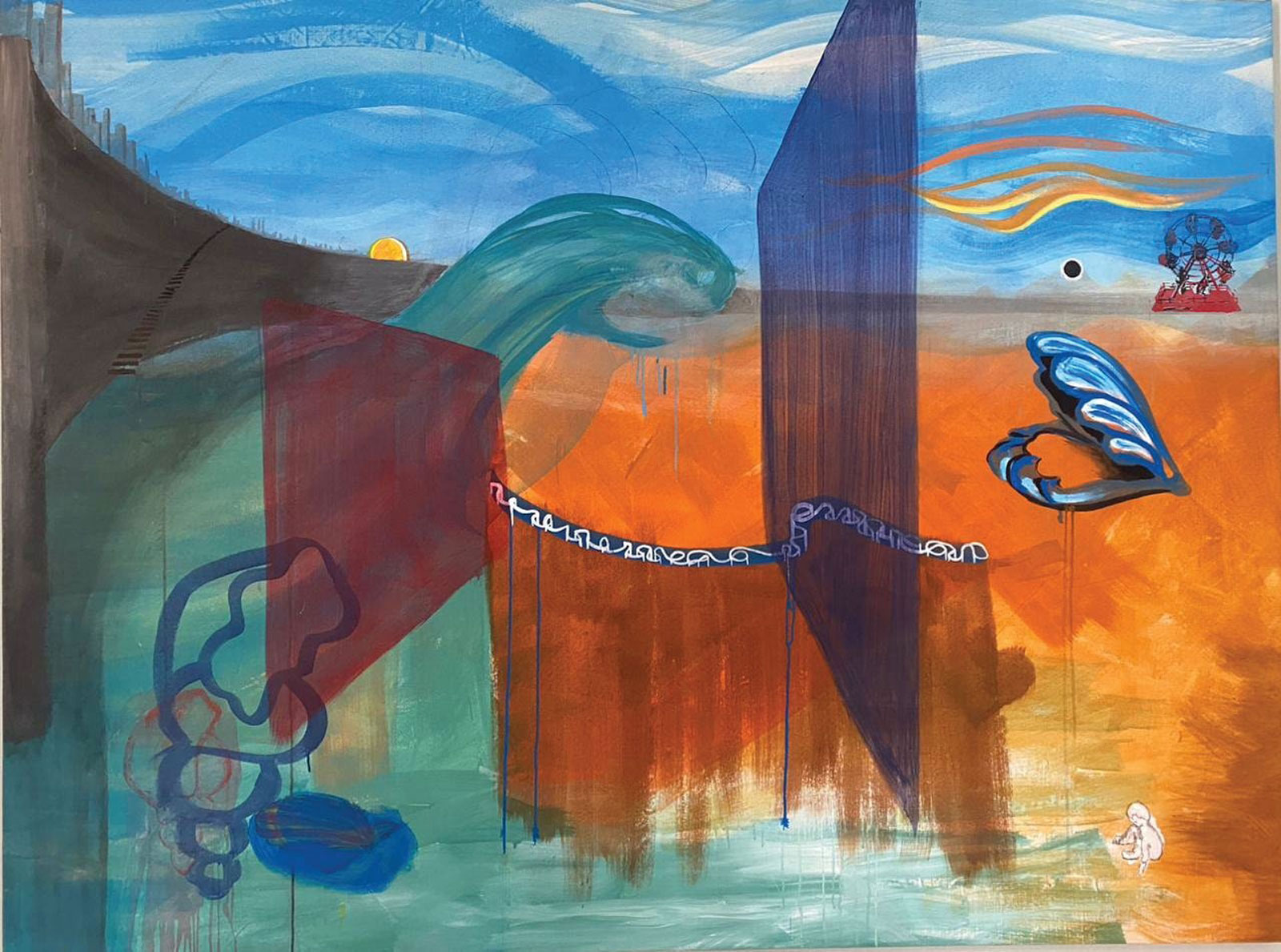
Work by Hanaa Bahri, Agadir. Photo credit: Ismaïl Ahendouz