In contrast to Mediterranean exhibitions that celebrate a shared heritage and dialogue between the two shores, “On the Frontier of Time” invites graduates of the region’s fine arts schools to pool their perspectives to analyze the present, without resorting to fixed representations or clichés.
By Basma Mansour
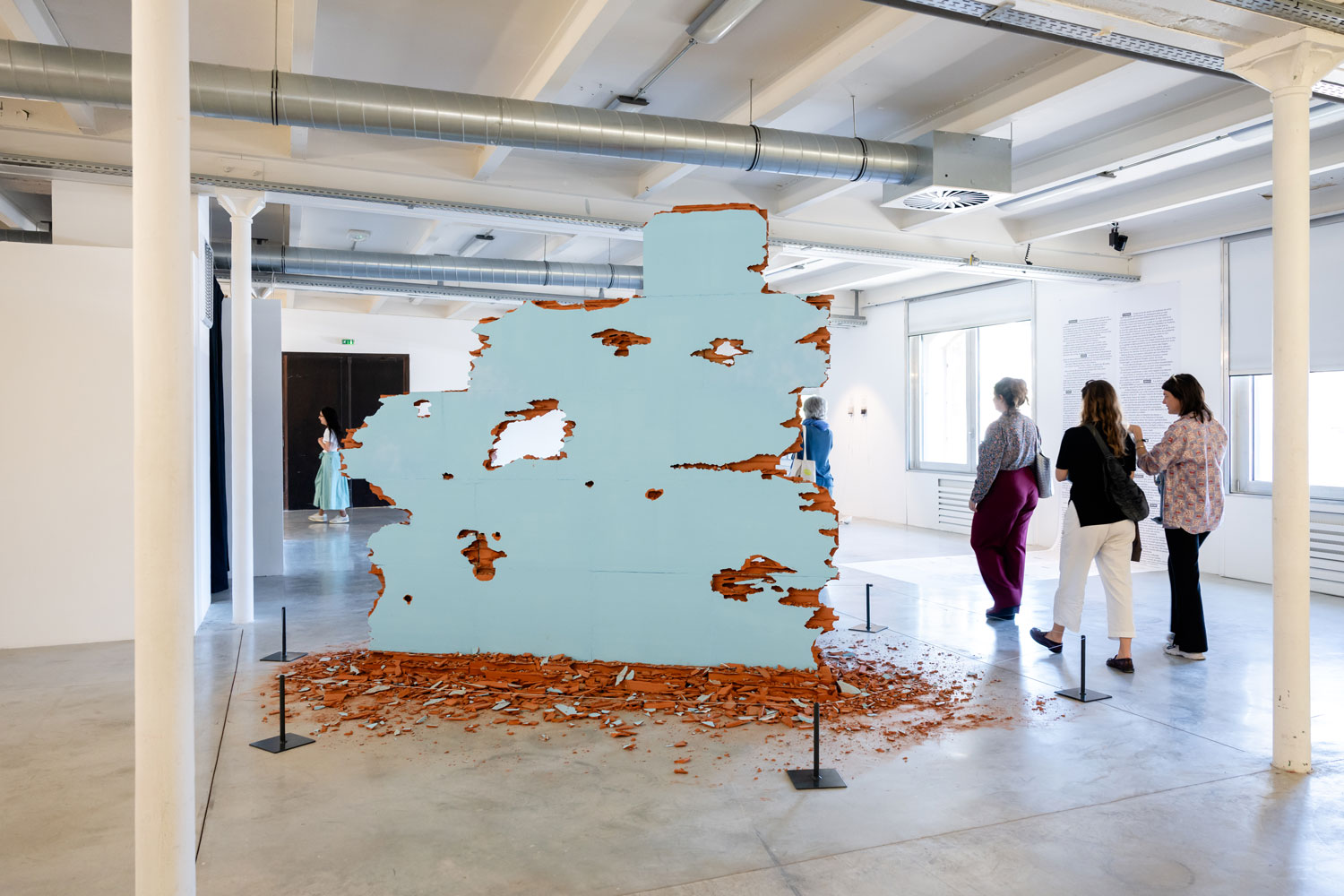
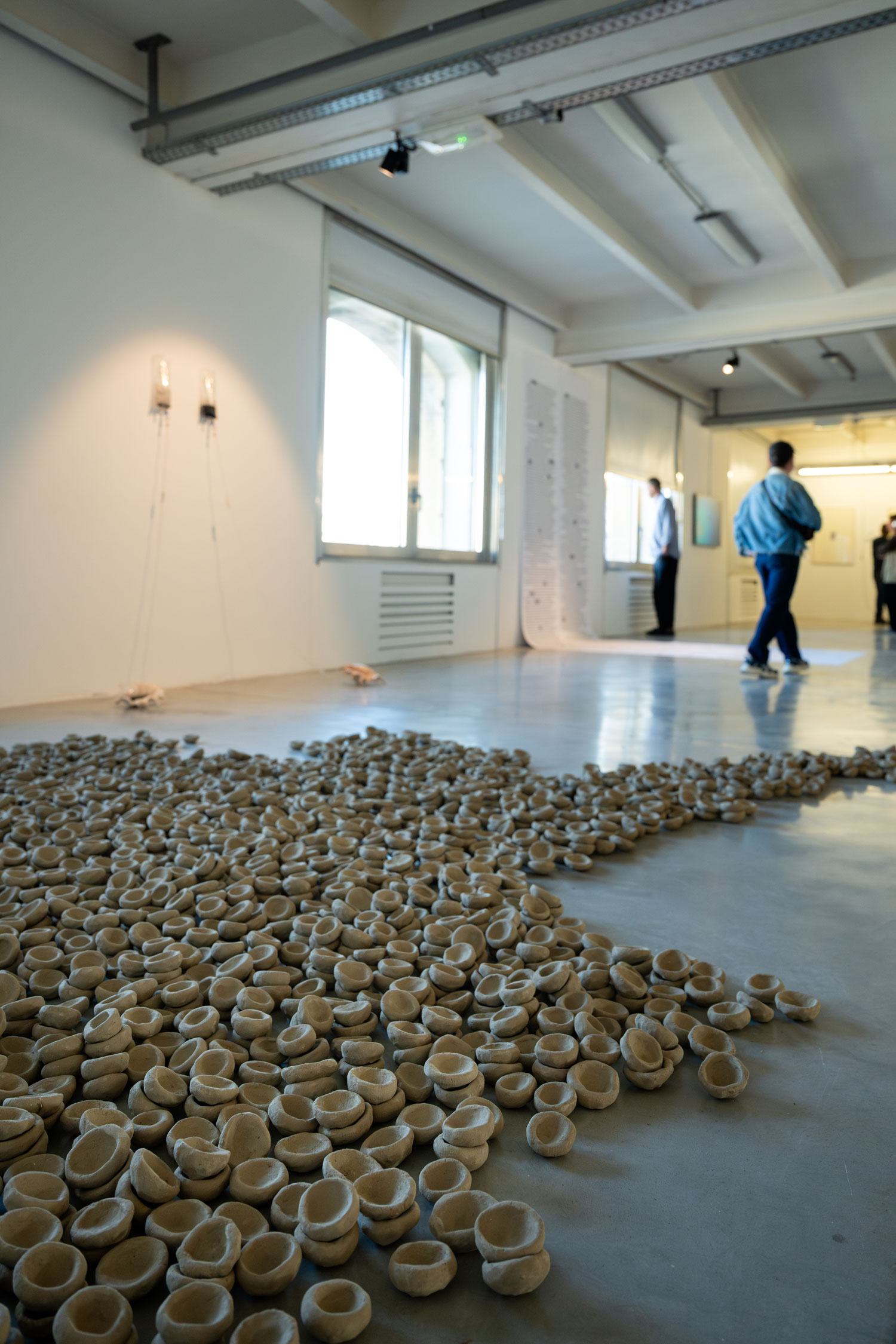
Views from the exhibition “On the Frontier of Time: A New Generation from the Mediterranean” at La Friche La Belle de Mai, Marseille. © Caroline Dutrey
Right from the start, the exhibition’s title sets the tone. “On the Frontier of Time: A New Generation from the Mediterranean” is taken from The Archaeology of Knowledge, in which the philosopher Michel Foucault describes “the edge of time that surrounds our present and marks it in its otherness.” The sentence concludes with “that which, outside of us, defines our boundaries.” It is here that Foucault moves from archaeology to an ontology of the present, to diagnose what we are. Choosing this phrase as the title for a Mediterranean exhibition, therefore, is not about invoking a heritage-based memory or initiating a soothing civilizational dialogue between two shores. The Mediterranean is not the subject, but the perspective, the vantage point from which this diagnosis is written in 2026—from shores scarred by multiple forms of colonialism, where violence accumulates day after day, and where art schools have trained a generation that no longer believes in inherited borders.
Questioning History
Curator Soukaina Aboulaoula brought together sixteen award winners from these schools in Tetouan, Algiers, Beirut, and the south of France. She advocates for “an approach based on encounters rather than groupings” and refuses “to assign works to their country of origin.” For while grouping is the classic institutional practice of classifying artists by country and presenting them as representatives of their national art scenes, encounter, on the other hand, presupposes that there is no fixed identity to represent, because everyone is already living in this in-between space marked by the passage of time. The exhibition thus rejects the role of a showcase to become a space where we examine, together, the same question: what defines us, at this moment, on this sea?
The answer is evident in the room, and it doesn’t come in the form of the expected imagery. No Mediterranean allegories, no shared symbols, no poetry of olive trees or harbors. Rather, what emerges is the unease of decaying matter, of a memory slipping away, of a colonial narrative that has not yet finished settling into the present. Amir Youssef makes this the heart of his film Apoléon. At the Musée de l’Armée des Invalides, he comes across a diorama of the Egyptian campaign, featuring figurines “frozen in display cases.” Who decided that history ended there, behind glass? In the film, Napoleon’s soldiers speak Egyptian Arabic, and when asked about the source of their story, they reply: “Wikipedia.” “I wanted people to doubt history, to doubt it even more,” he summarizes. The diorama, which we believe has been turned into a museum piece, continues to shape the perspective through which Europe tells its story of the Mediterranean.
Oumayma Abouzid Souali reflects on the chemical bombings carried out by the Spanish army in the Rif region between 1921 and 1926, which targeted crops, water sources, and the soil. Official records of this episode remain scarce. To make it tangible, the artist draws with incense. The smoke leaves a trail; the work takes shape as it burns, and the resulting map—composed of scents and the act of burning—forges a connection between northern Morocco and southern France through the memory of a violence about which the archives say almost nothing. She links this work to Abdelkrim El Khattabi’s exile in Réunion (1926–1947), where the Rifian leader grew geranium flowers to make a living. The transition from a world of toxic gases to a world of perfumes serves here as a diagnosis of the same colonial body that extended from one geography to another.
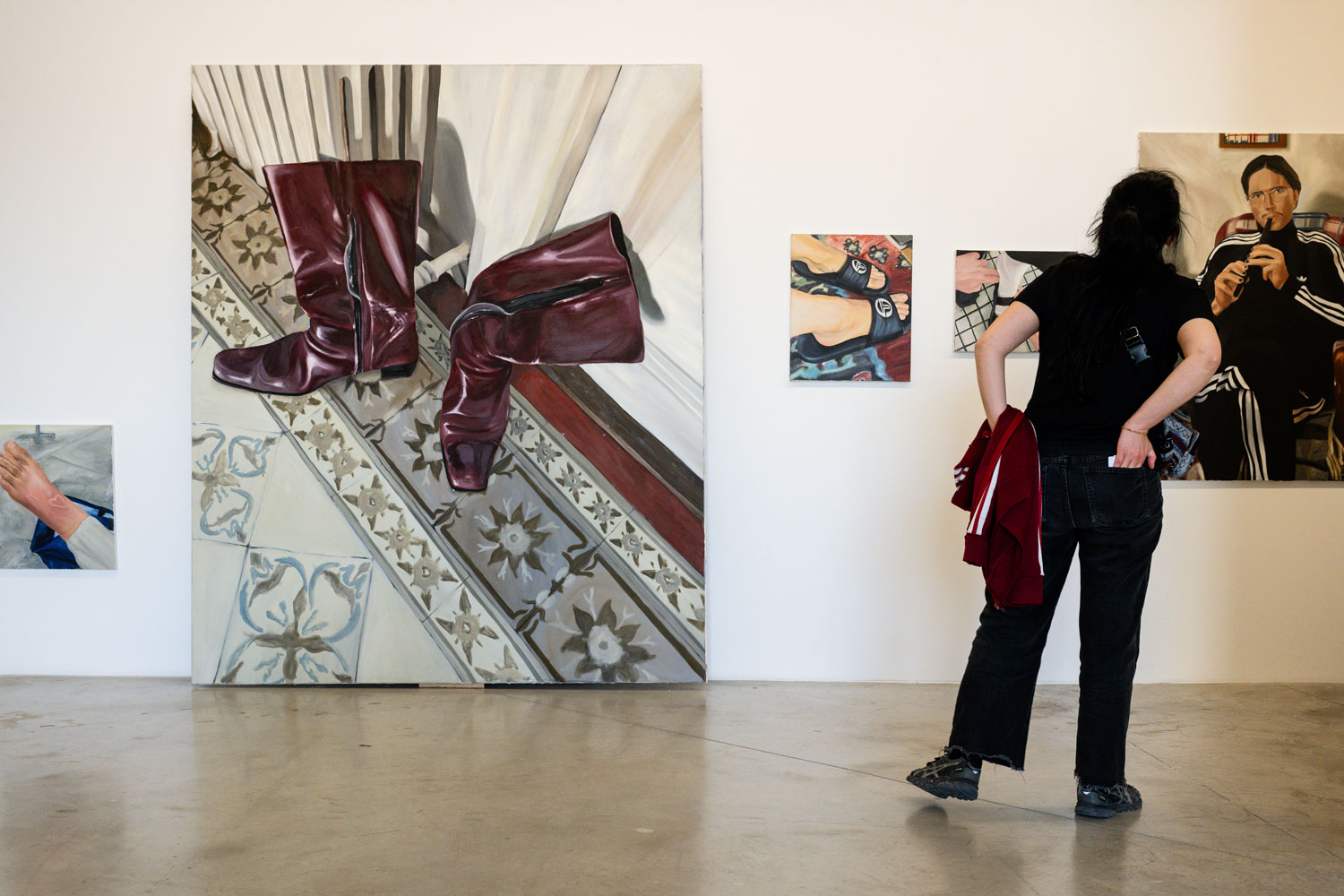
Views from the exhibition “On the Frontier of Time: A New Generation from the Mediterranean” at La Friche La Belle de Mai, Marseille. © Caroline Dutrey
What Defines Us
Mounia Bouchra extends this concern by applying it to herself. Her installation Passages is based on interviews conducted with people from the Maghreb living in the south of France, focusing on a single detail: the object one takes with them when crossing over. A clay cup, a scent, a material. Bouchra reinterprets them in ceramic, scaling them up to near-monumental proportions, yet without erasing her unease: “Questions arise about the legitimacy of working from narratives or archives that are not our own.” This scruple remains visible in the work. It is itself a diagnosis of the present: we, artists trained on both sides of the sea, by what right, by what legitimacy, do we speak of others?
Anouch Basbous shares this sense of vertigo. Her video Flood, shot in a cemetery on the outskirts of Beirut, shows dark water gradually covering the graves, blurring the plants and the engraved names, “water whose source I do not know.” Basbous gives up on fixing it: “we don’t have time,” the violence of the present prevents mourning. She prefers to remain with the unease. Hence her phrase, “a dance of death with one’s own archives,” and the phrase she borrows from the Palestinian thinker Walid Daqqa, who died in an Israeli prison: “I don’t want to go back to the Palestine of the past […]. I want to return to the Palestine of tomorrow.” The past ceases to be a place to return to and becomes a reservoir that we tap into for the future.
One lingering doubt remains, one that must be articulated. The exhibition remains highly accessible to the European institutional eye, and this may be the limitation imposed on it by its own Foucauldian ambition. Diagnosing the present is a sophisticated, elegant philosophical project, clearly articulated within the exhibition spaces. The rawest energy of the scenes the exhibition evokes lies elsewhere—more chaotic, less polished for biennials and artist residencies. The most striking works, in fact, are those where this refinement cracks slightly. Youssef, because he laughs at the museum exhibiting him. Basbous, because she says, in four words, that there will be no consolation.
“On the Frontier of Time,” however, embraces what its competitors still refuse to accept: making a Mediterranean exhibition not a celebration, not a dialogue, not a showcase, but an optical instrument. If the past is what, outside of us, defines our boundaries, then viewing these sixteen works together is an attempt to see what shapes us—here, in 2026—on both sides of this sea. It is a rare demand. And it is, without a doubt, the only honest way to continue speaking about a Mediterranean scene without betraying it.
— Group exhibition “On the Frontier of Time,” as part of the 2026 Mediterranean Season, La Friche La Belle de Mai, Marseille, through August 9, 2026.