Collector Rodolphe Blavy creates a dialogue between contemporary African art and the heritage of a village in Touraine. This year, the MONUMENT’AFRICA exhibition explores permanence, memory, and movement. It is a unique experience in which sharing a collection takes on its full meaning.
Certain experiences remind us why, after so many years spent mingling with artists, visiting exhibitions, museums, and art fairs, we can still be deeply moved by an encounter with a work of art and a place.
In Saint-Épain, a village in Touraine, Rodolphe Blavy has been on a remarkable journey for the past three years. A high-ranking civil servant and passionate collector of contemporary African art, he decided to move part of his collection out of his home and display it in the heart of the village. In the church, at the town museum, and in a former wooden theater. And, a little further away, in the castle’s stables.
Every year, he comes up with a theme, selects about thirty works, and draws connections between them. He takes the time to reflect on what they might convey together, and what they might contribute to these spaces and to those who visit them. This process of selection, installation, and interpretation is the very essence of curatorial work. It requires an intimate knowledge of the artworks, as well as a curiosity about the history of the buildings that house them.
In the Church of Saint-Épain, a crucified Christ engages in a dialogue with a soaring figure by Ndary Lo. Two presences, two stories, but also two ways of exploring the human condition, suffering, and transcendence. This unexpected encounter invites us to reflect on what religious art might look like in the 21st century. Also in the church, a massive canvas by Aliou Diack lends the baptistery a tangible presence: something flows between the stone, the forms, and the materials, and the space suddenly seems to breathe differently, with an almost esoteric energy. It retains all of its history, yet is revitalized with an unexpected intensity.
Places that are never frozen in history
In the charming little wooden theater, which looks as if it came straight out of the early 20th century, we discover Shadows of Re-Memory (2021), an animated film by South African filmmaker Lebohang Kganye. Using cut-out family photographs, the artist creates a small theater of shadows and silhouettes, whose sets unfold and fold back like the pages of a pop-up book. From the very first scene, two characters part ways: one boards a train and disappears, leaving the other alone. Behind the apparent lightheartedness of this puppet show lies a far darker story—one of death, absence, and the gradual fading of memories. Kganye attempts to hold on to those who have passed away by literally bringing them back to life through animation. It is deeply moving to experience this film in a theater once intended for popular entertainment. The same techniques—paper characters, miniature sets, the illusion of movement—are used here to represent the irreparable. And in this small village theater, the fragility of these silhouettes takes on a particularly poignant dimension.
The present needs the past. But the past also needs the present.
One might wonder what contemporary African art brings to European institutions, their collections, and the way they tell the story of art. Here, the question takes on a more concrete, almost physical dimension. What happens when a work from Senegal, South Africa, or Ghana enters a church in Touraine, a village museum, or a nearly abandoned theater? It brings with it different forms and different experiences of the world. And the place, in turn, offers it a history, an architecture, and a collective memory with which it must engage. This reciprocity is essential.
The Musée de la Prévôté immerses visitors in the intimate atmosphere of the artist’s studio: from Igshaan Adams to Ferdinand Kokou Makouvia, the memory of the material evokes that of history and its scars, ultimately transcending them through the beauty of the artist’s gesture. The works draw the viewer in, in a silence rich with meaning.
There is often talk of the need to circulate art, to make it accessible. It’s almost a recurring theme in political discourse. Here, that ambition becomes a reality: Important works leave the closed world of a private collection to be displayed in places that are part of village life. They can be discovered by visitors who have come specifically to see them, but also by local residents for whom contemporary African art may be a new experience. As part of an ambitious outreach program, dozens of children sit down, draw, and—above all—engage with the works they are discovering.
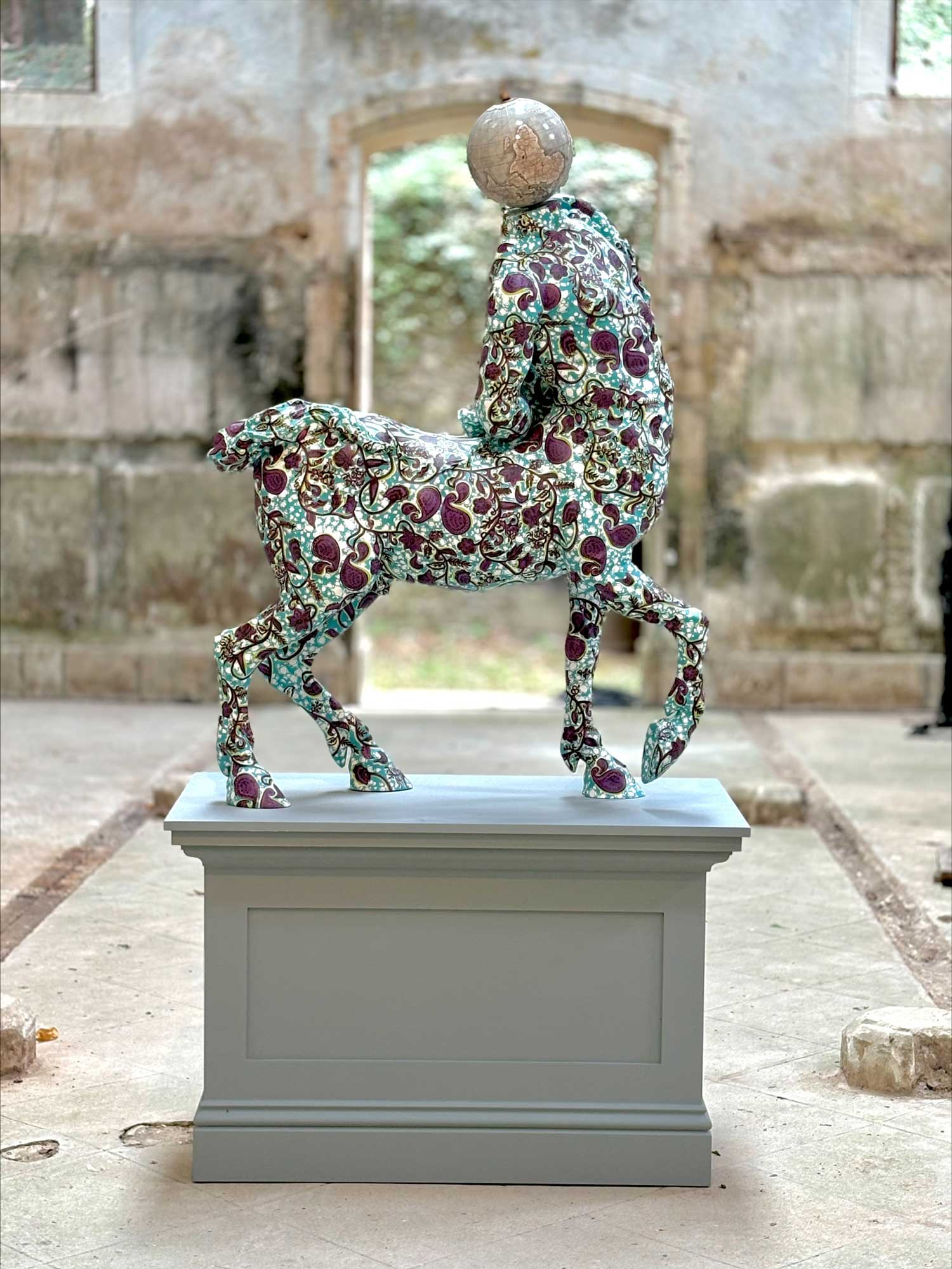
Further on, in the former stables of the Château de Montgoger, the exhibition takes on a whole new dimension. This year, Rodolphe Blavy has chosen to explore the concept of monumentality. MONUMENT’AFRICA – Against Permanence brings together twenty artists and pays tribute to Alexander Calder, fifty years after his death. The connection is clear: Calder liberated sculpture from its immobility, introducing movement, precarious balance, and void. Here, artists from the collection, in turn, explore what defines a monument: its material, its function, its authority, and its ability to stand the test of time.
These include, in particular, *The Furietti Old Centaur* (2018) by Yinka Shonibare. The centaur takes its form from ancient statuary, but its body is covered in colorful wax-print patterns. The British-Nigerian artist thus invokes a classical figure, inherited from the Western imagination, to subvert its conventions and affiliations. By a twist of fate in the curatorial schedule, the day before, in London, one could see at the National Gallery *Mr. and Mrs. Andrews without their Heads* (1998), displayed opposite Thomas Gainsborough’s famous portrait. Two headless mannequins, dressed in wax fabric, reenact the poses of the landowning couple painted around 1750. The critique of class privilege and the relationship between British wealth and colonial history is explicit here, almost literal.
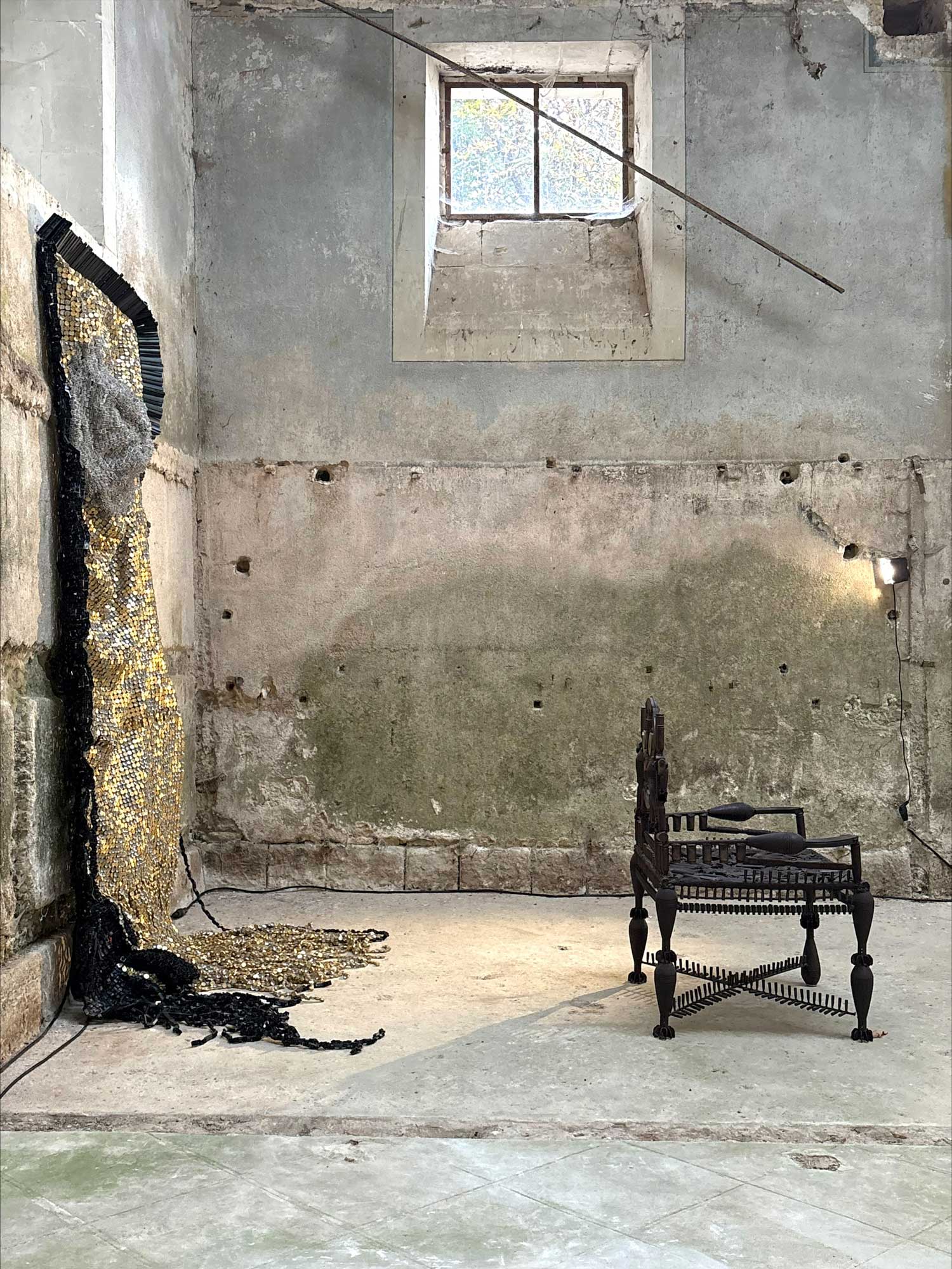
Further on, Gonçalo Mabunda of Mozambique is building with The Throne of the Emperor of Gaza (2018), a seat of power made from decommissioned weapons. The metal parts, once intended to kill, become elements of an almost ceremonial architecture. The throne, a symbol of sovereignty and authority, embodies in its very material the violence of Mozambique’s history. It is a work whose power stems as much from its construction as from the recognition of its components.
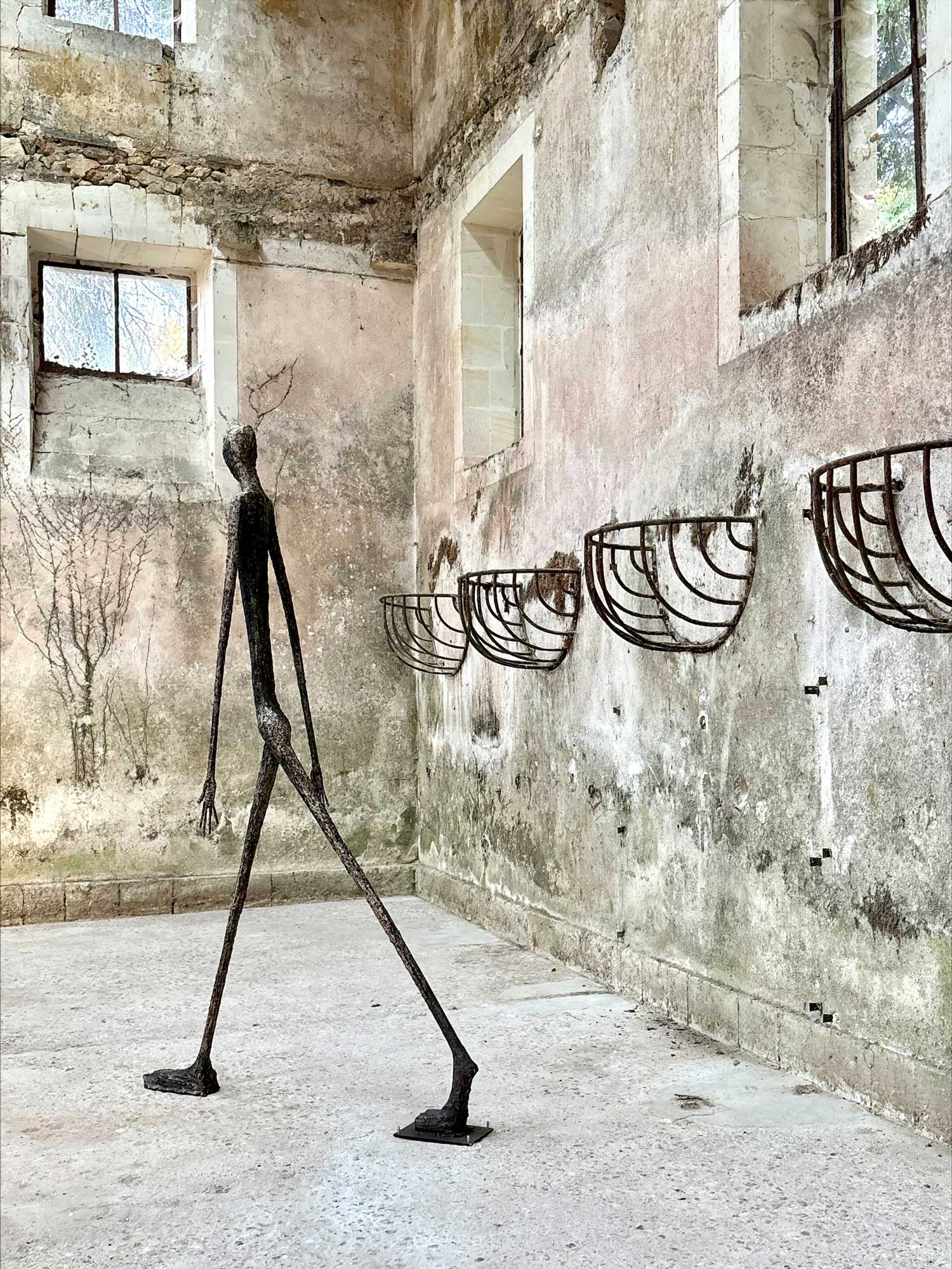
We think back to Ndary Lo. To his figures made of welded rebar—a humble material, a building material—which he manages to make seem almost immaterial. In *Les Envols* (2010), the bodies soar, as if torn from the pull of gravity. We can make out the rebar, the metal rods, and the assembly work, but our gaze is drawn first to the movement. That is the very paradox of this sculpture: to evoke flight in something that is ordinarily used to anchor buildings to the ground. “ In a project dedicated to Calder, this exploration of gravity and lightness naturally finds its place ,” Blavy points out.
Photography adds another dimension to the whole. With Senegalese artist Omar Victor Diop, the portrait becomes a means of examining the representation of Africans throughout history. His practice—based on photographic staging, costume, pose, and references to classical painting—is part of a reflection on visibility, memory, and the power of images. Here, the photograph is a work constructed with as much care as a historical painting. Its presence in this exhibition serves as a reminder that a monument can also take the form of a portrait: an image that restores a presence in the collective memory.
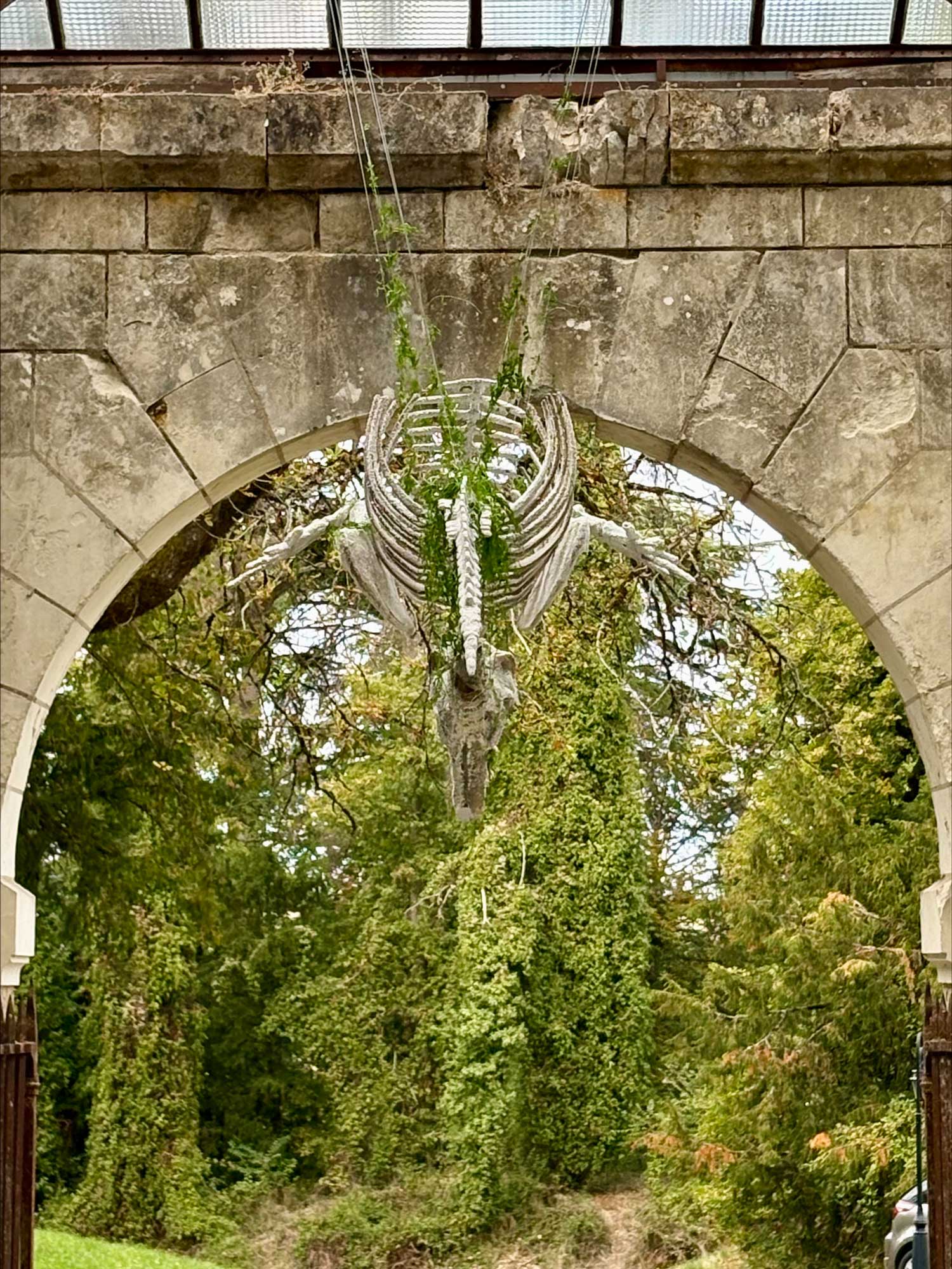
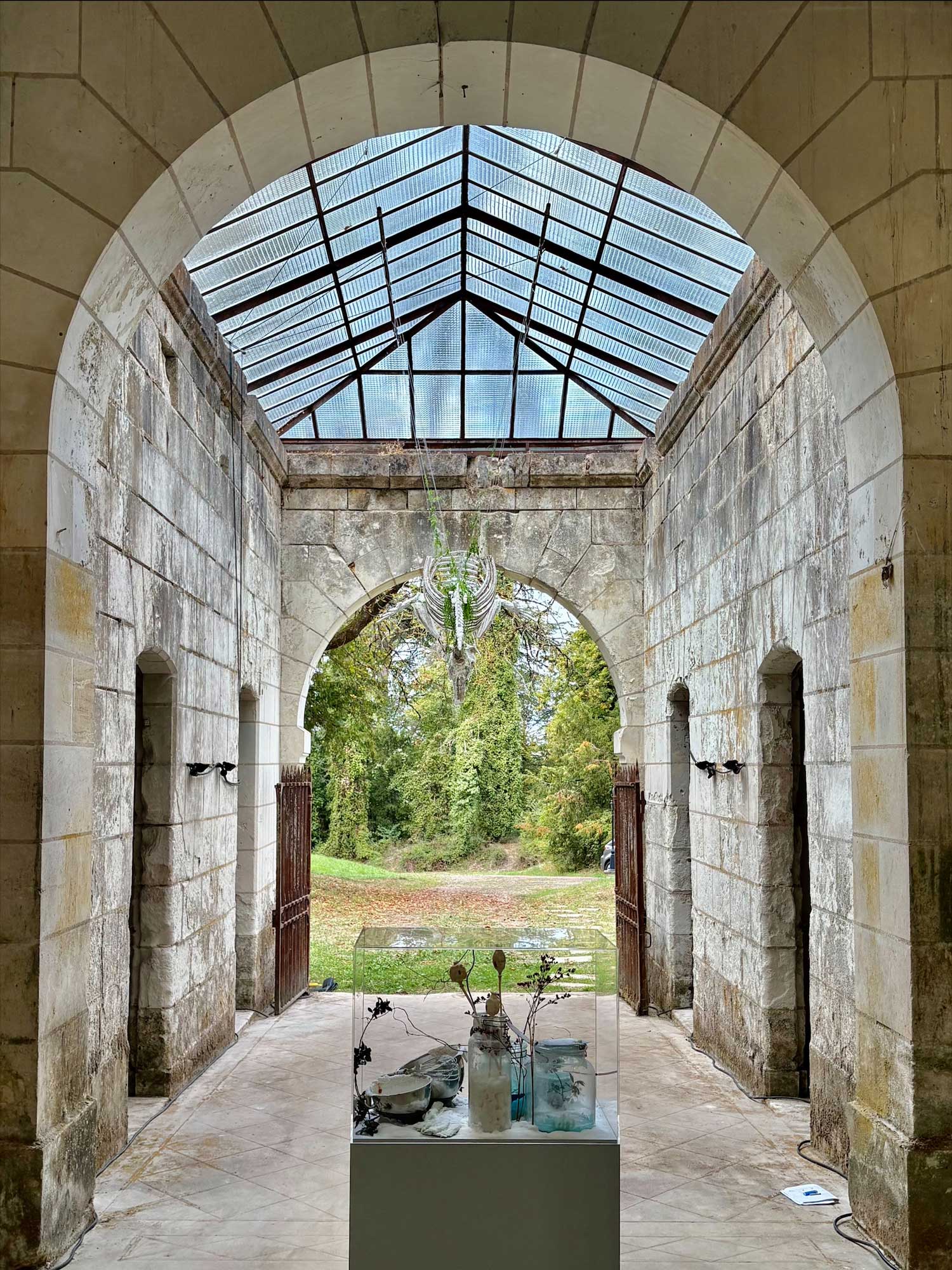
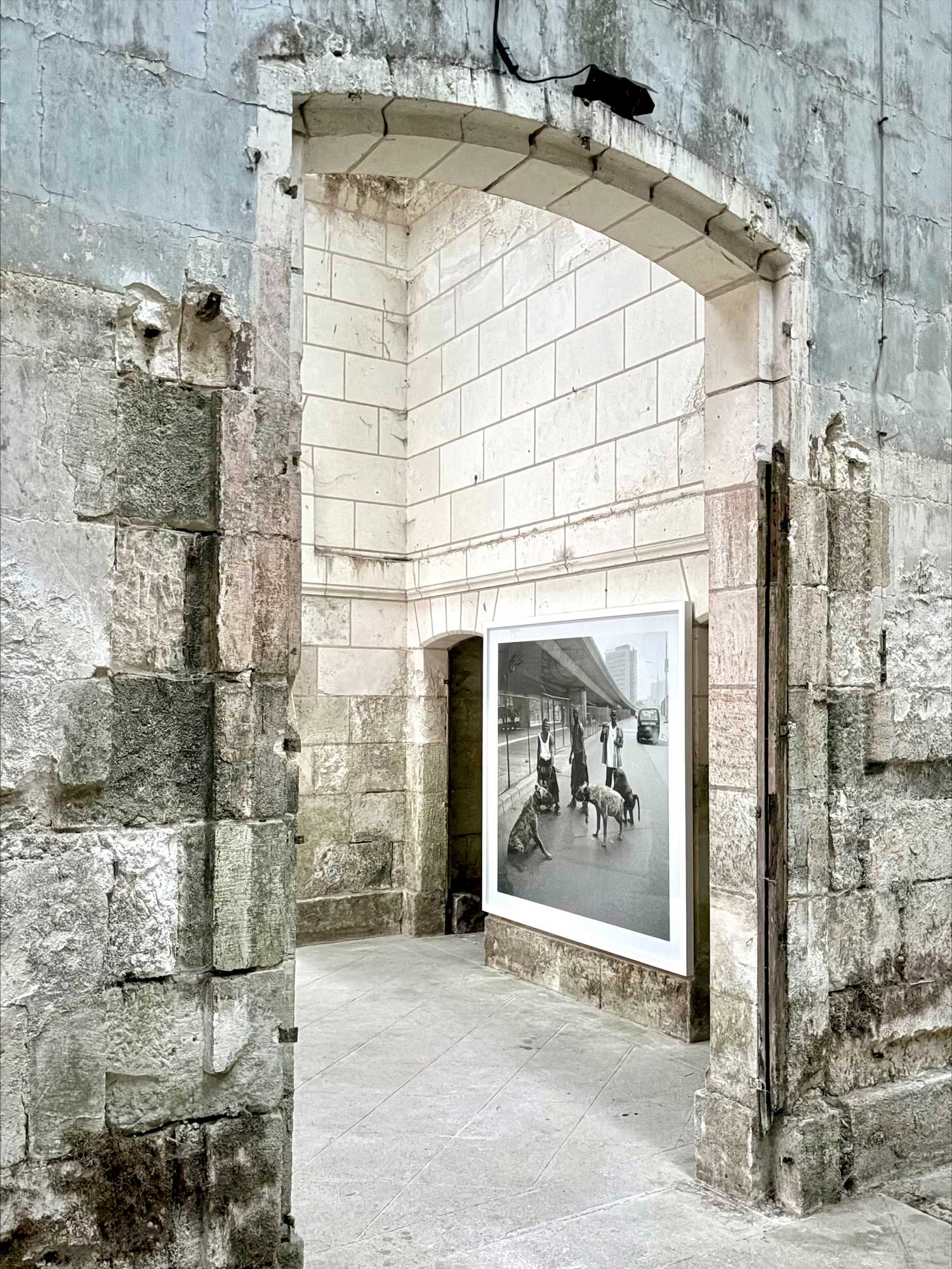
Like a jewel box in the heart of the forest, the old stables have withstood nature’s onslaught. Artist Bianca Bondi, with her suspended dolphin, explores how humans negotiate their place in the world, set against Pieter Hugo’s hyenas (photography), while Alexandre Lenoir displays his landscapes on walls that still bear the streaks left by ivy and the earth’s moisture.
By the end of the tour, one comes to appreciate what it means to bring a collection to life and the vision and passion required for a French village to become—for the duration of an exhibition—a meeting place for artists, works of art, residents, and stories. All of this, in Blavy’s words, stems from this “desire to continue believing in universalism, in the precious bond that unites us.”
MONUMENT’AFRICA – Against Permanence
Margaux and Raphaël Blavy Collection
Saint-Épain and Montgoger Castle, Indre-et-Loire, France
Through the AR(t]CHIPEL program, led by the Centre Pompidou and the Centre-Val de Loire Region.