In 2026, the Abu Dhabi Art fair became Frieze Abu Dhabi, thanks to a partnership between the emirate and the British group. More than just a name change, this transformation integrates the fair into Frieze’s international network. With a mix of major international players and regional galleries, this inaugural edition is shaping a new artistic landscape.
By Malak Yacoubi
Far from the instability that was palpable a few months ago at Art Dubai, a spirit of celebration and success now permeates the Emirati capital. Dressed in its finest for the celebration of the Union’s 55th anniversary on December 2, the city has just opened the Zayed National Museum. Yet another impressive architectural “statement” (by architect Sir Norman Foster) on Saadiyat Island, it traces the life of the nation’s founding sheikh, “Baba Zayed.” The Zayed National Museum also houses a collection of “1,200 to 1,500 works of modern and contemporary art,” according to Sanaz Askari, the collection’s acquisitions manager, based on the ongoing inventory—not to mention the thousands of collectible items and Orientalist paintings.
A Shift in Scale
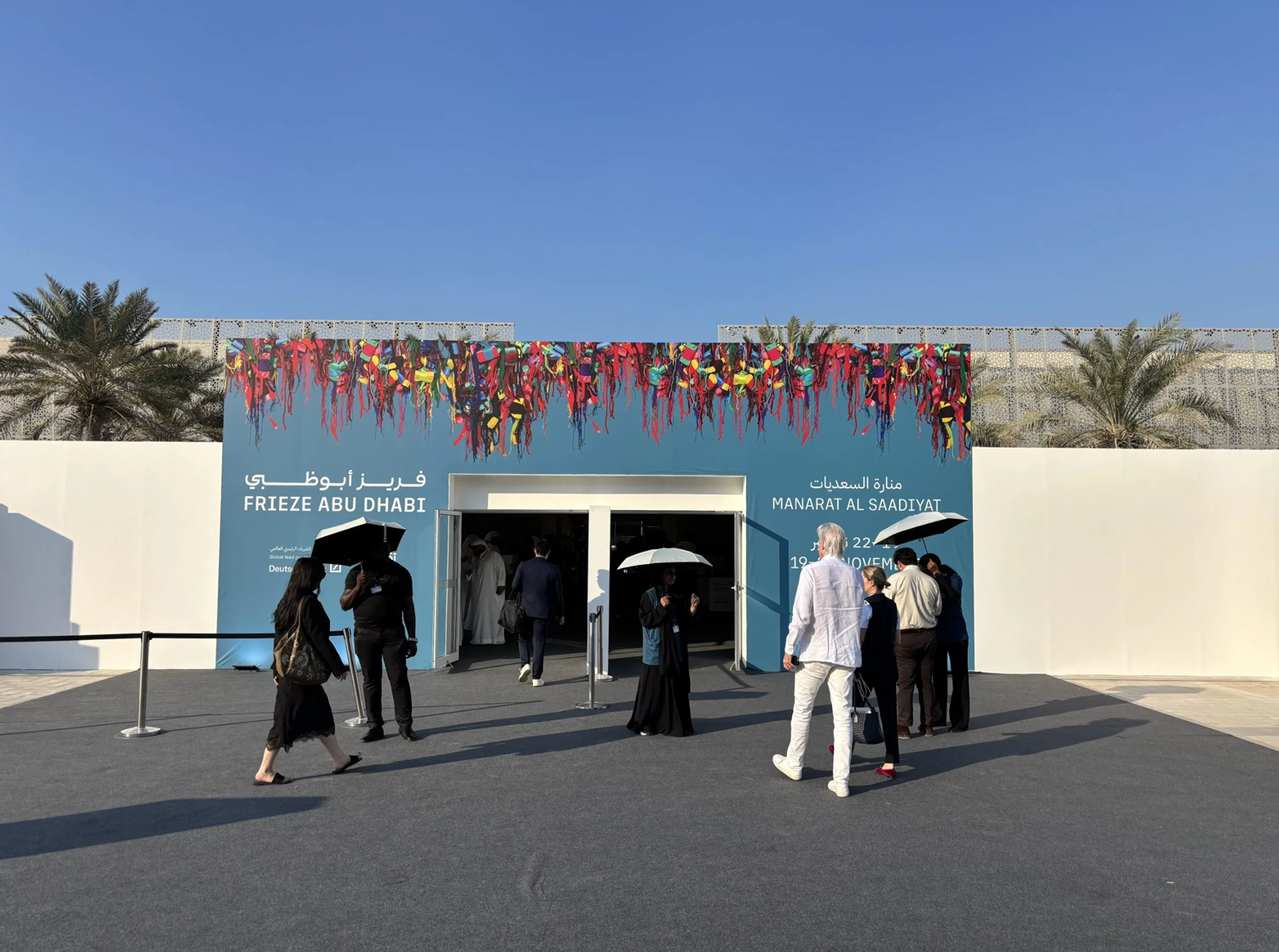
After years of methodically and boldly building a cultural strategy, Frieze serves as the crowning achievement. There is no longer any doubt: Abu Dhabi has risen to the rank of an international cultural capital. “ That says it all ”, says Simon Fox, CEO of Frieze, pointing to Saadiyat Island, where the silhouette of the highly anticipated Guggenheim looms in the distance. Frieze seems to have succeeded in bringing its expertise without diluting the fair’s roots in this ecosystem. Does the world really need yet another art fair? That’s the question people have been asking since the opening of Art Basel Qatar. “ No, explains Simon Fox, This isn’t an addition, but we’re building on a foundation that’s already in place “. The Abu Dhabi Art team has indeed remained intact, led by Dyala Nusseibeh, who has served as director of the Abu Dhabi art fair for the past 10 years. And the fair continues to be held at its historic venue, Manarat Al Saadiyat.
Right from the entrance, there’s a noticeable improvement in quality compared to previous editions. The booths are larger, and the flow of visitors is better organized. The selection process was more rigorous: the committee was very selective about the works and chose only a small number of galleries (89, compared to 142 last year). “Frieze provided its selection process,” explains Dyala Nusseibeh, “but the committee is largely made up of regional gallery owners.”
Sales Bring Recognition to Regional Artists
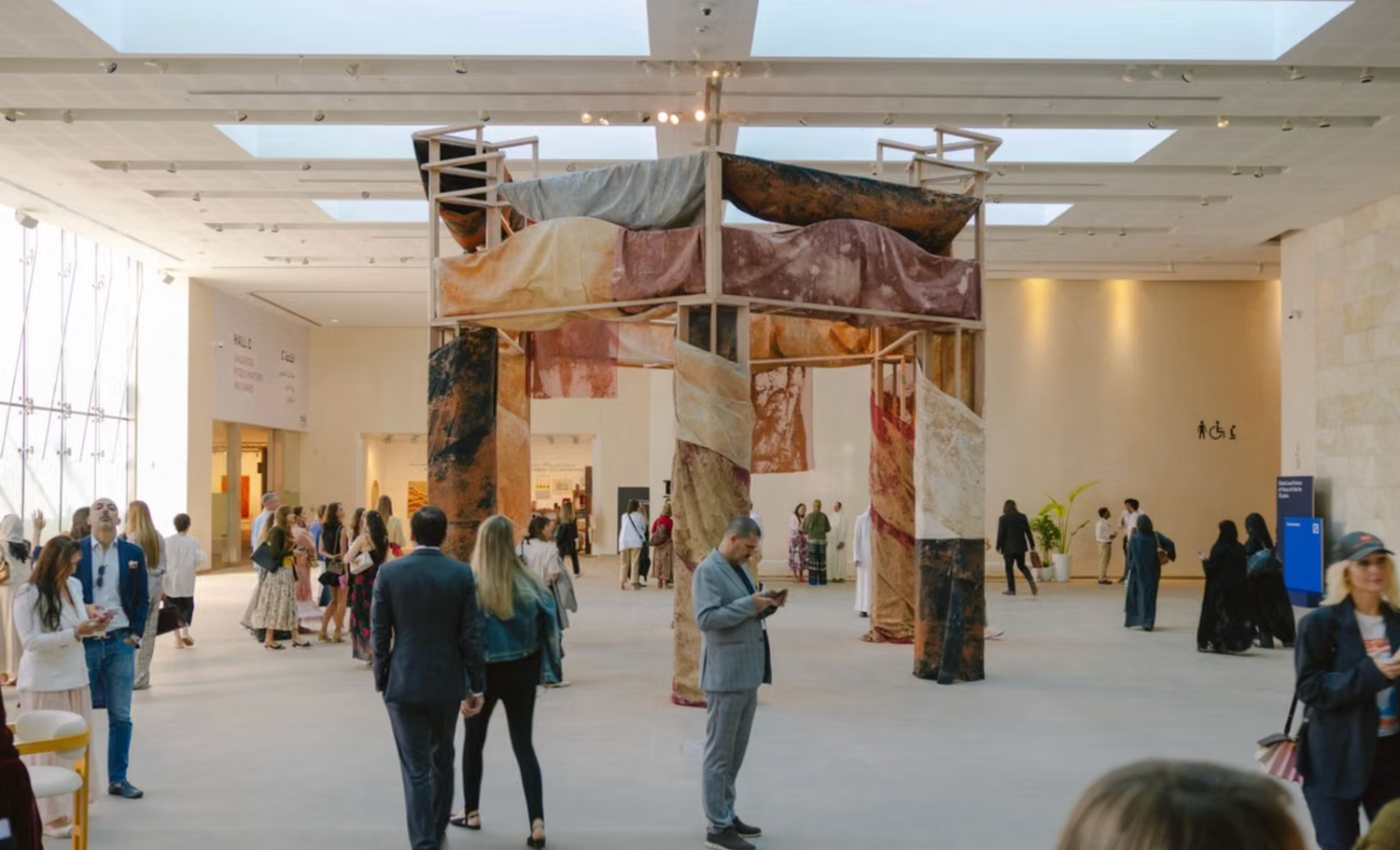
They have resolutely put Emirati artists in the spotlight. “In Dialogue,” curated by the local curatorial lab Dirwaza, spotlights Mohammed Kazem and Alia Zaal. At the entrance to the fair is “Slippers,” a work by conceptual artist Hassan Sharif. Frieze Sculpture features, among others, a work by the indispensable Mohammad Ahmed Ibrahim and one by Zeinab Alhashemi. “The arrival of Frieze will help galleries sell artists from the region at the right price, as most of them are still undervalued .” ,” explains Dyala Nusseibeh. And it’s a success: galleries in the region are posting some of the best sales. ArtTalks | Kanafani Gallery (Cairo) nearly sold out its solo show featuring Egyptian modernist Samir Rafi (including one work acquired by the Barjeel Foundation). Lawrie Shabibi (Dubai) sold all of Hamra Abbas’s works on its booth. The Dubai-based Aisha Alabbar Gallery sold five works by Abdullah Al Saadi, marking the Emirati artist’s very first sales in a commercial setting. Iris Projects (Abu Dhabi) sold out: a sculpture by Shamsa Al Omaira went for $32,000 to a new Emirati foundation, two ceramics by Eman Al Hashemi for $17,000 and $15,000, and a photograph by Ammar Al Attar for $12,500. Efie Gallery (Dubai) brings together three major names: Abdoulaye Konaté from Mali, El Anatsui from Ghana, and Maria Magdalena Campos-Pons from Cuba. The gallery is selling one work by Konaté and has another on reserve, with prices ranging from $45,000 to $65,000, while two pieces by Campos-Pons are on reserve. In the Global Futures section, Taymour Grahne Projects (Dubai) is presenting a solo show by Jordanian artist Ala Younis, whose mosaics depict iconic buildings of Abu Dhabi’s modernist architecture. The entire booth sold out on opening day.
Appealing to Emirati Collectors
On the exhibition floors, the Moroccan art scene holds its own. Loft Art Gallery presents a mother-daughter dialogue between Malika and Amina Agueznay, and sold a piece by Amina Agueznay on the very first day for 48,000 euros (approximately $52,700). The Tunisian gallery Le Violon Bleu, for its part, is giving pride of place to modern Moroccan artists, with works by Hassan El Glaoui priced around $60,000 and those by Farid Belkahia reaching up to $300,000. International galleries are not to be outdone. The Parisian gallery frank elbaz sold two large textile works by Sheila Hicks to private collections in the region for $350,000 and $70,000.
Finally, the fair was designed to appeal to the local audience. The Masters section, highly anticipated due to the prestige of London’s Frieze Masters, is presented here on a smaller scale. It features a selection curated by Marika Sardar centered on the Indian Ocean as a space for exchange, echoing the current exhibition at the Louvre Abu Dhabi, “ : Spices and Wonders: Journeys in the Indian Ocean.” It is aimed at Emirati families who have been collecting art for generations. Pace Gallery (New York) reports that it brought a solo show by Emily Kam Knwarray, a painter from the Australian desert, on the recommendation of Dyala Nusseibeh, who knew it would appeal to local collectors.
Amid all this excitement, the war in Iran is absent from conversations and has not disrupted the festivities’ schedule. Abu Dhabi is on track to fulfill its destiny as a global cultural capital, and this war appears to be a fly in the ointment.
– Frieze Abu Dhabi 2026, Manarat Al Saadiyat, United Arab Emirates, November 19–22, 2026