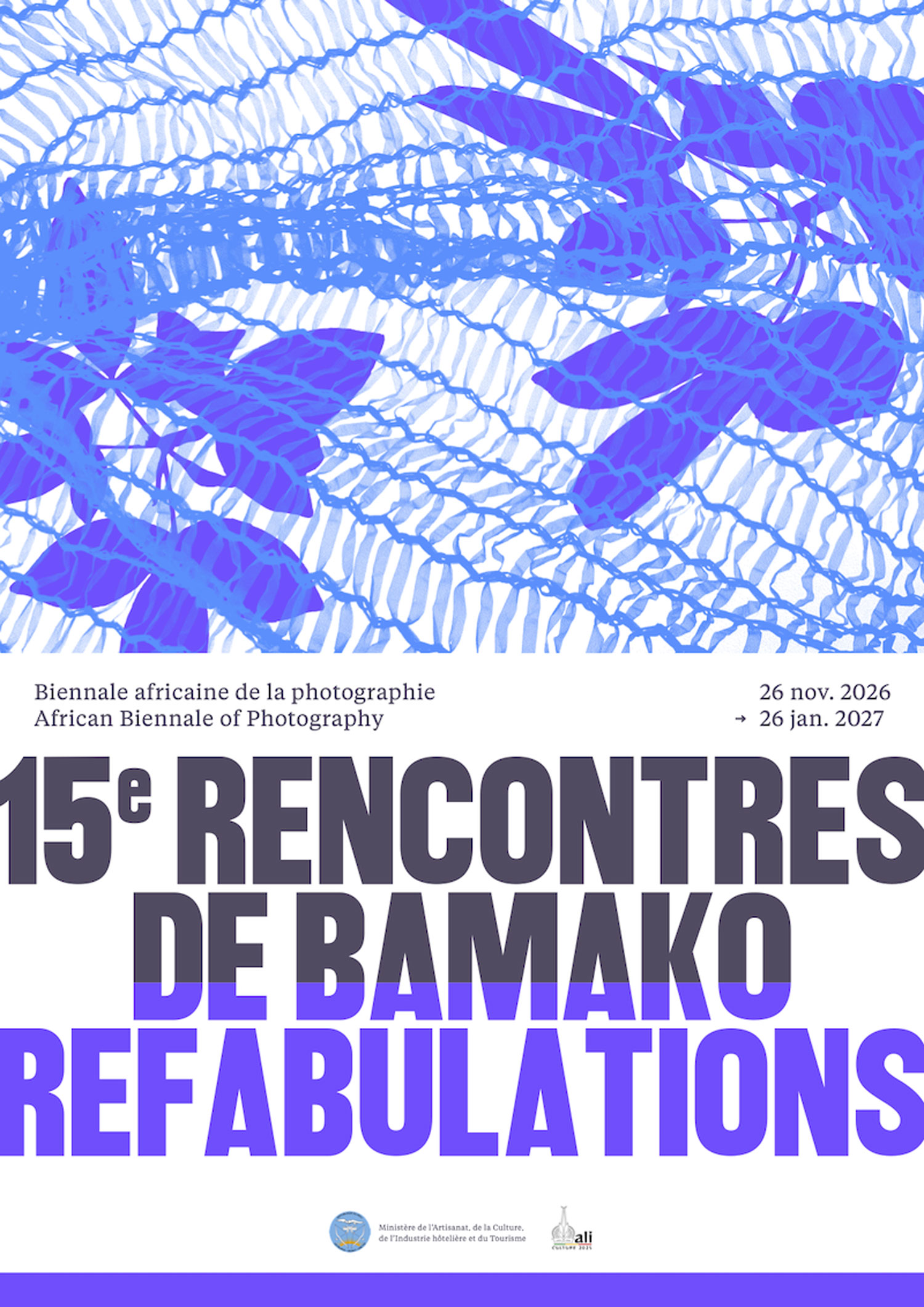
Starting November 26, the Rencontres de Bamako will bring together 49 artists from 26 countries under the theme “Refabulation(s).” Driven by a 100% Malian production team, this fifteenth edition will provide an opportunity to assess what the continent can achieve on its own and what it has yet to achieve. Here’s an overview.
By Shiran Ben Abderrazak
On May 14, at the Maison Africaine de la Photographie, Mali’s Minister of Handicrafts, Culture, the Hospitality Industry, and Tourism, Mamou Daffé, launched the 2026 edition of the Rencontres de Bamako by inviting artists to help “ rewrite new narratives that are more accurate and more authentic .” Four months later, the selection process has been finalized: forty-nine artists were chosen from among more than four hundred applications reviewed over seven weeks, including just under ten who were invited to produce their works in Bamako, in collaboration with Malian photographers. These figures place this edition in line with its historical average, a far cry from the thirty artists featured in 2024.
In essence, “ reimagining, as I define it, requires an act of invention in addition to an act of remembrance or protest ,” writes Chief Curator Armelle Dakouo, who has made this a selection criterion: “ the simplest to state, the hardest to meet .” The projects created on site—sculptures, installations, and three-dimensional works—maintain “ photographic practice at the heart of the process ,” and this method of production in Bamako is also a guideline set by the minister, according to General Delegate El Hadj Amadou Diop.
One fewer co-producer
Conceived by French photographers Françoise Huguier and Bernard Descamps, the Rencontres de Bamako were founded in 1994 “ at the initiative of the Government of Mali ,” according to the official website, and subsequently co-produced by French cultural cooperation under its various names, culminating in the “Institut français.” El Hadj Amadou Diop, who “ represents the ministry ,” identifies the period between 2011 and 2019 as the time when the Institut français was “ identified as a co-producer .” “ Since 2024, there has been no co-producer in the historical sense of the term: the Rencontres are 100% funded by the Malian side, explains Armelle Dakouo. This is therefore not a sudden break, but the culmination of a process spanning about ten years. »
This course of events is part of a diplomatic timeline that had nothing to do with culture, marked by the expulsion of the French ambassador in January 2022, the withdrawal of Operation Barkhane in August, the suspension of French development aid in November, and Mali’s withdrawal from ECOWAS in January 2025. The end of the co-production could therefore be interpreted in light of these two explanations: Mali’s desire to take back control of production and the rift between Bamako and Paris—one not precluding the other.
State Biennial or International Biennial?
In 2024, Contemporary And magazine reported significant budget cuts and a decline in the number of international professionals, which Moroccan photographer M’hammed Kilito publicly lamented. No figures have been released for 2026. The only publicly available figure dates from 2011—one million euros—“ “largely from France via the AFAA ,” wrote Christian Caujolle in these pages. When asked about this edition’s budget compared to previous ones, El Hadj Amadou Diop described “ a comparable order of magnitude, but with a different structure: more resources mobilized in Mali .” Curator Armelle Dakouo, for her part, mentions “ a tighter framework regarding certain logistical or financial aspects .”
The question has arisen since the decline in the presence of international professionals in 2024: Can a biennial organized by a single state—in a country led by a transitional government—remain the international event it once was? Armelle Dakouo, who moved from her role as artistic director of the AKAA art fair in Paris to Bamako, says she knows exactly what the outside world sees: “ what it values, what it overlooks .” “ A biennial that wants to free itself from an outside gaze does not do so by ignoring it, she asserts : it does so by understanding it well enough to make an informed choice to respond to it differently.” “His response does not pit two camps against each other, nor does the list of partners. The Rencontres de Bamako has always been a state-sponsored biennial, with an international scope thanks to its partners, and the 2026 edition, as presented on the official website, reads like a map. In the foreground are the ministry, the “Mali Culture 2026” label, and venues and media outlets—primarily Malian. Next comes the North, without France—or almost without it, since Canal+ is nevertheless listed among the official partners—along with Spain, represented by three logos, which is funding “ an international launch in Spain ,” and UNESCO, “ a long-standing institutional relationship .” Finally, South-South ties, with Royal Air Maroc, another official partner, and Morocco as the guest of honor, nine years after an edition in which Diptyk lamented “the near absence of Moroccan photographers.” Whatever one may think of it, cooperation still exists in Bamako, albeit in different forms.
Constellations and Voids
The fact remains that responding to a gaze in any other way requires being seen, and this is precisely where the end of the co-production weighs most heavily. For beyond providing a budget, it fostered circulation: the official website notes that the exhibitions produced in Bamako “ then travel to Paris, Angoulême, Angers, and Lille “. Without a co-producer, this kind of circulation is no longer a given, and the landscape of what might take its place on the continent is marked by constellations and gaps. There are events, of course: Dak’Art since 1992, the Lubumbashi Biennale since 2008, LagosPhoto since 2010, the art fairs in Marrakech, Lagos, and Cape Town, as well as a new generation of private museums, from the Zeitz MOCAA to the MACAAL and the Fondation H in Antananarivo. What’s missing between them is the circuit that would allow an exhibition produced in Bamako to travel to Dakar, Lagos, or Casablanca, just as it used to travel to Angoulême. Take, for example, the African Fund for Culture, based in Bamako and founded in 2018 by Mamou Daffé—now a minister—with European and American foundations and Afreximbank among its donors. Its first call for proposals, in 2019, distributed $100,000 among twelve projects, out of 446 received from 34 countries. That’s the scale; and the dates, too: Dak’Art, another state-sponsored biennial, opens on November 19—a week before Bamako—with no shared schedule. Ultimately, the 2026 edition has the support of the government and its partners, but it lacks what the continent does not yet offer: a network that enables its artists to travel beyond Bamako. The artists, for their part, did not wait for this network to respond to the call for proposals.
Regarding 2028, the Executive Director writes the only sentence that addresses the context: “ If we carry this edition through to November despite the harsh international scrutiny and a context marked by major diplomatic rifts, there is no reason to consider 2028 uncertain. ” The schedule is feasible, he adds. The question that November will settle lies elsewhere: how many curators, gallery owners, and journalists will make the trip, and from which capitals—Paris, Madrid, Casablanca, Dakar, or Lagos? It is against this backdrop that we will see whether the Rencontres, without a co-producer, have found their way to the continent and to the world.
— “Refabulation(s),” 15th Rencontres de Bamako, Mali, November 26, 2026, to January 26, 2027.