From a distance of 5,481 kilometers, two installations by Sophia Kacimi create a real-time dialogue between Fez and Doha. With this augmented Moroccan art fair, the founder of Zoubida symbolically moves Fez beyond its role as a repository of traditions and places it on the map of contemporary art.
By Chama Tahiri Ivorra
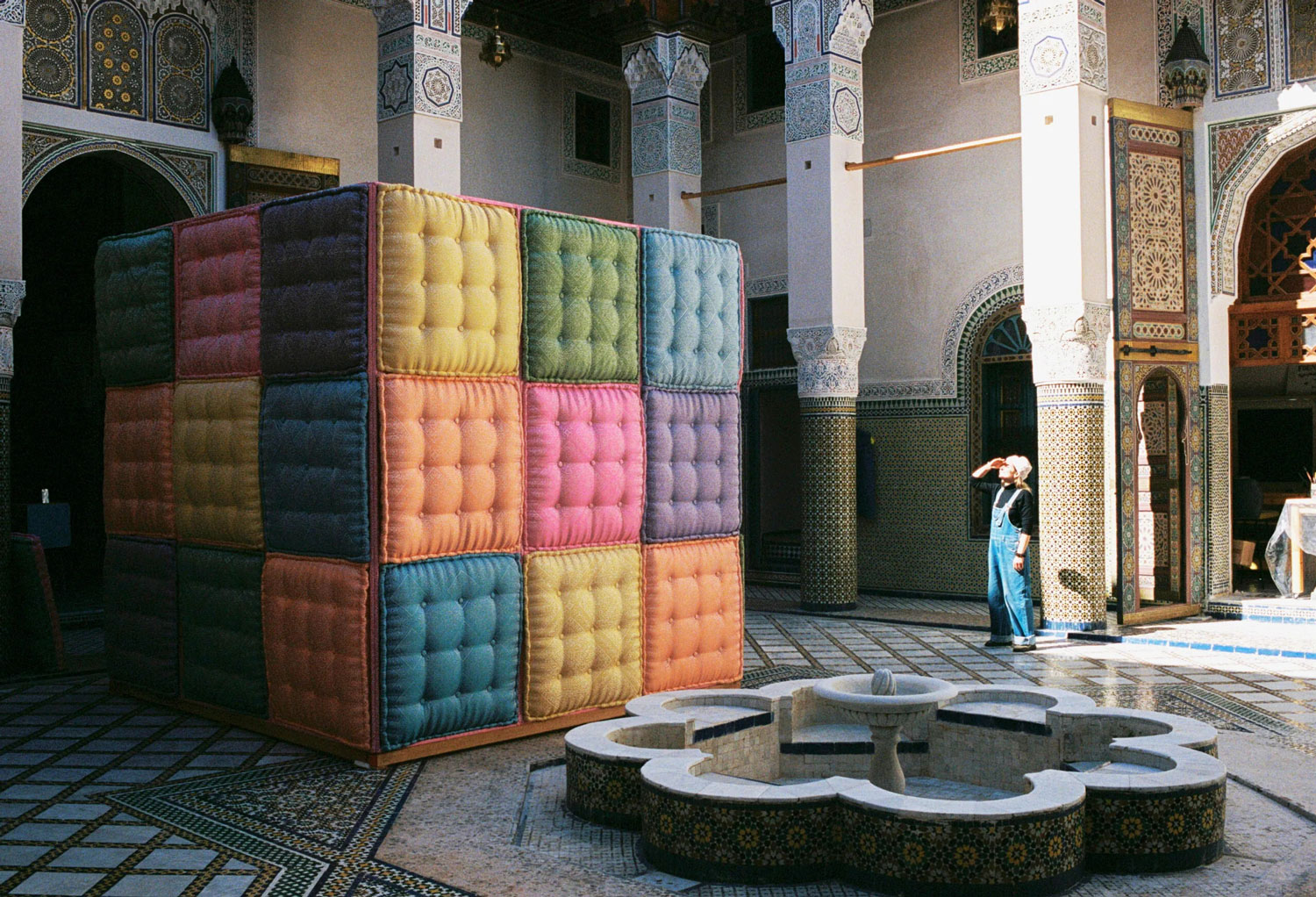
Mshreib Downtown, the second edition of the Doha Design Biennial. A large building with a glass facade houses the main exhibition, “Arab Design Now,” curated by Palestinian architect Noura Al Sayeh, across three floors. Upon entering, visitors are greeted by “Sharing the Same Roof,” a monumental installation in vibrant colors by Zoubida, the design studio founded by Sophia Kacimi. Presented in two versions—one in Doha and the other in Fez—this augmented Moroccan exhibition creates a real-time dialogue between the two cities, separated by more than 5,000 kilometers.
Sharing the Same Roof draws on the familiar elements of the Moroccan living room—cushions, poufs, tlamat, tarz fassi, traditional patterns, and upholstery techniques—to transport them into Zoubida’s playful and colorful world. Here, traditional furniture-making techniques move beyond their usual function to contribute to the construction of a livable space. The wooden structure is lined with poufs that form its walls. Having worked in the luxury industry, Kacimi is aware of the impact of overconsumption and the environmental cost of fashion. Today, she affirms her commitment to reusing and repurposing materials: “I don’t make anything new; I work only with existing textiles and materials that I find.” Displaying the tlamet on the façade is also a way of revealing the intimate, of bringing it out into the open.
A Collaborative Effort
The decision to create two installations was clear to the artist from the very beginning. She sums up her position bluntly: “For me, creating a beautiful work and sending it abroad is no longer enough. From the very beginning, the idea was to also create a piece that would benefit Morocco.” In Fez, where a large part of her professional network is based, the installation was also intended to benefit artisans, their families, and an audience that does not necessarily have access to exhibition spaces.
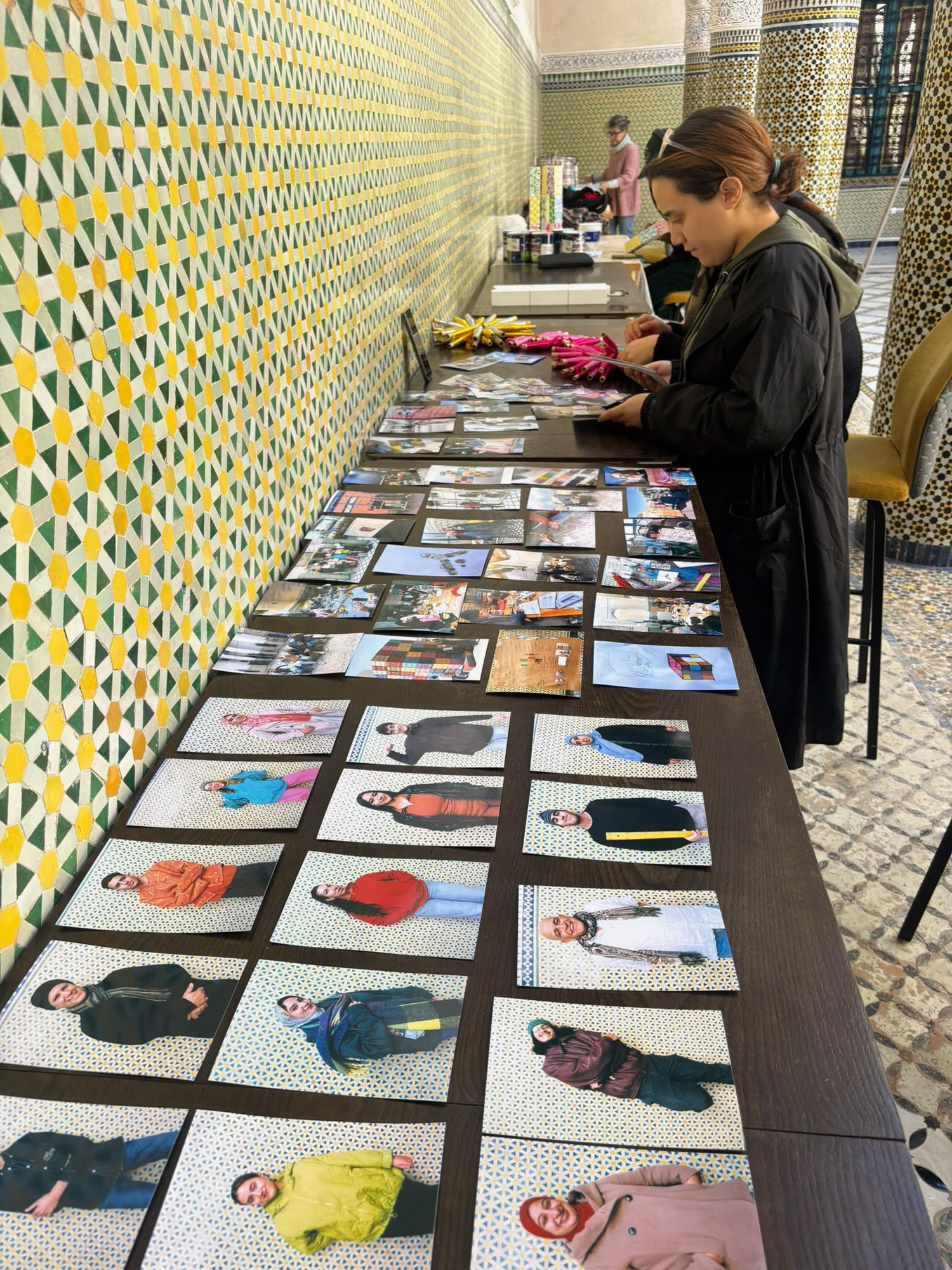
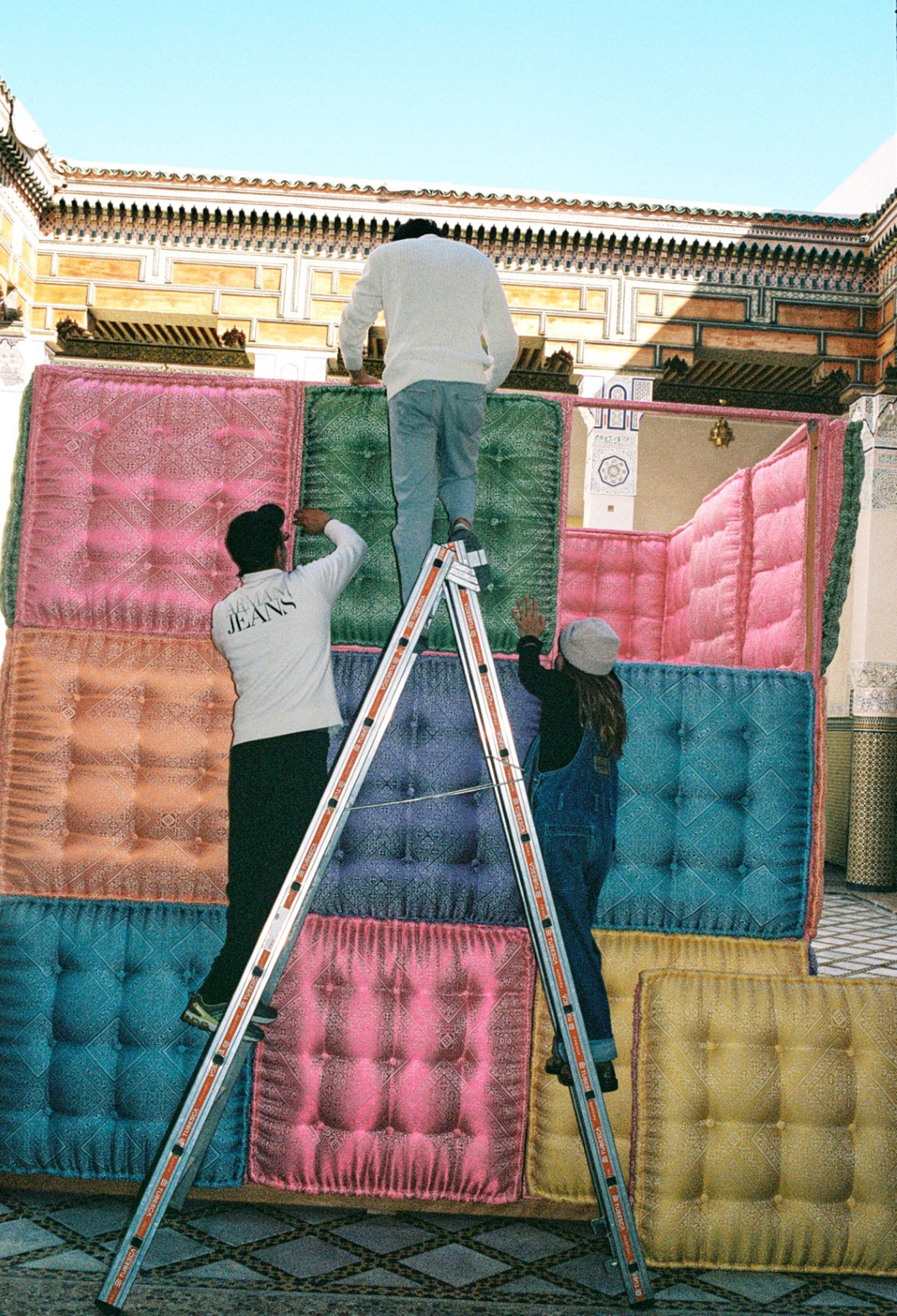
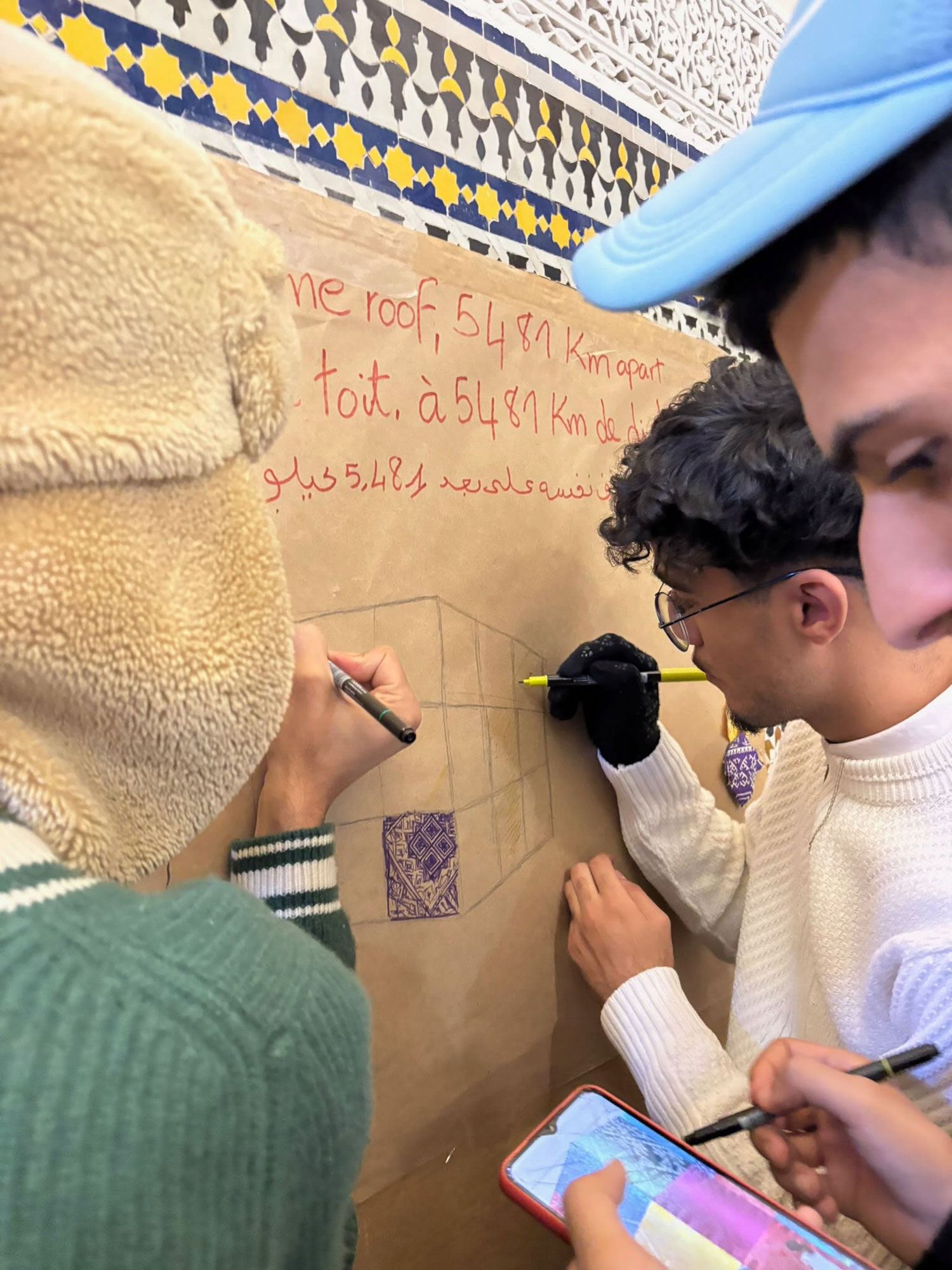
A year and a half of work, seven months of workshops, more than 55 people, and eight types of crafts were involved in the project. Sophia Kacimi collaborated in particular with AMESIP —the Moroccan Association for Assistance to Children in Precarious Situations—whose Shems’y and Kan Ya Makan schools in the medina of Fez offer free training in the arts and crafts to people who are far from the job market and sometimes lack formal qualifications. The very diverse group brought together for the project ranged in age from 21 to 47. During the seven months of workshops, the focus was on familiarizing them with design, sourcing materials, and the various stages of production, as well as facilitating their interactions with artisans.
The goal was not to assign them predefined tasks. His approach involves a process of research, in which some workshops turned into observational walks and photo sessions in the medina, to find ideas and starting points collaboratively. His ideas are never set in stone, and the design process moves forward through exchanges with the artisans, trials, and adjustments: “It’s a constant back-and-forth.” An initial idea may be modified to make it feasible; the testing phases are lengthy, and there are many setbacks. This relationship of trust has been built over the course of five years of practice, thanks in particular to the presence of the artist’s father, Moulay Abdellah, a native of Khénifra, who serves as a production partner and mediator.
The Contemporary Nature of Morocco’s Cultural Heritage
At first, some suggestions were met with confusion: “I don’t just send a sketch and wait for the result. I spend time with them, I’m there when they try, I listen, and I also identify where they’re getting stuck.” Today, she works with a core group of regular artisans who are willing to experiment with new forms. Crediting each participant in the work was also a way to level, at least symbolically, the usual hierarchy between the signing artist and the artisans relegated to the shadows. For Mohamed Lhayfi, an upholsterer who has been collaborating with Sophia since her early days, there is both the challenge of creating works that are completely out of the ordinary and the pride of succeeding—of earning a form of recognition from the community and visitors. He confides: “We are truly artists.”. For Sophia, there is a real challenge in restoring the dignity of the craft, showcasing its relevance today, and highlighting the possibilities offered by Morocco’s cultural heritage. This sentiment is echoed by certain artists and designers who work closely with the craft sector, including the New Tangier label with its motto “Craft cannot die / l’artisanat ne peut pas mourir”.
In Fez, the installation is located in Bab Boujloud, in a public space, and will be on view through the end of November. This was a deliberate choice: “I thought that people who don’t feel comfortable going into a museum might be able to see it.” She will then return, for the last two months of the Biennale, to the school where the workshops were held. Straddling the realms of craft, design, and installation, Kacimi’s work defies overly narrow disciplinary categories. Her approach involves starting with a material and a craft, then allowing the form to evolve through interaction with the people who make it possible. The Moroccan salon thus becomes less a symbol of identity and more a testing ground. Beyond the telepresence system, the project’s value also lies in this other form of exchange: the circulation of skills, recognition, and opportunities. Finally, this experience helps move Fez beyond its image as a repository of traditions and heritage, empowering it to become a place where contemporary creation is actively fostered.
Arab Design Now 2026, through January 31, 2027, Doha.