

Exhibition Curator « État(s) de passage » (State(s) of Transition), currently on view at the Villa des Arts in Rabat, Achraf Remok reflects on transnational mobility—both as a lived experience and as curatorial material—and questions the notion of the “new Moroccan scene,” which is sometimes reduced to a convenient category by the art world.
Interview by Meryem Sebti
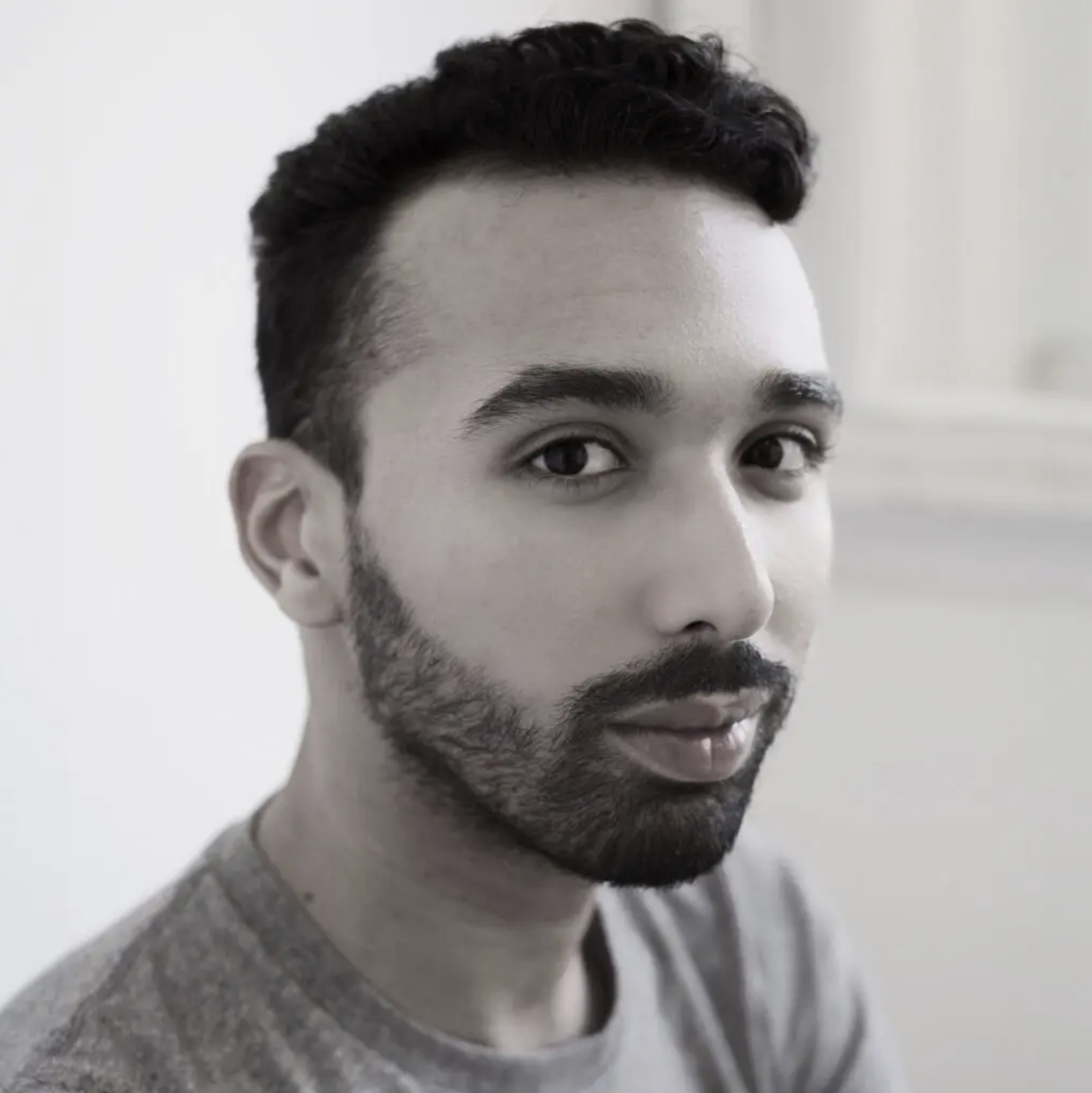
Portrait of Achraf Remok. © Le Cube
In your exhibition “État (s) de passage ,” you borrow the concept of “ deterritorialization ”. Hasn’t this become almost mandatory vocabulary in contemporary art today? What makes you think it still offers a way to interpret this generation?
I use the concept of deterritorialization with caution, aware that it is so widely circulated that it risks becoming worn out, like a stone held in one’s hand too often, co-opted by all manner of curatorial discourses seeking to appear in step with the times. But I refuse to turn it into a theoretical veneer applied to works to make them exportable. What I recognize in this exhibition is a concrete experience—mine as much as the artists’—a sensation of inhabiting several territories without quite belonging to any of them. The concept serves to name, in hindsight, what the body already knows. What interests me—and what should also be cause for concern—is how this vocabulary appeals precisely to Western institutions that love to celebrate the mobility of artists from the Global South without ever questioning the borders that remain perfectly immobile for those very same artists. The word travels more freely than the bodies it purports to describe.
In recent years, there has been a lot of talk about a “ new Moroccan scene ”. Do you think it actually exists, or is it a construct of the art world (or the art market)?
I’m wary of labels that are applied too quickly to things that are still evolving—and even more so when those labels feed a market eager to find its next bankable generation. What I see are studios, late-night conversations, and scattered trajectories—as far from the big cities as they are at their very heart. This dispersion resonates with me more than any notion of a unified art scene. We must call things by their proper names: part of this so-called “new scene” is constructed more in the offices of international art fairs and commercial galleries than in Moroccan studios themselves. It follows a logic of commodification, always on the hunt for new geographies to exploit. My curatorial work rejects this haste, this urgency. I prefer to let these trajectories breathe, even if it means depriving the market of a ready-made label. For everything has its time.
“The mobility of the Moroccan artist exhibiting in Brussels or Paris bears no resemblance to that of the European commissioner who comes seeking the exoticism of a Marrakech biennial. This asymmetry deserves to be stated plainly rather than diluted in a uniform discourse on contemporary nomadism.”
Most of the artists in your exhibition travel back and forth between Morocco and Europe. Is this still a unique characteristic, or simply the norm for many artists today?
Traveling between two worlds has become second nature to many—almost commonplace by now. But I remember what it felt like the first time: the sensation of no longer quite belonging here, yet not yet belonging anywhere else. It’s not just a matter of plane tickets, even though these obstacles weigh far more heavily depending on the color of the passport one holds. This is where I connect with a more political conception of travel: the mobility of a Moroccan artist exhibiting in Brussels or Paris bears no resemblance to that of a European commissioner seeking the exoticism of a Marrakech biennial. This asymmetry deserves to be named outright rather than dissolved into a uniform discourse on contemporary nomadism. What distinguishes these trajectories is not the act of leaving, but the unequal cost of each journey—and what one brings back, without ever truly intending to, upon each return.
This translation was generated using AI. For the original text, please see the French version of this article.
” Transitional State(s) ”, Villa des Arts Rabat, through July 29, 2026.
