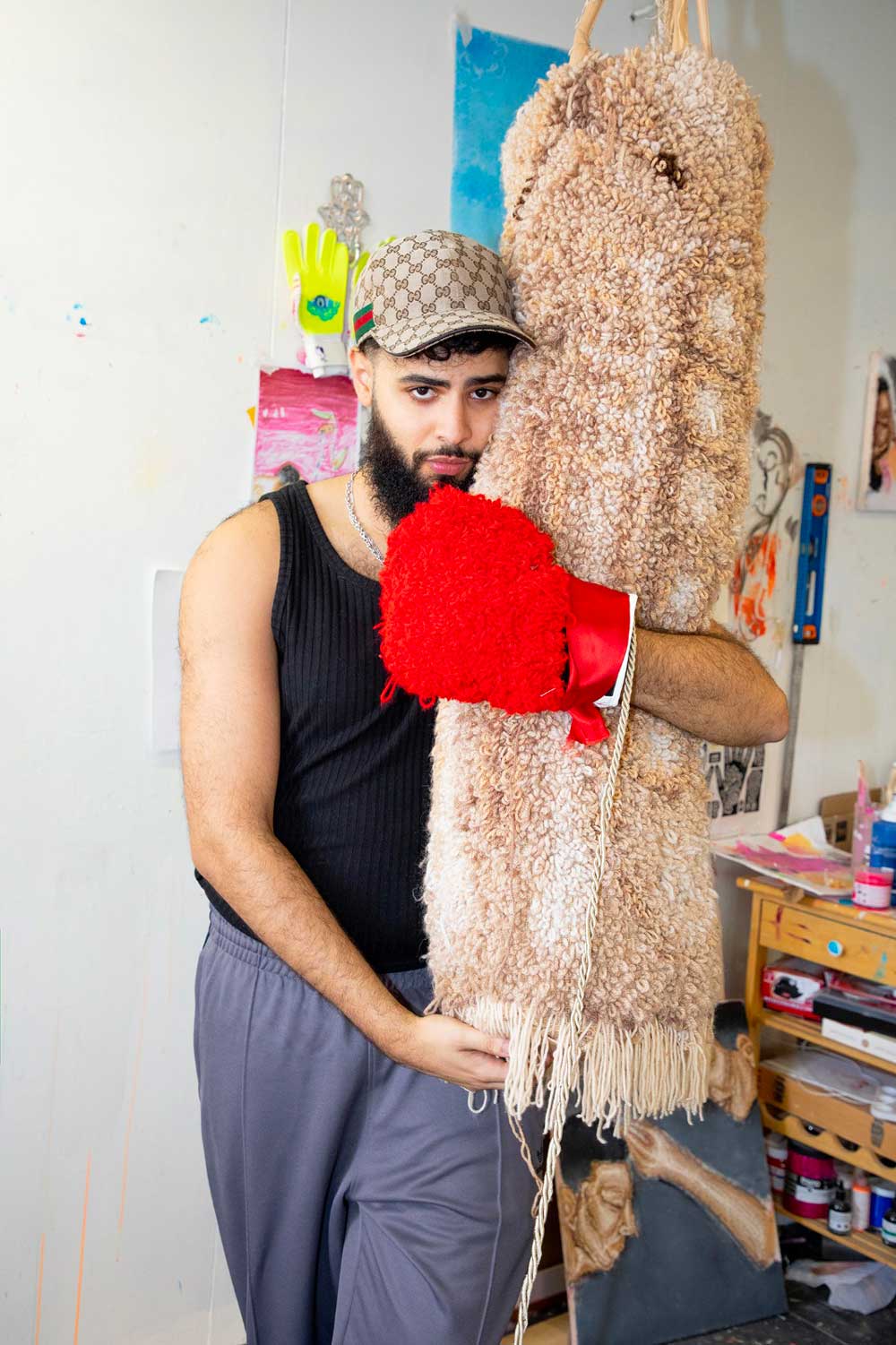
Describing himself as a painter and textile artist, Amine Habki draws on imagery from social media and scenes from everyday life to create compositions that challenge conventional perceptions. We met with him in his studio, where he is preparing for his first solo show in Paris.
We discovered Amine Habki, a recent graduate of the École supérieure des beaux-arts de Cergy, during the 2024 edition of the “Être ici” art tour in Tangier. His textile works, which subvert the clichés of heroic, conquering masculinity—ironically represented by delicately embroidered boxing gloves—struck us with their sense of calm and tenderness. We were also captivated by the ease with which his various installations were staged, as in the group exhibition “La rhétorique du rideau,” in which he participated in 2025 at the Institut des Cultures d’Islam in Paris.
While cinema remains a major source of influence—among his influences, he likes to cite the documentary Reel Bad Arabs: How Hollywood Vilifies a People (2006) by Sut Jhally, an adaptation of Jack Shaheen’s book of the same name that criticizes the way Hollywood cinema essentializes Arab bodies—his iconographic vocabulary draws from a wide range of sources, much like his generation: “The images I draw often spring from a memory of a real-life scene or a movie, or from scrolling through Instagram. My imagery comes from everywhere.”
Challenging Myths
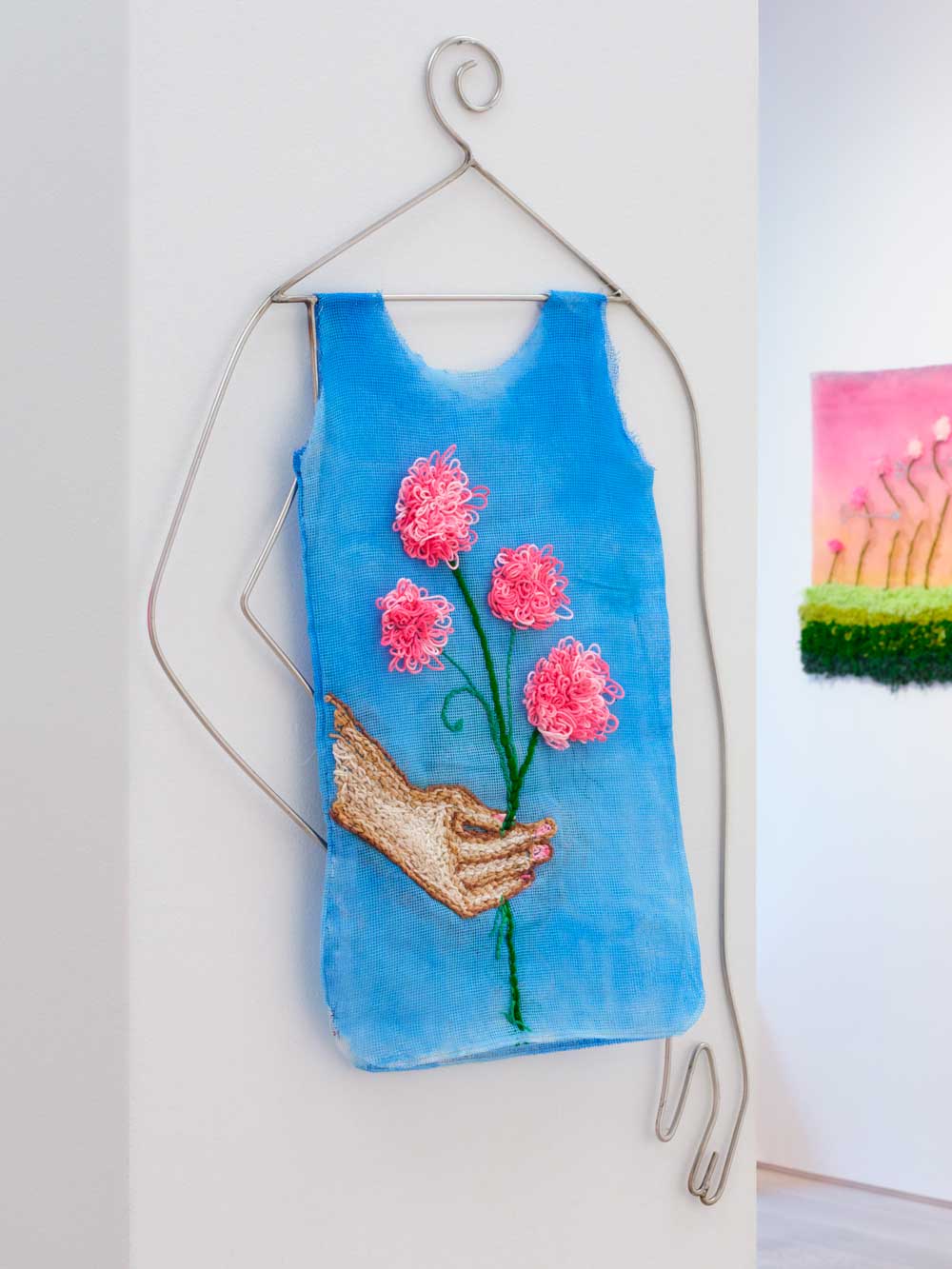
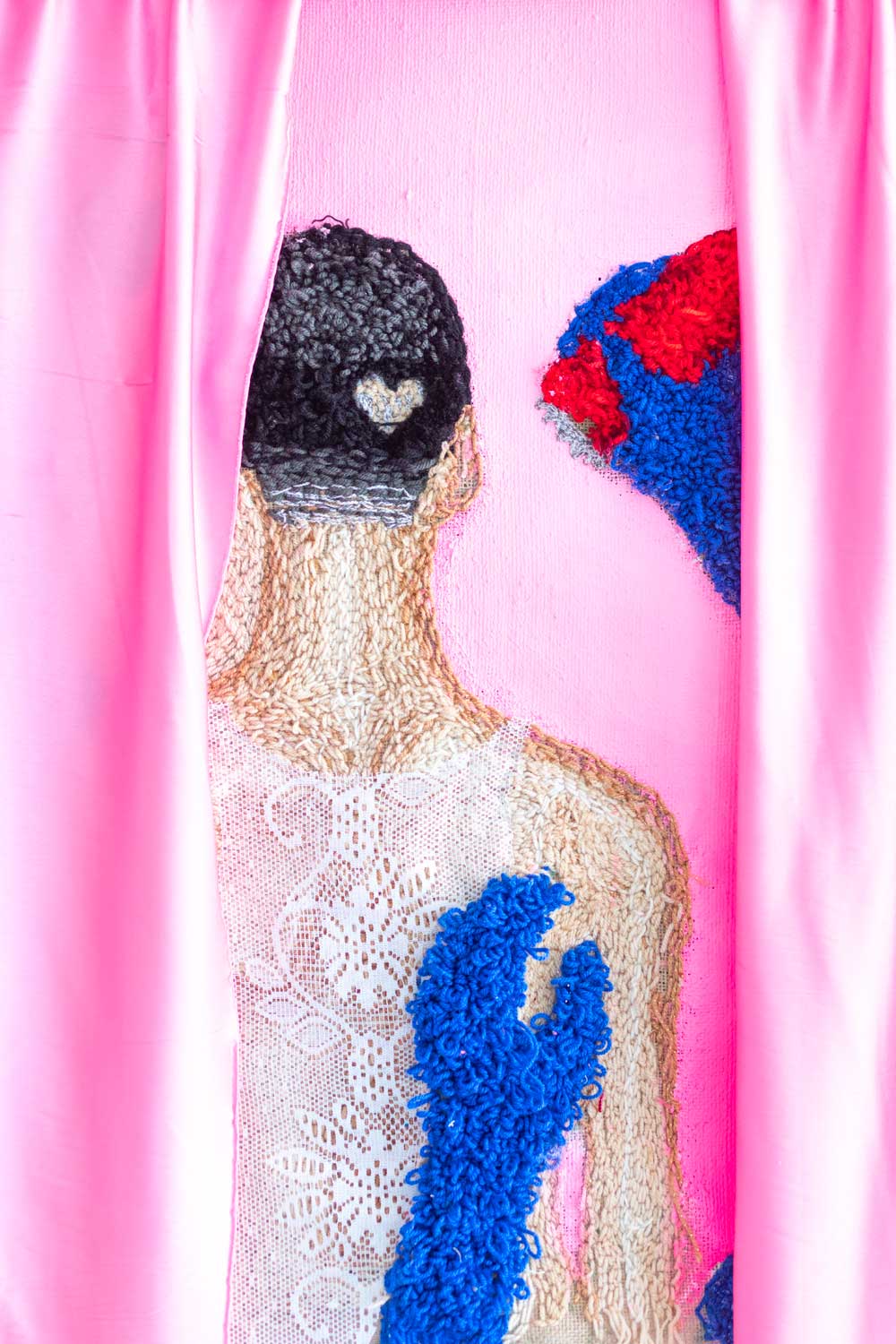
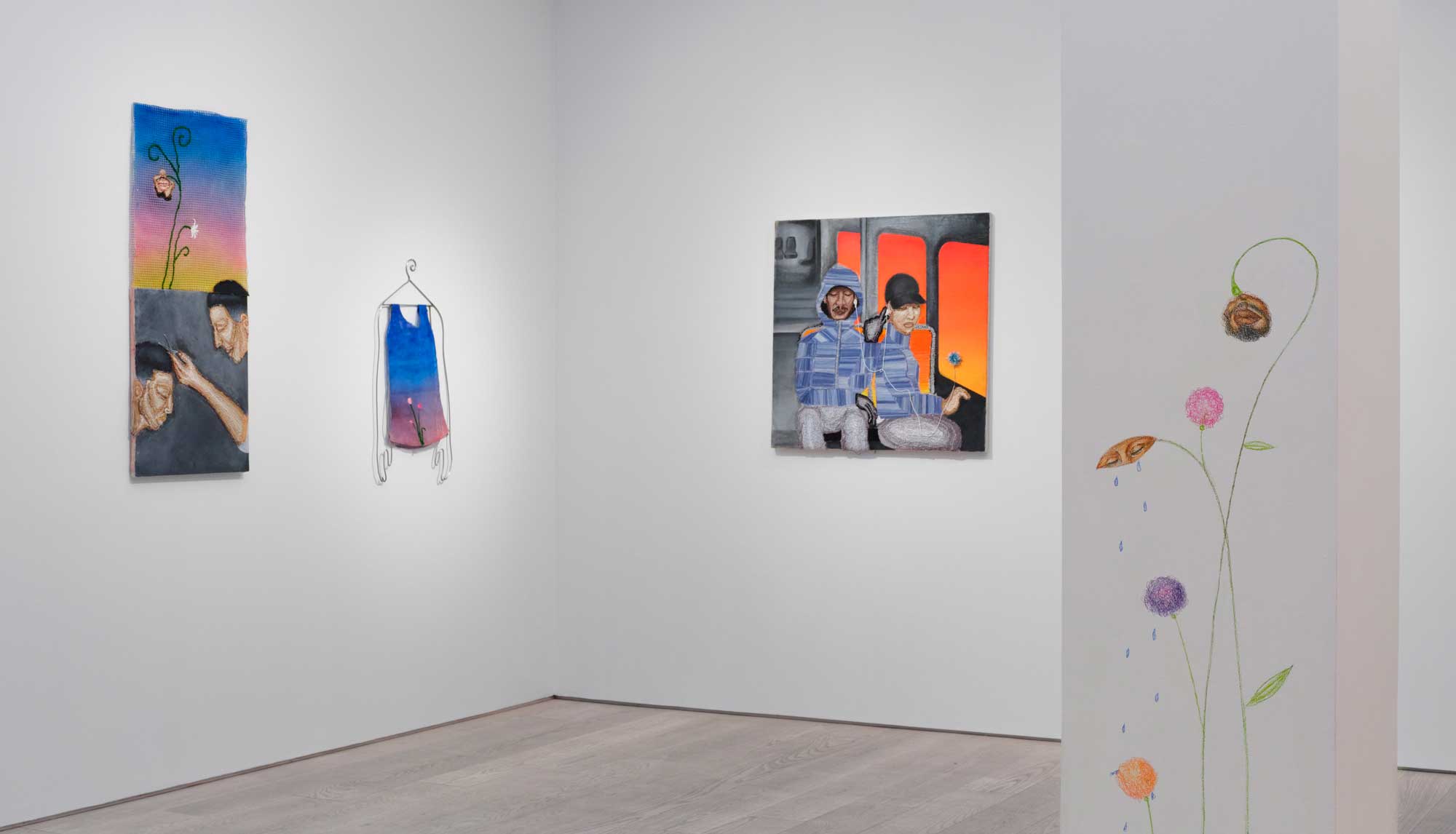
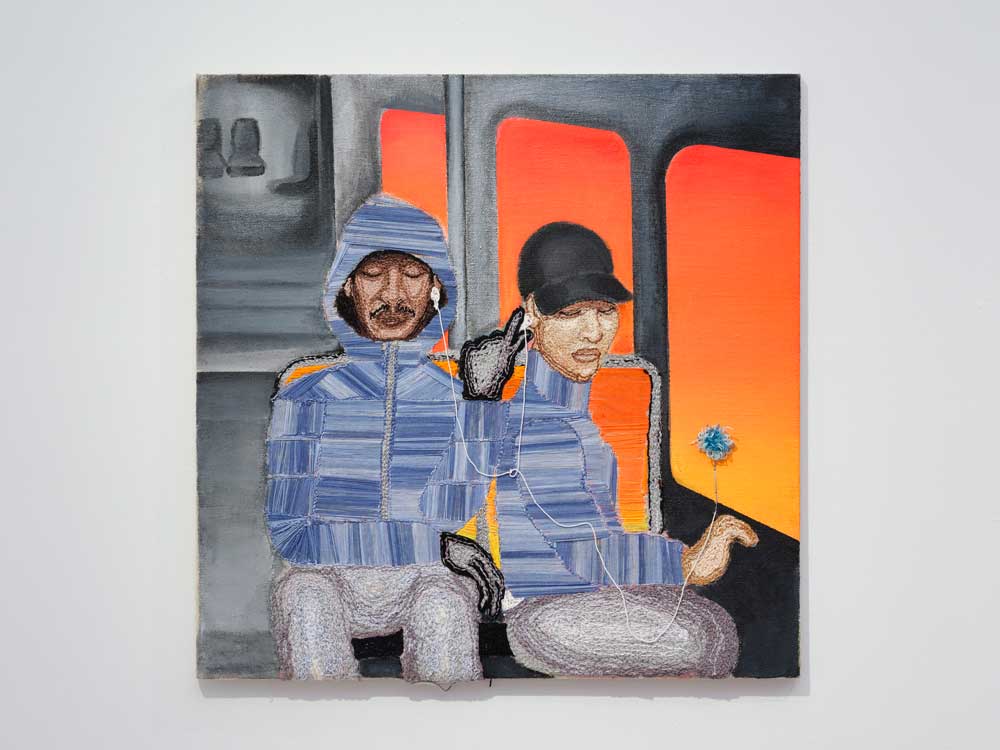
His visual art skillfully draws on the art of embroidery, drawing, and painting—all mediums he handles with great dexterity. “I’ll embroider on the fabric to bring out a pattern, and then I’ll paint over it to erase it. This allows me to create a three-dimensional effect. I’m also experimenting with my needle on materials that are rarely used, such as the sheer fabric used in upholstery lace.” The choice of fabric often sets the stage for the narrative and the selection of scenes to be depicted, as in Still dirty (2025), in which a simple tank top serves to create distance from the triumphant gesture of a shirtless man, whose vulnerability the artist explores. “I like to find softness in strength and slowness in speed,” he explains, acknowledging the debt he owes to many artists—contemporary, classical, or romantic—including Delacroix, whom he says he admires but whom he criticizes for his “ essentialization of bodies.” For now, Amine Habki is actively preparing for his first solo exhibition which will be held in September at Galerie Mennour in Paris, and which he has chosen to title “My desire is my compass.” Drawing inspiration in particular from the Treatise on the Fixed Stars, a work on astronomy by the Persian writer Abd-al Rahmane al-Soufi dating from the 10th century, he set out to invent his own constellations that would “challenge existing myths.” He prefers to substitute the figure of Penelope for that of Odysseus; in place of the great navigators who explored the constellations, he contrasts the Parisian public transit system, from which he continues to observe his Arab brothers with tenderness, as in his dreamlike, romantic work Please Mind the Gap (2025), in which two men share a pair of headphones on an RER train, searching for a more desirable place.
Olivier Rachet
This translation was generated using AI. For the original text, please see the French version of this article.