

Without resorting to spectacle, these six pavilions are among the most thought-provoking proposals at the Biennale. They explore the nature of images, reinvent textiles, celebrate craftsmanship, and invite viewers to slow down their gaze, aptly extending Koyo Kouoh’s curatorial vision.
By Olivier Rachet and Emmanuelle Outtier
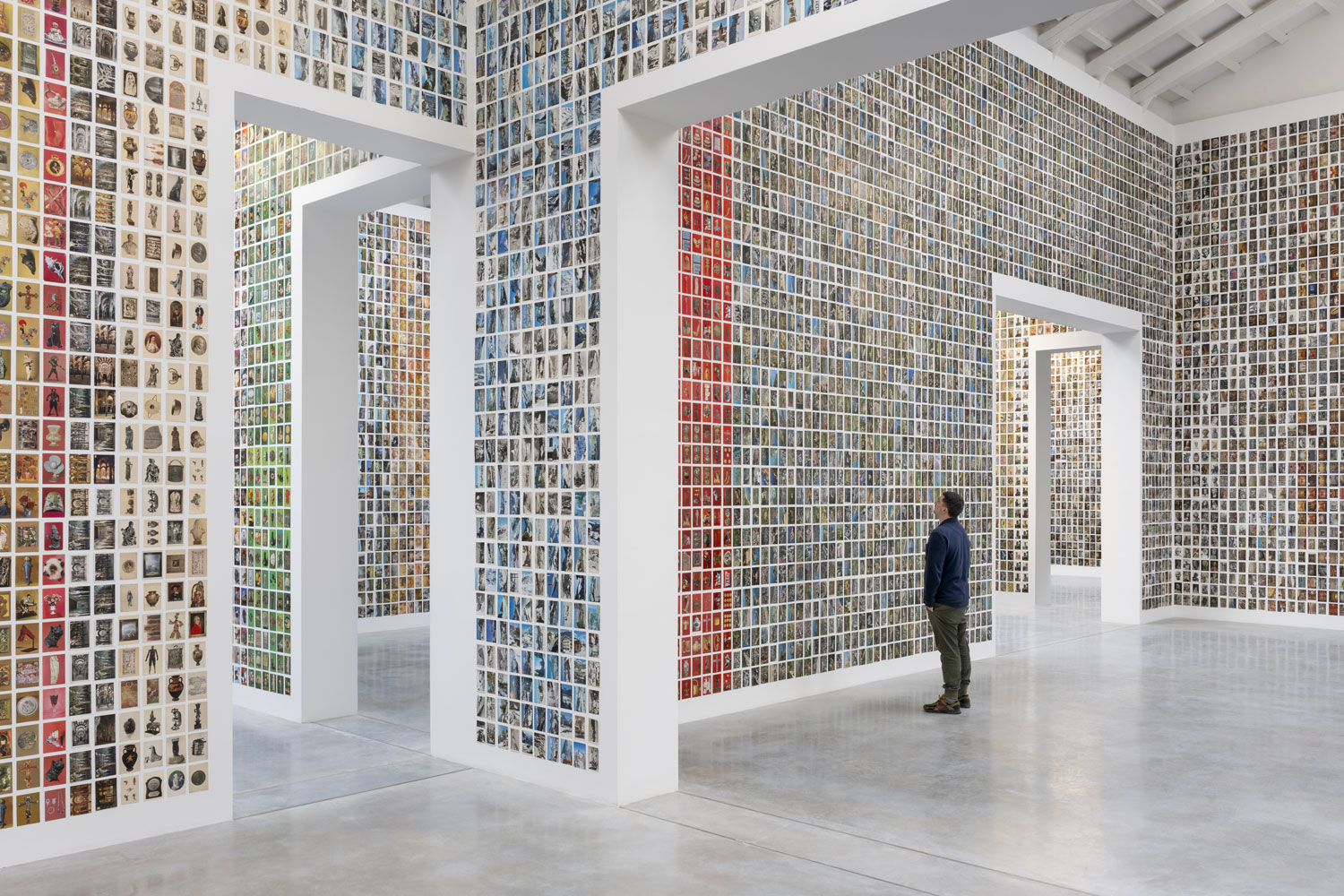
Spanish Pavilion: “Los Restos” by Oriol Vilanova, Giardini
The Spanish pavilion by Catalan artist Oriol Vilanova, “Los Restos,” is striking both for its monumental scale and for its mastery of miniature art taken to its extreme. Composed of thousands of postcards collected by the artist and grouped by random themes—views of Morocco, architectural columns, sculptures, fountains, or sandy deserts…—the walls of the space are entirely covered with images that are as outdated as they are technically flawless. Is this, in a somewhat “pop” reinterpretation of the Atlas Mnémosyne by Aby Warburg, to reconnect with the practice of the collector and art lover seeking to break down barriers and dismantle hierarchies of reference? Or is the artist inviting us, without warning, to a unique sensory and visual experience, given that certain groupings seem to have been chosen for purely chromatic reasons? The viewer, as dazzled as they are cautious, seems to be traversing a forest of signs whose literal meaning captivates them, but whose arrangement sometimes baffles them. At a time when images are becoming increasingly democratized in their value as a constant medium of exchange, the artist also questions a “use value” that has perhaps become a thing of the past.
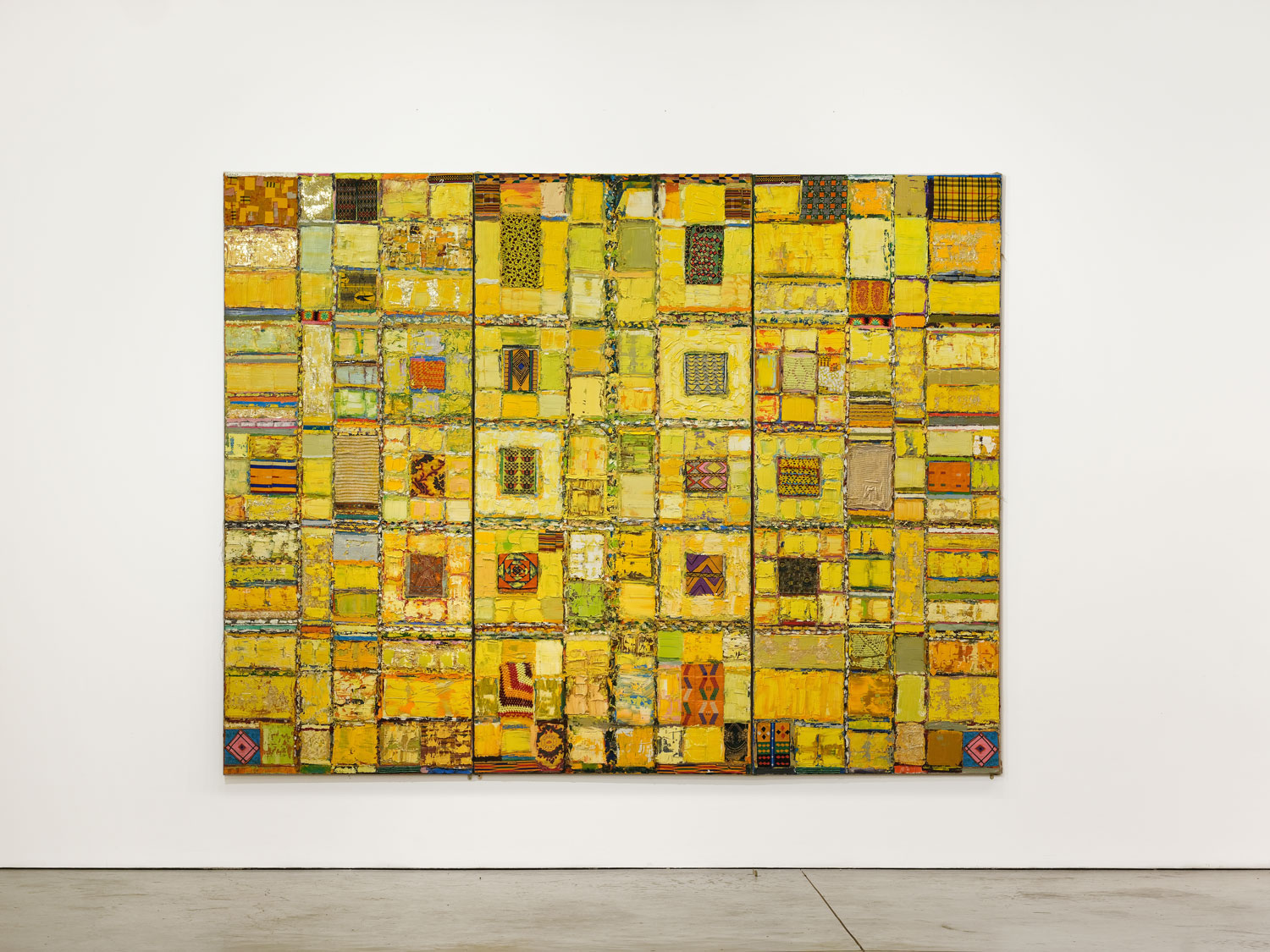
Ethiopian Pavilion: “Shapes of Silence” by Tegene Kunbi, Palazzo Bollani
For its second appearance at the Venice Biennale—following painter Tesfaye Urgessa’s participation in 2024—the Ethiopian Pavilion is featuring artist Tegene Kunbi, represented by Primo Marella Gallery. On the first floor of Palazzo Bollani, located just a few steps from the Arsenale, viewers discover a series of captivating patchworks, featuring monochromatic palettes of yellows, blues, or reds, though most often focusing on blending the brightest colors. On often imposing surfaces, horizontal or vertical layers of paint coexist with textile pieces and a few drawings whose symbolic or narrative dimension—even if it sometimes eludes us—nonetheless offers a moment of respite. The artist combines a wide variety of fabrics: some are knitted by her mother, others are mass-produced and sold at markets, and still others are used in religious ceremonies. Here, the act of painting extends the act of weaving, in the attention the painter pays to the interstices. Weaving calls to painting; both activities share the same attraction to flatness and a technique all over from a representational space to timeless abstraction.

Holy See Pavilion: “The Ear Is the Eye of the Soul,” Mystical Garden of the Discalced Carmelites
“We need something else. We need to listen. We need to love, to nurture beauty,”, Koyo Kouoh stated in her curatorial note, before her passing. The Holy See Pavilion takes this gentle recommendation literally in one of its two installations, transforming the Mystical Garden of the Discalced Carmelites—just a few steps from the Santa Lucia train station—into a sound installation. Equipped with headphones, visitors are invited to wander through the outdoor spaces of a 17th-century th century, guided by sound compositions created by artists such as Brian Eno, Otobong Nkanga, and Patti Smith. The entire experience is orchestrated by Soundwalk Collective, which, for its part, invites visitors to listen to the micro-acoustics of the wind, water, and insects. Conceived as a tribute to Saint Hildegard of Bingen [1098–1179], this immersive pavilion resonates with the words of Pope Leo XIV, as quoted by curators Hans Ulrich Obrist and Ben Vickers: “ The logic of algorithms tends to repeat what ‘works,’ but art opens up the realm of possibilities. Not everything has to be immediate and predictable”. In Venice, the rhythm of art is no longer dictated solely by the market.
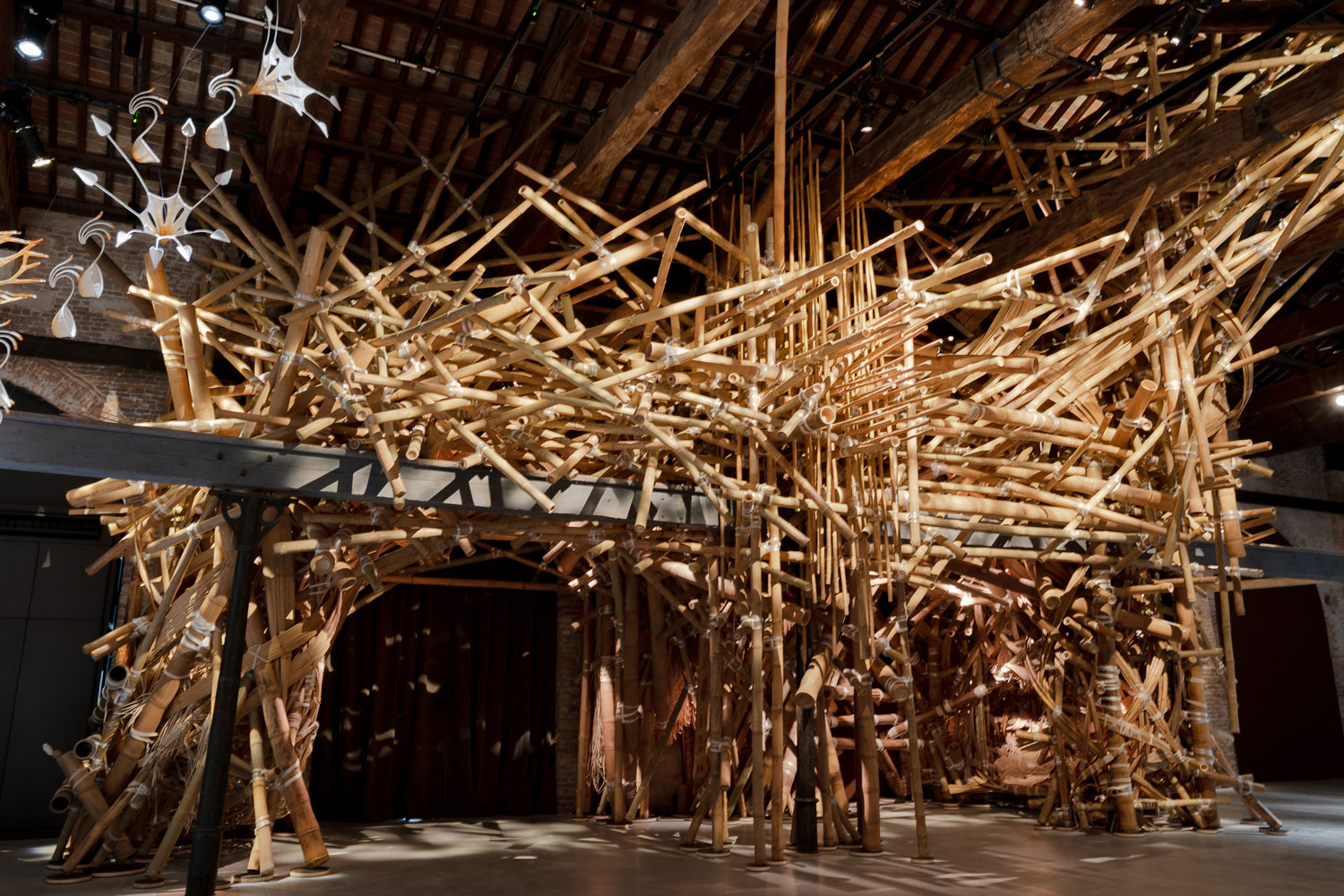
Indian Pavilion: “Geographies of Distance: Remembering Home,” Arsenale
The artistic power of the Indian pavilion lies first and foremost in its collective nature. Five artists, using materials as diverse as bamboo, clay, papier-mâché, and string, explore the concept of home. The installation Permanent Address by Sumakshi Singh, created from very fine threads of silk, cotton, and nylon and evoking her hometown of New Delhi, is striking for its ethereal quality and jagged appearance. Opposite it and facing it is the monumental work Chaal by Asim Waqif, composed entirely of bamboo, evokes—not without nostalgia—the traditional scaffolding once used in India, which has now been replaced by more industrial materials such as steel and aluminum. Beyond the pavilion’s successful scenographic design, the universal nature of its message also wins over the audience. The collective is also what we have in common—an Earth cracked on all sides, much like the two entirely cracked clay works by Alwar Balasubramaniam. “The way the earth drifts, fragments, or isolates itself symbolizes our own fragmentation—this act by which we distance ourselves from everything or from one another,”, the artist aptly remarks.
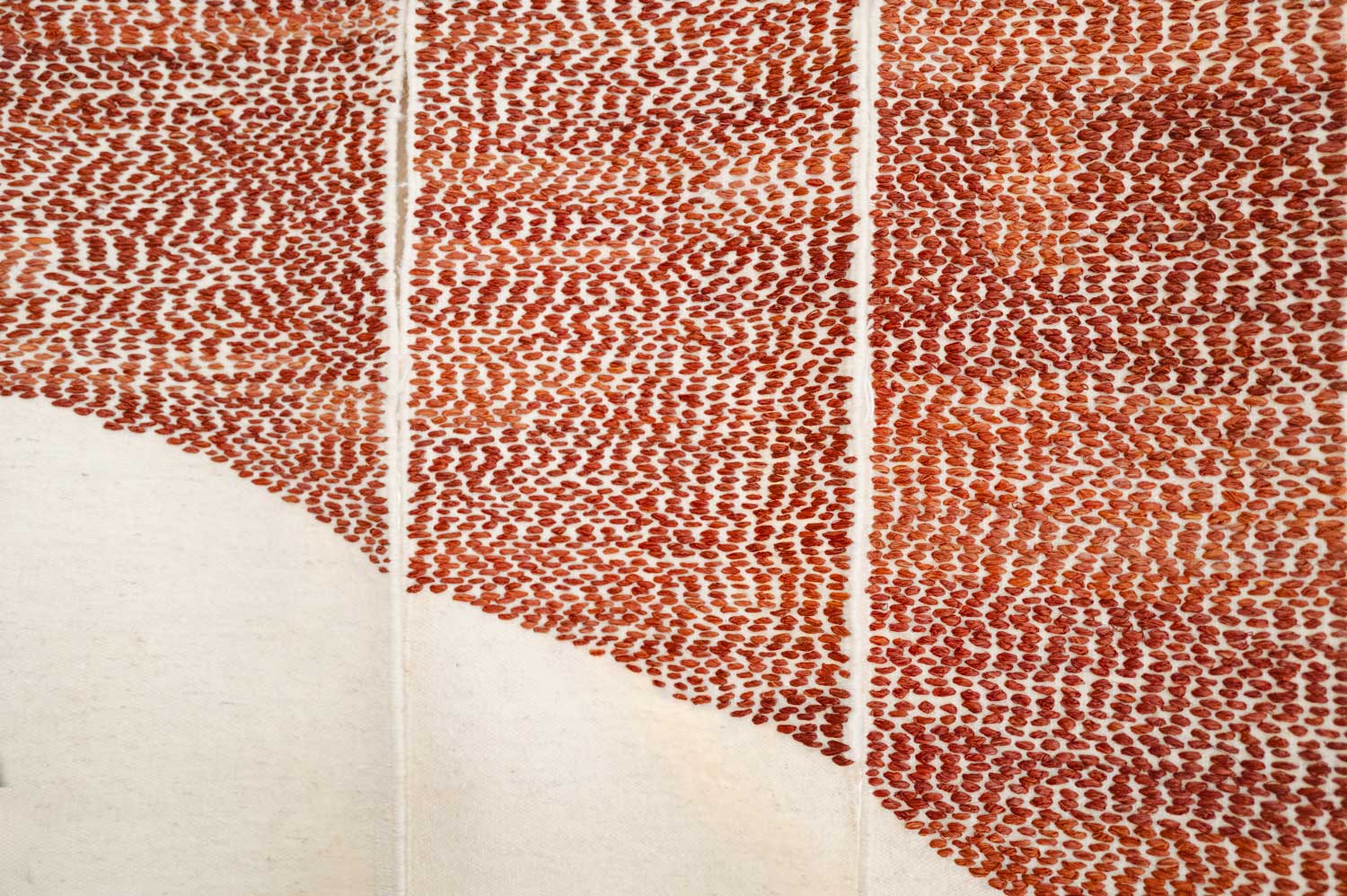
Moroccan Pavilion: “ Asǝṭṭa ” by Amina Agueznay, Arsenale
Morocco’s first national pavilion at the Venice Biennale, “ Asǝṭṭa ” impresses with its ambition as much as with its craftsmanship. In the 300 m² of the Sala degli Artiglieri, Amina Agueznay presents a monumental installation composed of hundreds of strips woven and embroidered by more than 160 master craftswomen from across Morocco. Wool and raffia form an abstract landscape that alternately evokes the Venetian lagoon and the Atlas Mountains, while motifs borrowed from the ceramics of her mother, Malika Agueznay, anchor the work in a family and artistic history.
Far from being a mere tribute to vernacular craftsmanship, the artist transforms the building into a “second skin”: the fabric strips peel away from the walls, create thresholds, filter the light like a mashrabiya, and invite visitors to pass through a space made of material, light, and breath. This exploration of thresholds—which gives the installation its name—resonates deeply with the Biennale’s theme, In Minor Keys, conceived by Koyo Kouoh.
The result of nearly thirty years of collaboration with Maâlmates, “ Asǝṭṭa ” also celebrates the passing down of traditions. The installation Interstices, created using Murano Rosetta beads reimagined in Morocco, evokes the historical exchanges between Venice and Africa—with all their interactions as well as their ambiguities. Both protective and open, the pavilion ultimately forms a work of rare intelligence in which textiles, architecture, and memory weave a narrative of exchanges, running counter to the tendency toward insular identity.
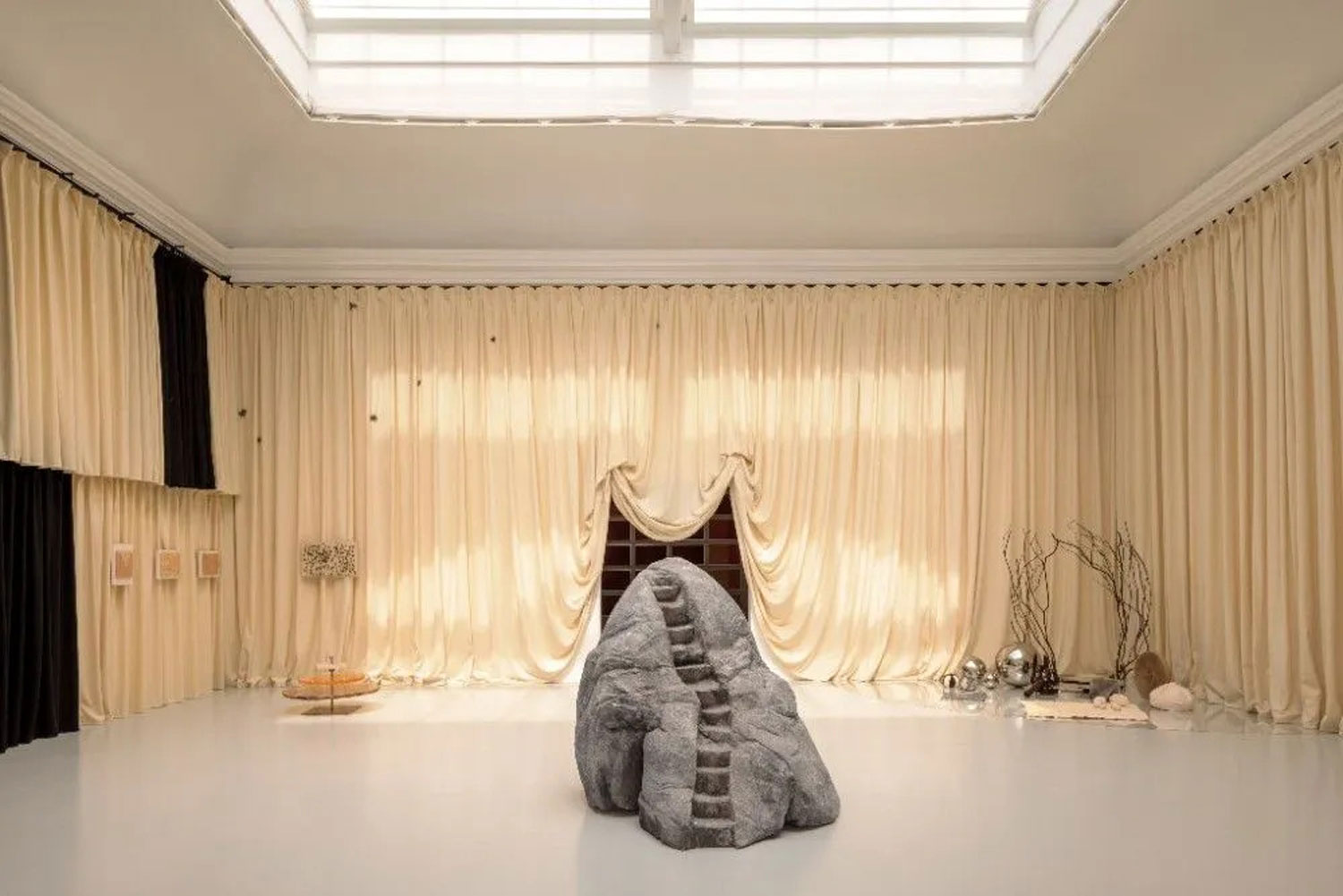
French Pavilion: “Like Saturn” by Yto Barrada, Giardini
Praised by some for its depth and coherence, yet deemed obscure by others, the French pavilion—curated this year by the Franco-Moroccan artist Yto Barrada—has become one of the most debated projects of this edition. The artist, whom we in Morocco naturally know well, explores her theme, “Like Saturn,” in a Dadaist style. Drawing inspiration from Goya’s painting *Saturn Devouring One of His Sons*, she weaves a series of associations—like an *exquisite corpse*—around the verb “to devour,” which also refers to a dyeing technique. This exhibition showcases the artist’s recent work with textiles and traditional craftsmanship.
From the score of an 18th-century revolutionary song, the red monochromes that evoke American minimalism—except that here they celebrate natural pigments rather than the industrial and extractivist golden age of the United States—and the anti-suckling sheep masks, visitors can easily feel lost. Perhaps that is precisely the point of the pavilion: to invite us to let go of the search for a single, unambiguous meaning and instead surrender to the pleasure of forms, colors, and associations of ideas. Barrada’s playfulness permeates the entire project, right down to the puns that punctuate the tour, such as “Yto ou tard.” It’s a way of reminding us that, behind the erudition of the discourse, the pavilion also cultivates a sense of whimsy and humor.
This translation was generated using AI. For the original text, please see the French version of this article.
