What does a young artists’ award reveal when it no longer merely recognizes artists, but seeks to map out the contemporary young art scene? With “Momentum,” the sixth edition of the Mustaqbal Prize, the TGCC Foundation brings together fifteen artists aged 18 to 35 at the Artorium, representing diverse backgrounds and training. Painting, photography, installation, sculpture, textiles, drawing, video, technological installations, and—for the first time in the prize’s history—sound art: the selection does not reflect a homogeneous aesthetic. Rather, it offers a snapshot of a generation.
By Salima El Aissaoui
One thing, however, immediately stands out: the strong presence of artists with transnational careers. Several of them currently live or work in Paris, Arles, Marseille, Montreal, Toronto, Brussels, or Milan. Karima El Karmoudi divides her time between Nice and Paris; Bahia Ourahou between Paris, Arles, and Rabat; Sfiya is based in Canada; Mohamed Mouhieddine works between Marrakech and Toronto; and Oualid Lazrak between Arles and Morocco. This growing presence of the diaspora speaks first and foremost to the renewed appeal of the Mustaqbal Prize.
The award thus serves as a point of reconnection with the Moroccan art scene for artists who have built their careers elsewhere. It is significant that some choose to return and situate their work within a Moroccan context: as if geographical distance did not necessarily mean a departure from the national art scene, but could, on the contrary, spark a desire to find a place within it.
Momentum
In this regard, the exhibition’s title, “Momentum,” is less a theme than a proposition. In physics, momentum refers to the amount of motion of a body, related to its mass and velocity. In everyday usage, the word also conveys the idea of impetus—a dynamic force that builds. According to Othmane El Farsi, Head of Development and Heritage at the TGCC Foundation, this concept refers precisely to the moment when a practice gains momentum and begins to take shape as a trajectory. This choice is indicative of an award that is increasingly viewed less as a simple competition and more as a support mechanism.
This year, this approach extends beyond the exhibition itself. The Mustaqbal Prize has partnered with the Ellipse Prize, whose sixth edition is being held in Morocco following previous editions in Côte d’Ivoire, Togo, Benin, Senegal, and Ghana. This collaboration aims to promote the mobility and circulation of artists, notably through an exhibition in Marseille followed by one in Casablanca for the winner of the first prize. In addition, there is a partnership with the Montresso Foundation, which allows the winner to benefit from a residency at Jardin Rouge, as well as the TGCC’s annual participation in the 1-54 art fair, designed as an opportunity to connect artists with gallery owners and collectors. El Farsi also mentions the creation of a permanent space dedicated to showcasing, throughout the year, works by artists who have been part of the Prize. The concept of “momentum” thus also refers to the trajectory of the works after their creation: exhibitions, residencies, networking, collections, and international circulation.
The Political as Intimate?
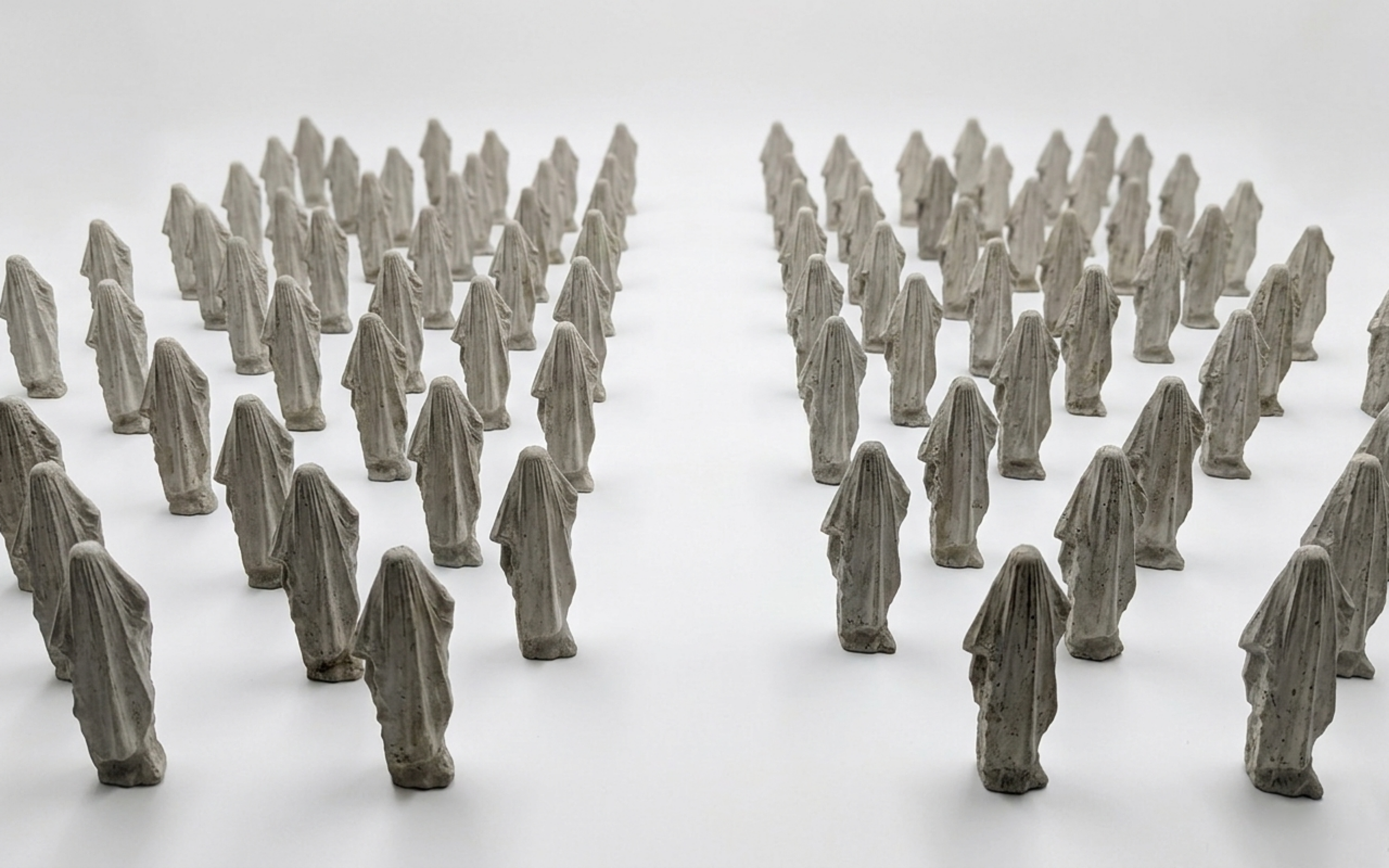
But what does this 6th edition tell us about the young Moroccan scene? What can we understand about this generation of young Moroccan artists? Abdellah Karroum, a member of the jury, notes a general depoliticization of the young scene. This observation, he assures us, “does not mean that questions of identity, memory, gender, or society have disappeared. On the contrary, they are omnipresent.” But they are often approached through what could be called “biographical fragments”: life stories, family memories, displacements, inheritances, bereavements, and senses of belonging. The question then becomes less about politics itself than about how politics is embedded in individual lives. This trend is indeed present in “Momentum”: Karima El Karmoudi works from her parents’ oral stories and vernacular materials to question family memory and colonial heritage, Bahia Ourahou—who took home First Prize—links territory, migration and identity, Mohamed Mouhieddine starts from uprooting and solitude, Amine Reda from objects and spaces of intimacy.
The scene is therefore not apolitical in the strict sense. Rather, it seems to have shifted the locus of politics: from the collective to the intimate, from broad social issues to personal narratives, from explicit demands to the traces that a historical, economic, or cultural context leaves on bodies and in memories. This is both its strength and its point of tension. For while individual narratives make it possible to bring to light experiences that have long been rendered invisible, they can also contribute to obscuring the structures that produce them.
Painting Without Hegemony
Looking at the fifteen works in the exhibition, one initial impression is striking: the young Moroccan art scene doesn’t seem to be seeking to define itself through a dominant medium. Painting certainly hasn’t disappeared. It remains very much present, notably with artists like Naoual Bazzi, Mohamed Boumhaoud, and Sfiya. But it no longer appears as the self-evident language of artistic practice. In Bazzi’s work, oil painting becomes the site of a reflection on the transformations of the sacred, ritual, and desire in a consumer society, while in Boumhaoud’s work, realism is imbued with symbolic and poetic dimensions. It would therefore be artificial to speak of a simple “return” of painting. What seems to be “returning,” rather, is the possibility for painting to coexist with a scene that has long since integrated the achievements of installation art, photography, and conceptual practices.
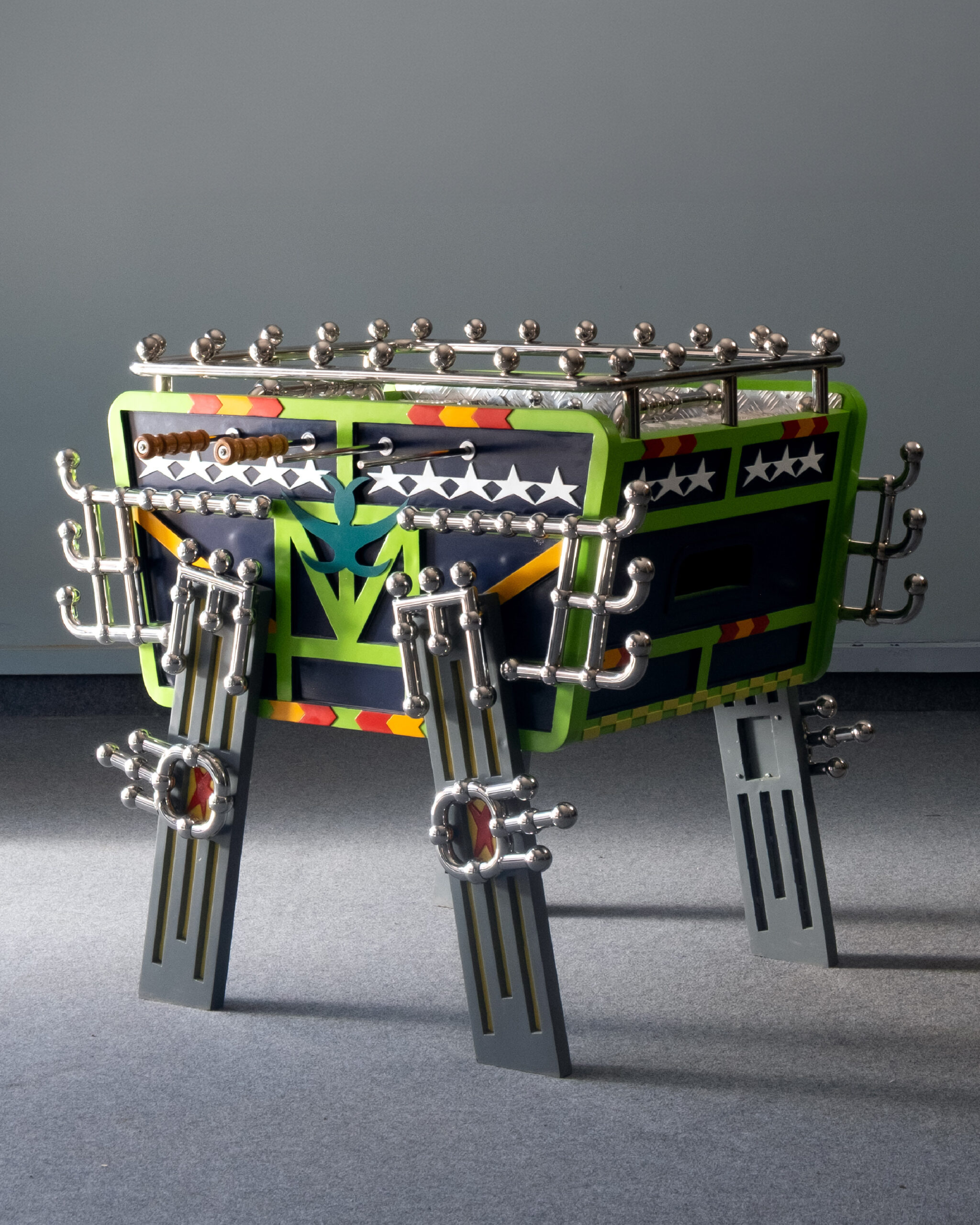
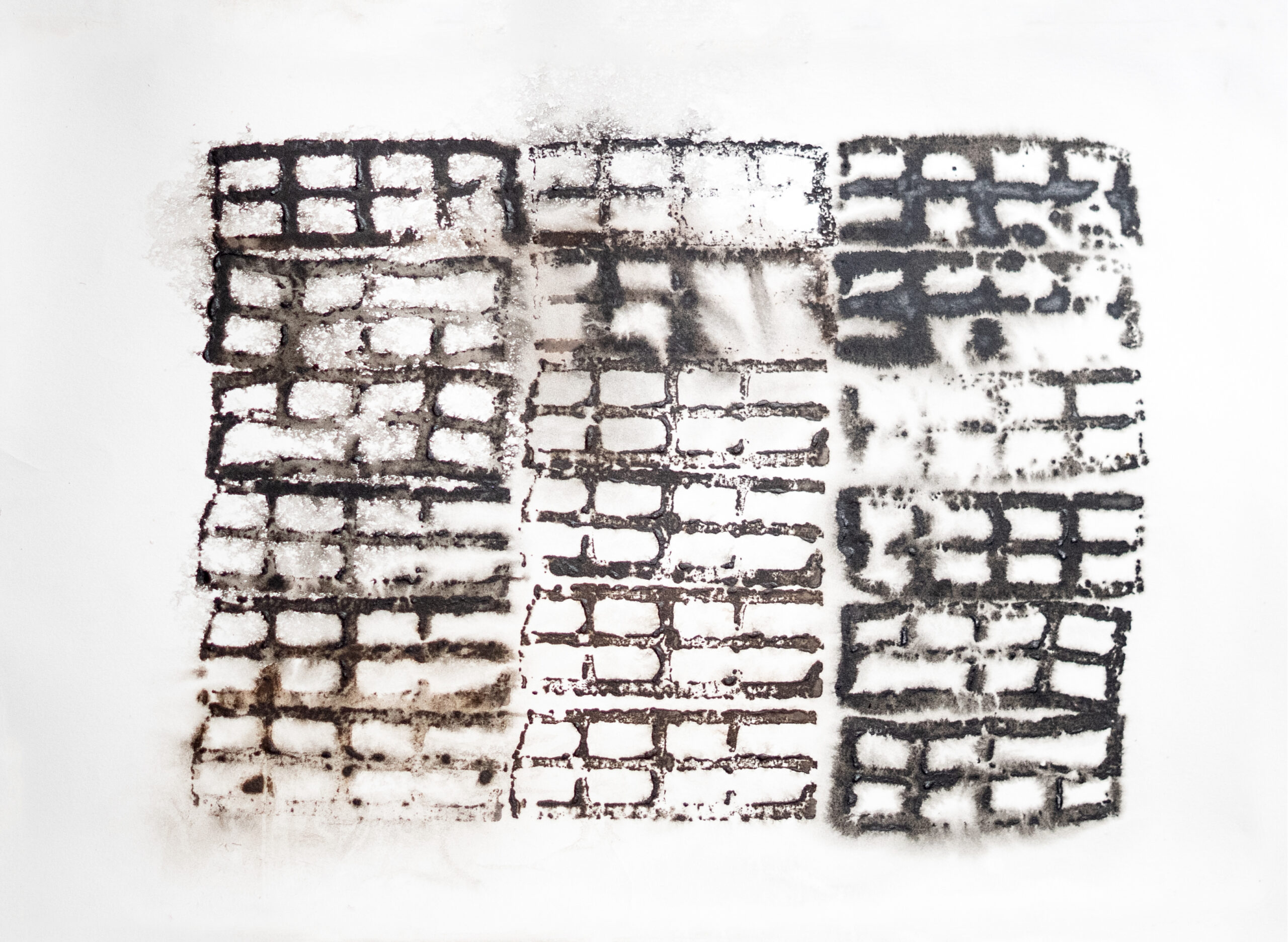
The conceptual aspect is, in fact, very much present, though not in the form of a purely speculative exercise. It manifests itself through materials and a network of reflexive operations. Houssam El Belrhiti, who received the 2nd Prize, works with bricks, casting, and industrial processes to explore standardization, reification, and dehumanization. Oualid Lazrak combines photography, computer science, and the history of Islamic optical knowledge, while Basma Mansour creates “speculative models” centered on the institutional mechanisms of visibility and the commodification of otherness. Youssef Es-Sousy, for his part, transforms objects and materials from the maritime world into symbols through which to reflect on borders, sovereignty, and crossing.

Sound Enters the Field
Photography, for its part, remains particularly prominent. It continues to be a favored medium of the younger generation—not so much to document reality as to explore intimacy, territory, and the very conditions under which images are produced. Ali Ed-Dahbi thus constructs dystopian and contemplative landscapes centered on time and impermanence.
Perhaps the most significant shift in this edition is the introduction of sound. Leila Bencharnia and Mohamed Khamaily, in particular, treat sound no longer as an accompaniment to the image but as a medium in its own right. In Hadra, Bencharnia explores the ways in which women transmit memory through voice, rhythm, textiles, and gesture; the work takes the form of an ultra-minimalist embroidered diptych accompanied by sound. In Khamaily’s work, the overlooked sound phenomena of the urban landscape intersect with an exploration of waste, materials, and the memory of objects. The expansion of the Prize to include sound thus appears less as an artificial diversification than as a sign of a broadening of the very definition of the artistic work.
“Momentum” therefore does not offer a definitive portrait of young Moroccan artists. A selection of fifteen artists cannot claim such representativeness. But it does reveal a moment: that of a generation in motion, moving from one capital to another, from one continent to another, from painting to sound, from craftsmanship to computational intelligence, from family archives to industrial infrastructures. A scene, as Aliocha Tazi, who was awarded the 3rd Prize, seems to express, less concerned with choosing between tradition and contemporaneity than with continually shifting their boundaries.
“Momentum,” the 6th edition of the Mustaqbal Prize, Artorium Art Space, September 17–October 31, 2026.