
As part of the Saison Méditerranée, the Centre Photographique Marseille presents the first French exhibition devoted to Photo Kegham, Gaza’s historic photography studio, founded in 1944 by Kegham Djeghalian, a survivor of the Armenian genocide. His grandson unfolds four decades of Gazan social life, running counter to a regime of representation that allows the Palestinian image to circulate only as evidence of catastrophe.
By Basma Mansour

The exhibition allows no breathing room. Prints saturate the walls, hung tightly along a passage one climbs, up to a sign suspended high like a lintel, PHOTO KEGHAM in heavy capitals beneath its Arabic calligraphy. Below it, a large sepia-and-mauve print shows the photographer in old age, in profile in front of his own shop window crowded with portraits in gilded frames. The image is cut off sharply at the edge of the panel, so that the old man’s back touches the room’s actual corner. He stands at the junction between the reproduced shop and the room we are in, and one must pass beneath his name to continue. We then enter through the customers’ door, among grids of identity portraits, class photographs, and groups gathered outdoors.
These images belong to an order that rarely crosses Gaza’s borders. Nothing about them was remarkable at the moment they were taken, and everything about them has become so since, through the effect of the conditions under which an image of Gaza reaches us. Palestinian life gains visibility only in the vicinity of death, rubble, bodies, mourning — and this proximity has become the tacit condition for an image’s circulation. Mohammed El-Kurd described the workings of this economy of the gaze in Perfect Victims and the Politics of Appeal (Haymarket, 2025). Only two figures are admissible within it: the “terrorist,” who can be neither mourned nor listened to, and the “perfect victim,” too wounded to fight or show anger, confined to personal tragedy and kept at a distance from any collective claim. Only the second grants access to speech, on condition of paying the price El-Kurd calls the politics of appeal — the performance of a sanitized “victimhood” before the gates of recognition.

Photographing the Ordinary
The collection on display took shape far from this economy, decades before it took hold. Founded in 1944 by Kegham Djeghalian Sr (1915-1981), a survivor of the Armenian genocide, Photo Kegham was Gaza’s first professional photography studio. For nearly forty years, he photographed weddings, families, children, sports teams, celebrations, beaches, official visitors, street scenes, and studio portraits, serving a society crossed by multiple communities — Armenians, Greeks, Bedouins, refugees from 1948. These images were first and foremost addressed to those they depict. Commissioned, hung in living rooms, slipped into albums, they circulated within the very society that had commissioned them. When Kegham Djeghalian Jr discovered three red boxes of negatives in the family’s Cairo apartment in 2018, he found far more than old photographs — he found the fragments of a social infrastructure of the image, a way for a city and its inhabitants to look at themselves, preserve themselves, and recognize one another. The ordinary predominates here, and it is this regime of images of life that the boxes preserved.

Still, it had to be exhibited without betraying it. The danger was well known: turning these scenes into the happy witnesses of a “before” against which the present would appear as nothing but catastrophe — a retrospective paradise manufactured by destruction itself. The grandson’s choices can be understood as so many ways of guarding against this trap. He organizes the collection into four groups (The Studio, Gaza Memento, Family Album, Zoom Call) rather than following a chronology that would mechanically lead up to 2026. Above all, he forgoes many of the dates and captions and names the result an unmade archive — an open, unfinished archive that refuses to settle into a definitive narrative. Yet captions and dates are precisely the apparatus through which the Palestinian image is ordinarily instructed, contextualized for an outside audience, subjected to the questions that determine its admissibility. By withholding them, he strips the image of its status as evidence submitted to a case file.
This withdrawal has a precedent, one that came from the institution itself. In 1983, Edward Said obtained permission to hang photographs of Palestinians in the lobby of the Geneva Conference on the Question of Palestine. The UN agreed, on one condition: “no legends, no explanations.” Images admitted, provided they stayed silent. The same clause resurfaces forty years later in the Marseille galleries — but this time, stated by the one doing the showing. The silence has changed hands.

A Living Archive
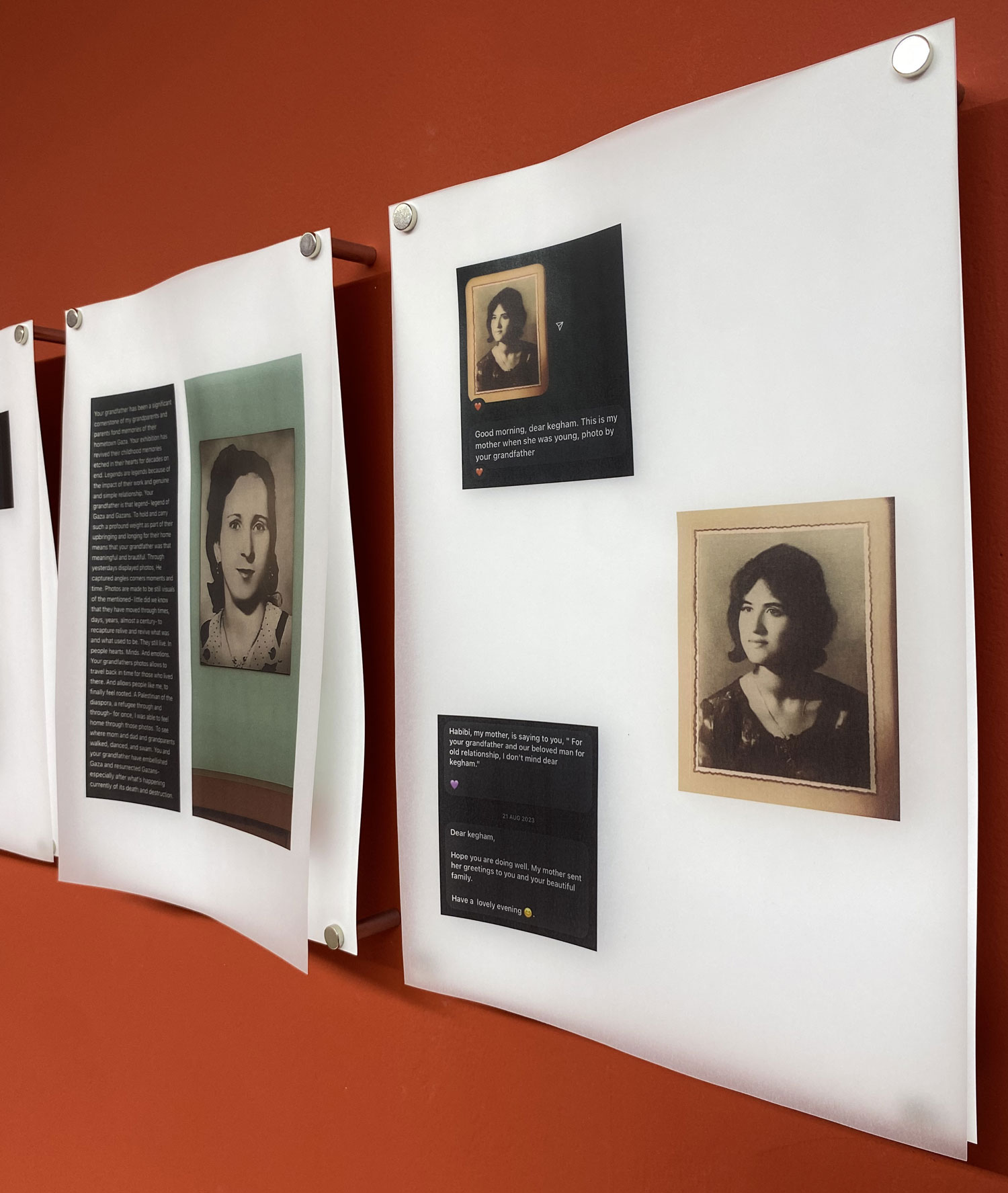
Yet this silence is not muteness — on the contrary, it opens up a space for speech that the exhibition fills in other ways. A sound piece lets us hear former customers of the studio. Their memories bring back the changing room where one dressed before posing, a bride’s artificial flowers, the print of a deceased father that the photographer refused to enlarge because he kept a better one, or the memory of a man the whole city called Abu Bishara. On pinned sheets of tracing paper, messages received by the artist since the project’s first presentation in 2021 extend the archive further — a childhood portrait sent from the diaspora, a wedding portrait recognized by a descendant, a note from Canada from a man born after the studio closed. The archive is built by those it represents, and descriptive authority belongs to them.
Only one section departs from this rule. Zoom Call presents, dated and captioned, screenshots from a January 2021 call during which Marwan Al-Tarazi, the caretaker in Gaza of what remained of the collection, showed the studio’s most famous prints to the camera. Al-Tarazi was killed along with his wife and granddaughter on October 19, 2023, in the strike on Gaza’s Greek Orthodox church, and the bombing destroyed the portion of the archive that had remained on site. These screenshots have become its last traces, and they alone carry the status of evidence. Destruction imposes the caption wherever it has struck.
Photo Kegham of Gaza: An Unmade Archive
May 16 – September 12
Centre Photographique Marseille
This translation was generated using AI. For the original text, please see the French version of this article.