By erasing everything that would tie the Sahara to a particular history or identity, the artist lets the plants, the stones, and the wind speak in its place. “On the Ruins, Stones Bloom” is the most ambitious exhibition he has presented in France.
By Basma Mansour
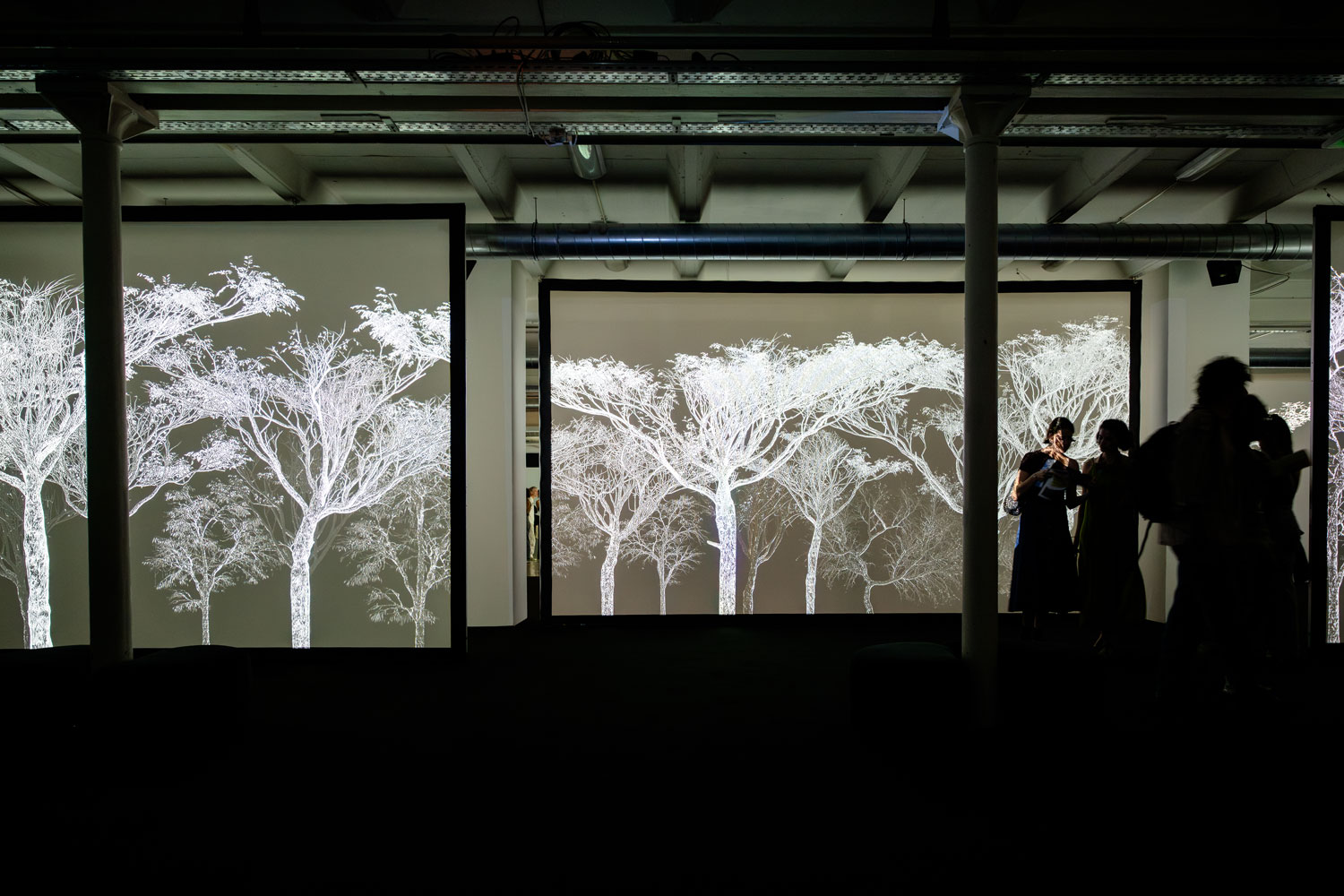
Scenes from the exhibition “On the Ruins, Stones Bloom” at La Friche La Belle de Mai in Marseille. Photos © Caroline Dutrey
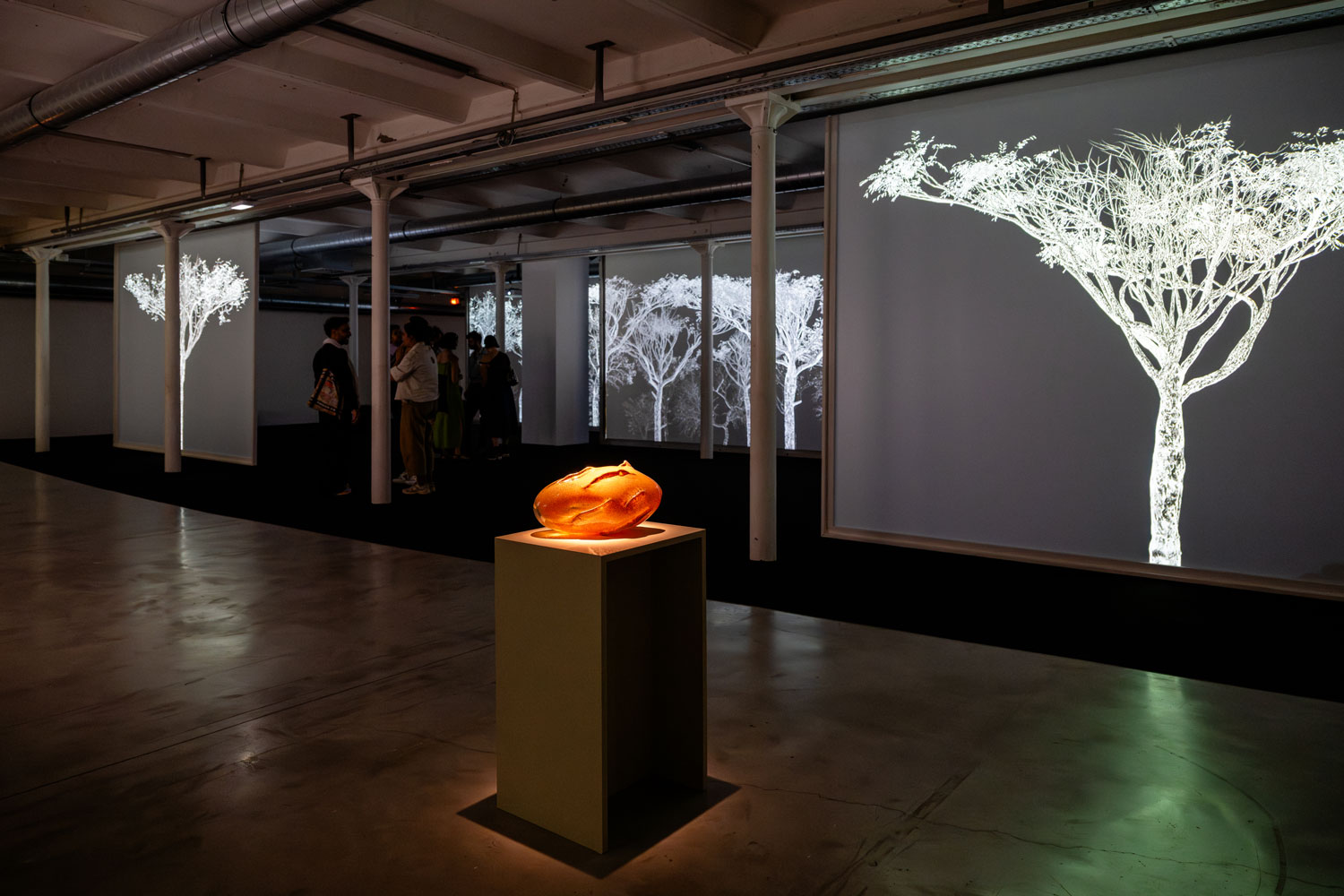
You enter the exhibition through a forest. Five screens, stark white acacia trees that tremble silently. The immersive installation Sadra Kodia is based on a Sahrawi belief: every man is bound to an acacia tree, and the tree is etched into his eye at the moment of death. The tree bears the mark of the man. Even before catching sight of the first human face, the visitor is confronted with Abdessamad El Montassir’s central theme: the memory of a life does not reside solely in people’s minds; it takes root in the living world around them. In the desert where the artist is from, many things go unsaid—out of modesty, out of pain, or because those who know claim the right to remain silent. Rather than forcing people to speak, Montassir turns to what cannot lie: plants, stones, sand, and the wind. “Everything around us is both a witness and a messenger,” he said. Every omission has its reason: not to appropriate what belongs to others, not to freeze what eludes them, to allow the unspoken word its right to remain so. It is an ethic, and it holds water. But what is stripped of its points of reference also becomes, by that very act, transportable. The opacity that shields the witness and the opacity that detaches the work from its homeland are the same gesture, viewed from both sides.
Convey Rather Than Show
Galb’Echaouf is where the work escapes this slope—by turning on itself. Khadija, born a nomad and now living in the city, can no longer put into words what she has been through, so she points to the ruins and the thorny plants. Dah, for his part, refuses to speak. The storyteller is a bush, the daghmous, bristling with needles. The entire exhibition revolves around the idea that the landscape sees in place of the silent men. The exhibition text repeats this: “Go ask the desert.” Yet the verse the artist displays on the screen says the opposite: the mountains have gone blind. The exhibition’s central thesis—that the earth bears witness—is contradicted by this key phrase. The witness has lost its sight. Far from being a slip-up, this is the exhibition’s most honest admission—the suspicion that turning to the non-human is itself a fragile consolation, and that the earth is just as silent and damaged as people. If even the earth is blind, what reaches the visitor is no longer a testimony, but its atmosphere—the mood of memory without its content. And a mood travels even farther than an image.
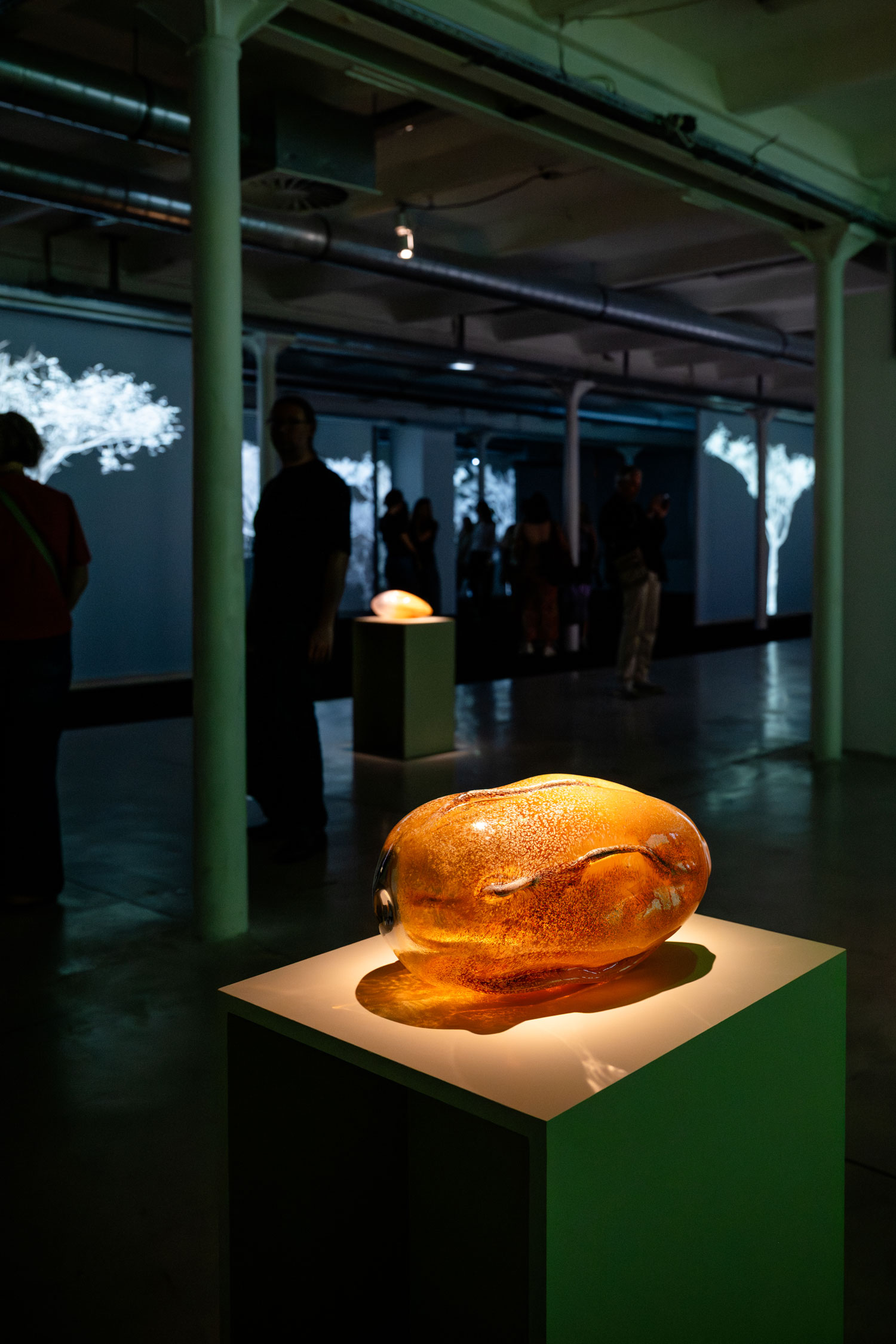
Scenes from the exhibition “On the Ruins, Stones Bloom” at La Friche La Belle de Mai in Marseille. Photos © Caroline Dutrey
A Double-Edged Sword
Âabide l’kadia takes the paradox to its logical conclusion. The beads, enlarged here, served as secret maps for the Harratine, descendants of slaves. They were landmarks that the master was not supposed to be able to read, tools for escape and running away. Montassir recreates them in glass, blown at the Cirva (International Center for Research on Glass and the Visual Arts) by a team of glassblowers from Marseille—polished, luminous, and displayed under gallery lighting. The object, whose sole purpose was to remain illegible, becomes a form to be viewed. The map that was meant to be hidden now sits prominently on a pedestal. The same reversal lies in wait for Athar Dakira, where the songs of the Harratine are accompanied by the sounds of instruments carved from desert flora, and Asserfa, which openly chooses to no longer depict the landscape but rather its transmission—gray, grainy prints of places that may never have existed. The formal care is genuine, and it is this care that smooths out the rough edges and allows these restrained stories to slip into the realm of the object.
The circuit, for that matter, is already global, as the press kit states quite plainly. These works on confiscated memories and the right to silence were produced by the DRAC (Regional Directorate for Cultural Affairs), the Villa Medici, the Frac (Regional Contemporary Art Fund) of Franche-Comté, the Institut français, and, for Sadra Kodia, by Arts AlUla in Saudi Arabia. Marginalized narratives championed by major cultural institutions are commonplace in contemporary art, and this is precisely what subtraction makes possible without a hitch. The less a work reveals about its roots, the better it fits on any wall.
“The goal isn’t to put on a historical exhibition,” warns curator Gabrielle Camuset, who refuses to let this work be reduced to issues of identity. Montassir had already put it more bluntly in the pages of Diptyk in 2022. He works on the Sahara because he grew up there, not to make any claims. His caution is justified; the subject stifles any discussion, and it’s clear that he prefers poetry to slogans. Yet in seeking to shield this work from any interpretation rooted in identity, we run the opposite risk. When a lived sense of belonging is transformed into pure forms—into acacias of light and polished glass—perhaps it is belonging itself that we are turning into a beautiful image. Montassir has anticipated this objection: his refusal to extract and translate aims to prevent the desert from becoming a postcard that we consume. The fact remains that the postcard and opacity share the same flip side—both do without a caption. The crux of the exhibition lies precisely there: whether opacity shields us from this consumption or invites us into it, and whether the hurried visitor will take away anything other than the grace of the surfaces.
— Abdessamad El Montassir, “On the Ruins, Stones Bloom,” as part of the 2026 Mediterranean Season, La Friche La Belle de Mai, Marseille, through September 27, 2026.
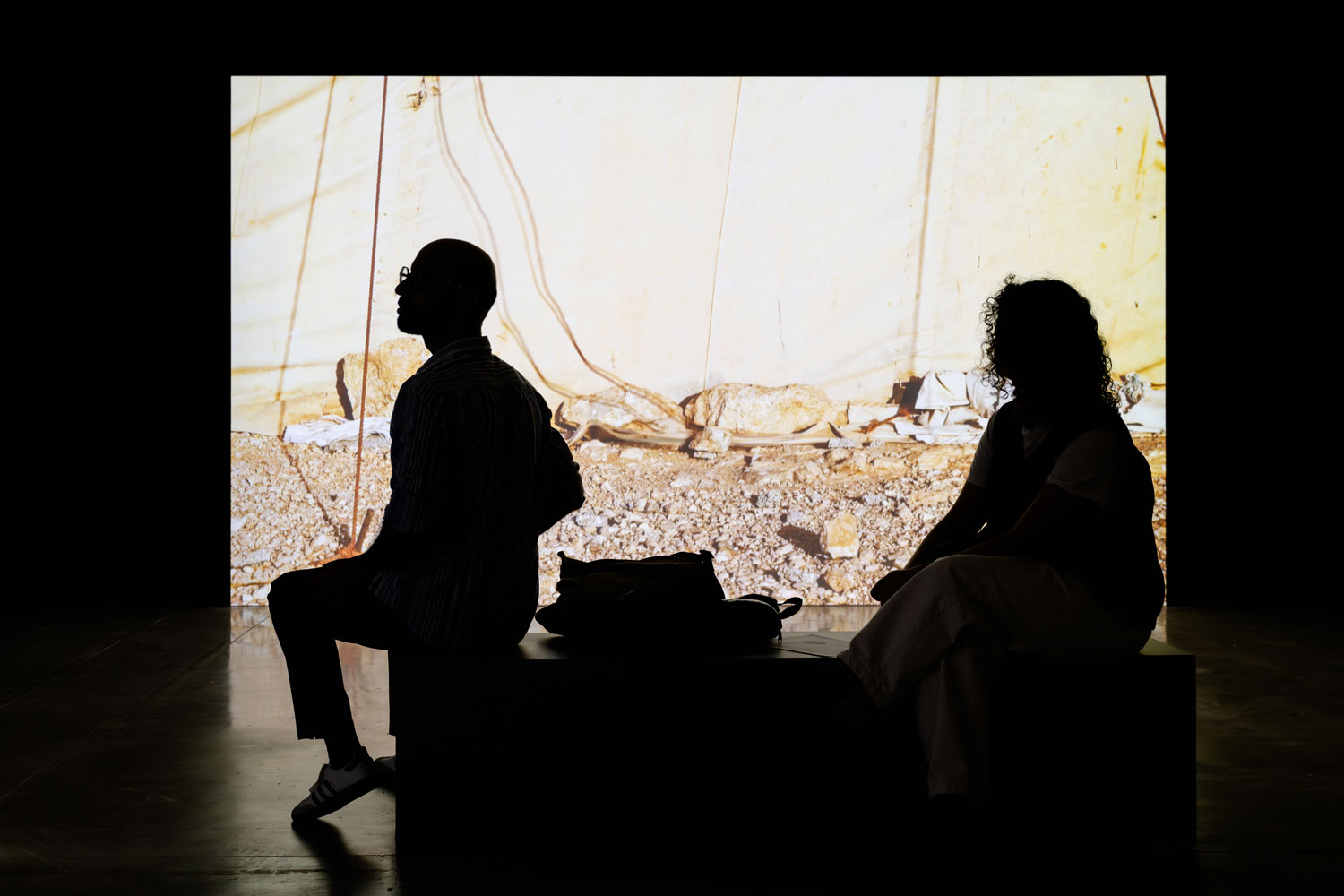
Scenes from the exhibition “On the Ruins, Stones Bloom” at La Friche La Belle de Mai in Marseille. Photos © Caroline Dutrey