At the Musée d’Art Moderne de Paris, Kerry James Marshall rewrites the history of painting by bringing to the forefront Black figures who have long been relegated to its margins. With “The Histories,” the American artist delivers a masterful lesson in painting, whose subversive power is fully expressed when he makes pictorial experimentation an extension of his political commitment.
By Olivier Rachet
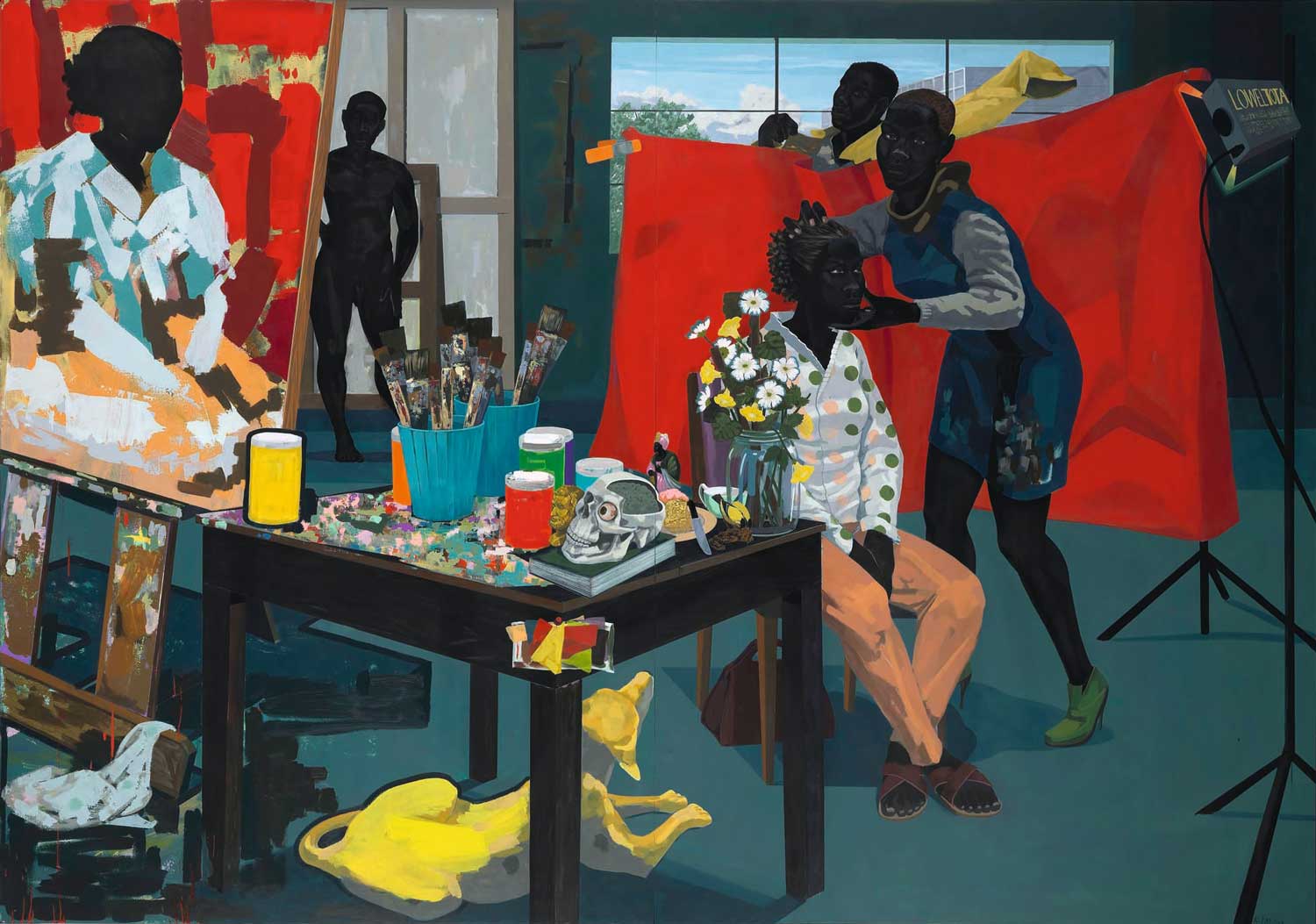
The first exhibition hall, titled “The Invisible Man” in homage to Ralph Ellison’s novel, provides the a for Kerry James Marshall’s “The Histories,” which dazzles as much with its subject matter as with its technical mastery. Oscillating between rebellion and derision, the early works serve as a manifesto in favor of painting and greater visibility for Black bodies. A first entirely black canvas, *Invisible Man*, tackles the issue of representation head-on from the outset, revealing only defiant eyes and a set of teeth of insolent whiteness. Long obscured or caricatured by a Western-centric gaze—as illustrated by an ironic drawing on paper *If I Had Possession Over Judgement Day*, the Black figure makes a dramatic entrance into the world of painting through another vivid portrait of a painter in his studio. His shimmering palette evokes the aesthetic of Abstract Expressionism, which Kerry James Marshall nevertheless ostensibly rejects.
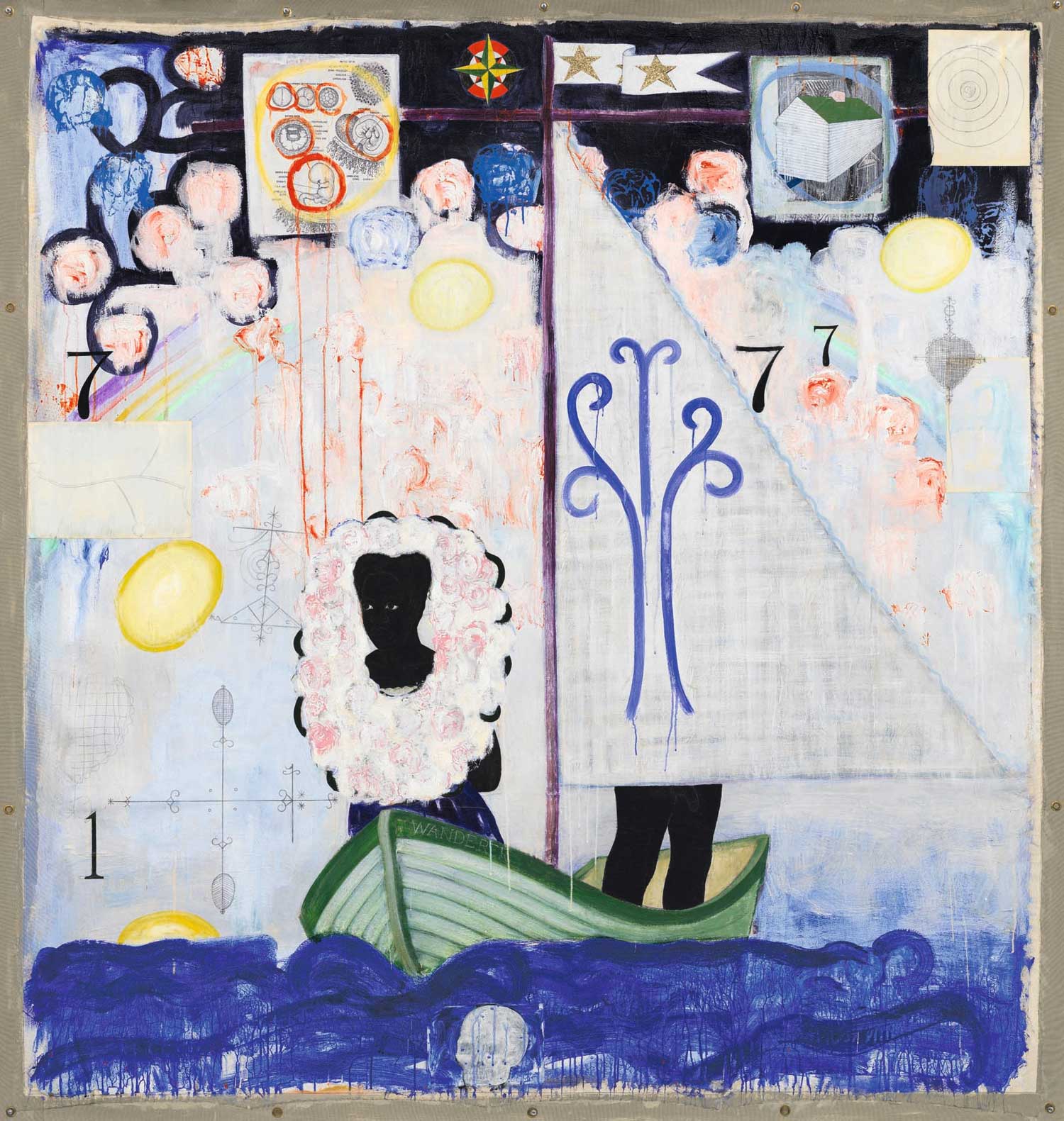
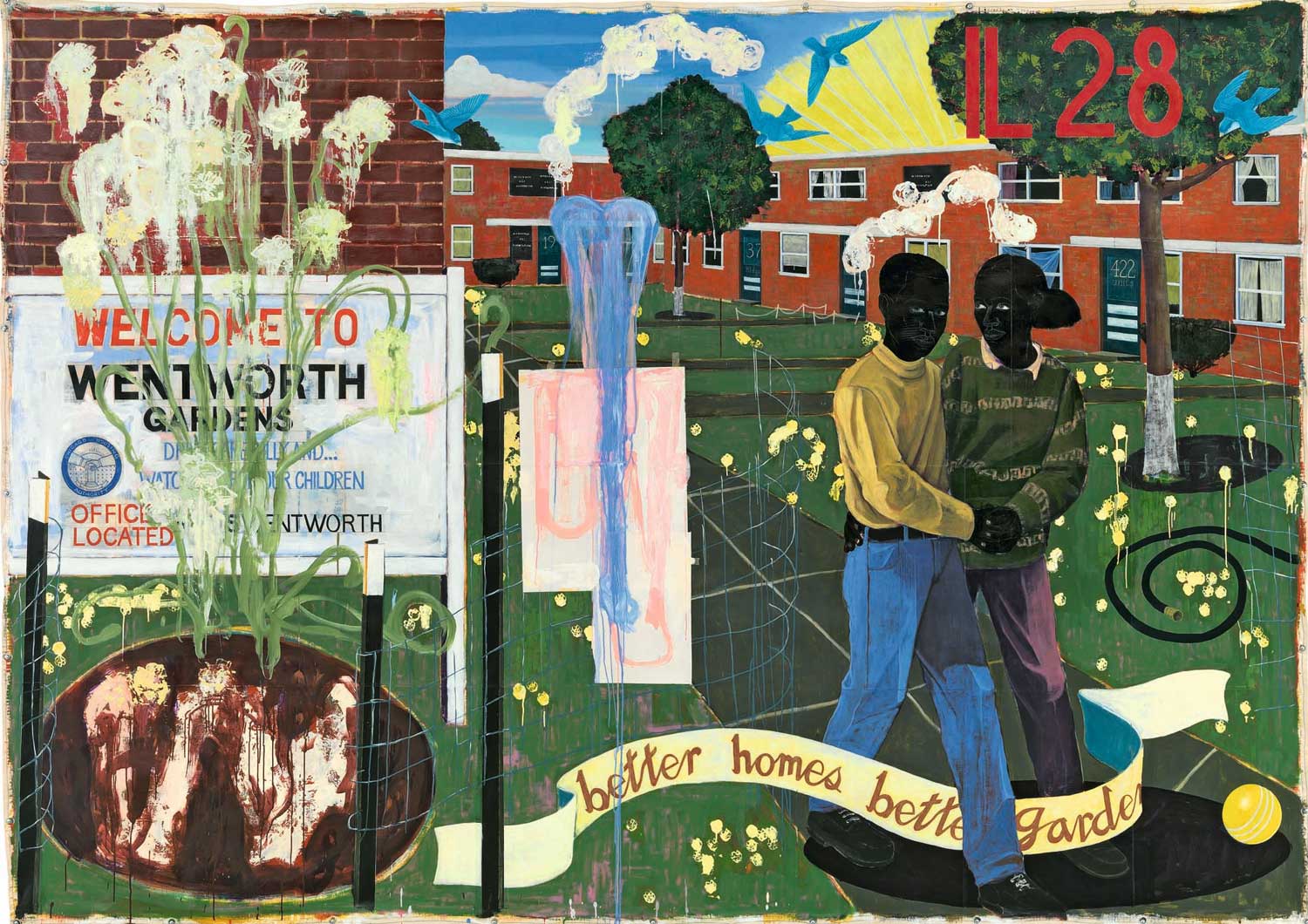
Building on this introduction, the exhibition—previously shown at the Royal Academy of Arts in London and the Kunsthaus in Zurich—presents a series of paintings in which the artist addresses issues ranging from the transatlantic slave trade, police and political violence against the African American community, and the vicissitudes of daily life, marked in particular by the issue of public housing. A painter of history, Kerry James Marshall is also a “painter of modern life” who celebrates the triumphant assertion of civil rights, as highlighted by two sections of the exhibition that take their titles from an essay by Baudelaire. But the artist is not an illustrator: through a process of constant self-reflection, he confronts the question of the pictorial medium, which he samples, like a true musician, in all its dimensions. This undoubtedly explains the prominence that many of his paintings give to music; the artist reproduces lyrics from various African-American songs, ranging from funk to rap. Drawing on both Renaissance religious painting—through his use of egg tempera—and the conventions of Abstract Expressionism—through his use of collage— he is also one of the first to introduce the deities of Yoruba culture—emblematic of West Africa—into painting. This is evident in a series of woodcuts created in 1982 dedicated to the deities Eschu, Shango, and Obatala, whose images appear throughout many of his other works.
Pictorial Marronage
In a 1997 painting Past Time, inspired by the Impressionist works of Monet and Seurat, the painter depicts a flock of blue birds taking flight above the scene, reminiscent of the doves of the Holy Spirit. Similarly, the series Memories reinterprets the motif of the Annunciation by the Archangel Gabriel to the Virgin Mary as a tribute to various public and political figures who have been victims of racist crimes or police violence. Most of the canvases are hung freely, without frames, using metal grommets, as if to better assert the desire to break free from the restrictive constraints of Western art history. Following in the footsteps of those slaves who fled the plantations at the risk of their lives, Kerry James Marshall practices a form of pictorial “marronage” that is formidably effective. In a series of portraits, the artist takes on the figures of Presidents George Washington and Thomas Jefferson, founding fathers of the American nation, whose faces are stretched into anamorphic distortions, serving as a reminder that they owned slaves who worked on their estates.
Resembling a retrospective, the exhibition also focuses on the artist’s various interventions in public spaces, notably his 2017 mural at the Chicago Cultural Center Read more in response to the South Dakota National Memorial, built between 1927 and 1941 by a Ku Klux Klan sympathizer. In 2023, the painter replaced two of the stained-glass windows at Washington National Cathedral, infusing them with his demands for justice. However, this legitimate activism seems to have since diminished the impact of his painting, as evidenced by the unconvincing series of Vignettes from idyllic scenes tinged with irony to his most recent, more academic works that return to history painting. Kerry James Marshall is undoubtedly at his best when he sets aside the message—however valid it may be—in favor of exploring the possibilities offered by painting. Take, for example, this 2018 painting depicting a school field trip to a museum featuring Black children, where the brown tones of the first layer of paint evoke the need to consolidate the gains of the civil rights movement—gains that remain fragile due to the persistence of racist prejudice.
Kerry James Marshall, “The Histories,” through January 24, 2027, Musée d’Art Moderne de Paris.