From the salt marshes of Assilah to vials of crystallized tears, this young artist-researcher makes salt the central theme of a comprehensive body of work, transforming everyday gestures and human vulnerability into true architectures of memory.
By Houda Bensebaa
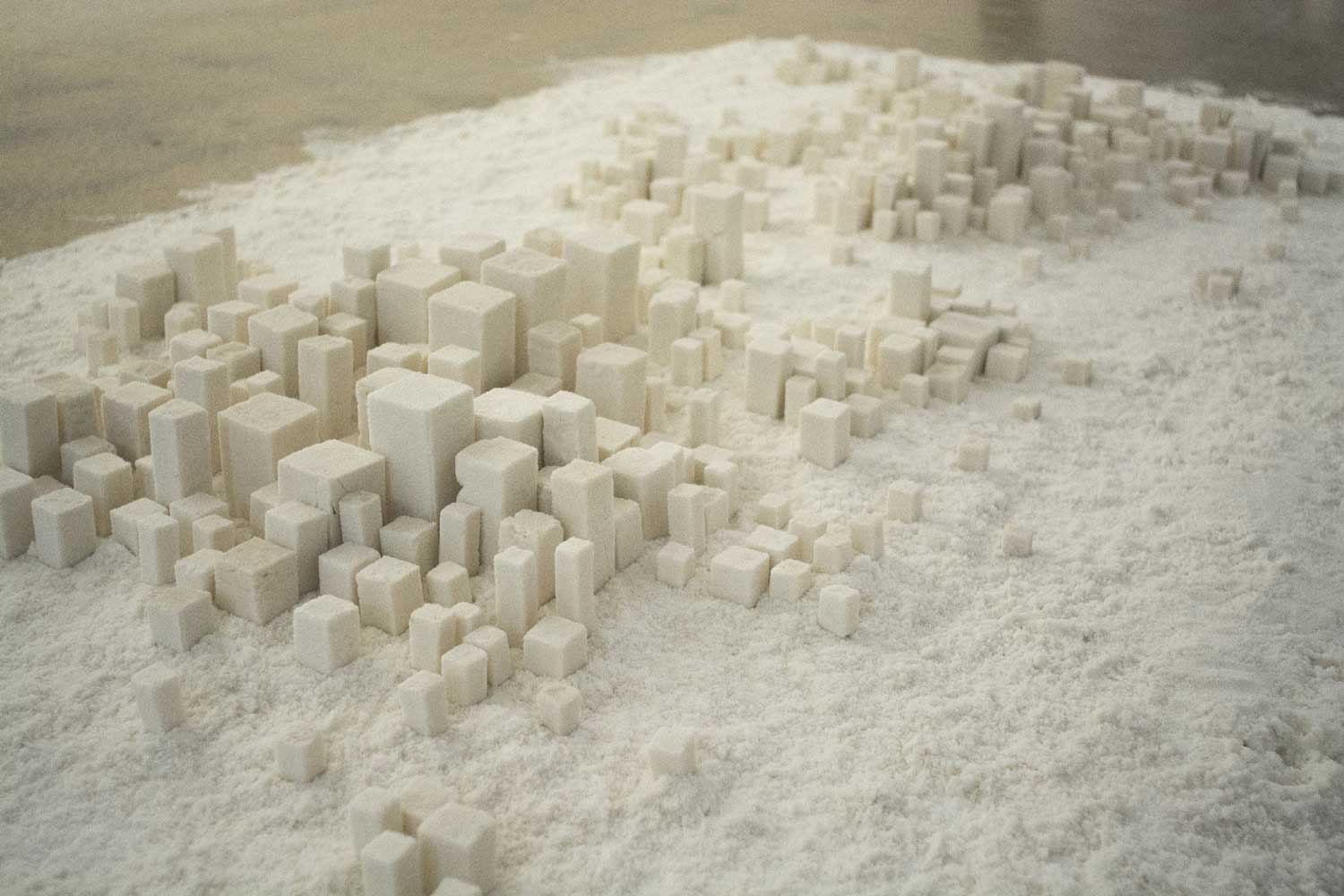
A constant preoccupation with salt guides Ahmad Karmouni’s work. This exploration of matter is also, inevitably, an exploration of societies: matter inhabits territories, domestic spaces, repeated gestures, and silences. There are countless stories surrounding salt. Its whiteness, its historical rarity, and its preservative and purifying properties lend it an almost magical quality. Used in the practice of mummification—which can be defined as a struggle against death in pursuit of eternity—it has also become, in certain traditions, a means of warding off the unseen. A string tied to a child’s ankle may have a small bag of salt attached to it, as Amine Karmouni observed in a photo from his family archives. When the child asks his mother why the pouch is there, she might reply that it doesn’t exist. Yet that same mother might slip another pouch of salt under his pillow. No one seems able to truly explain its purpose; the gesture is passed down without explanation.
From his childhood, Ahmad Karmouni has cherished the memory—or perhaps the fantasy—of cities deeply rooted in their surroundings, where daily life is intimately connected to the world around them. Born in 1994 in Assilah, the youngest of a large family, he discovered almost by chance a drawing studio dedicated to reproducing the works of the masters. This experience led him to the School of Fine Arts in Tetouan, where he had to choose a personal project to develop. Ahmad Karmouni realized that this decision, with its far-reaching consequences, could seal his fate as an artist. He decided to look at what was right there, all around him: what seems so familiar as to become invisible, and which can only truly be understood through the gestures that produce and transmit it.
“Transparent Worlds”
In northern Morocco, between Assilah and Larache, salt marshes stretch out at the foot of the Lixus archaeological site. This fragile ecosystem is home to a multitude of waterfowl and migratory birds. In this region, traditional salt harvesting has persisted. Evaporation, concentration, and then crystallization still follow the rhythm of the seasons and depend heavily on the climate. Ahmad Karmouni recalls these landscapes that shaped his childhood: “ I still have vivid memories of scenes of whiteness stretching out along the road, scattered across salt pans shaped like small mountains and in scattered blocks. The salt pans between Assilah and Tangier were transparent worlds reflecting the image of the sky. ”
Growing up surrounded by salt culture means learning to live with a substance that is everywhere—not only in the landscape, but also in homes and in our bodies. Salt protects. It cleanses. It purifies. It can turn a home into a sanctuary and accompany certain rituals meant to ward off threats that never reveal themselves. Its mystical use does not necessarily need to be explained to be passed down. It exists in the fragile space that separates knowledge from belief, the visible from the inexpressible. Habit gives rise to belief.
Salt in All Its Forms
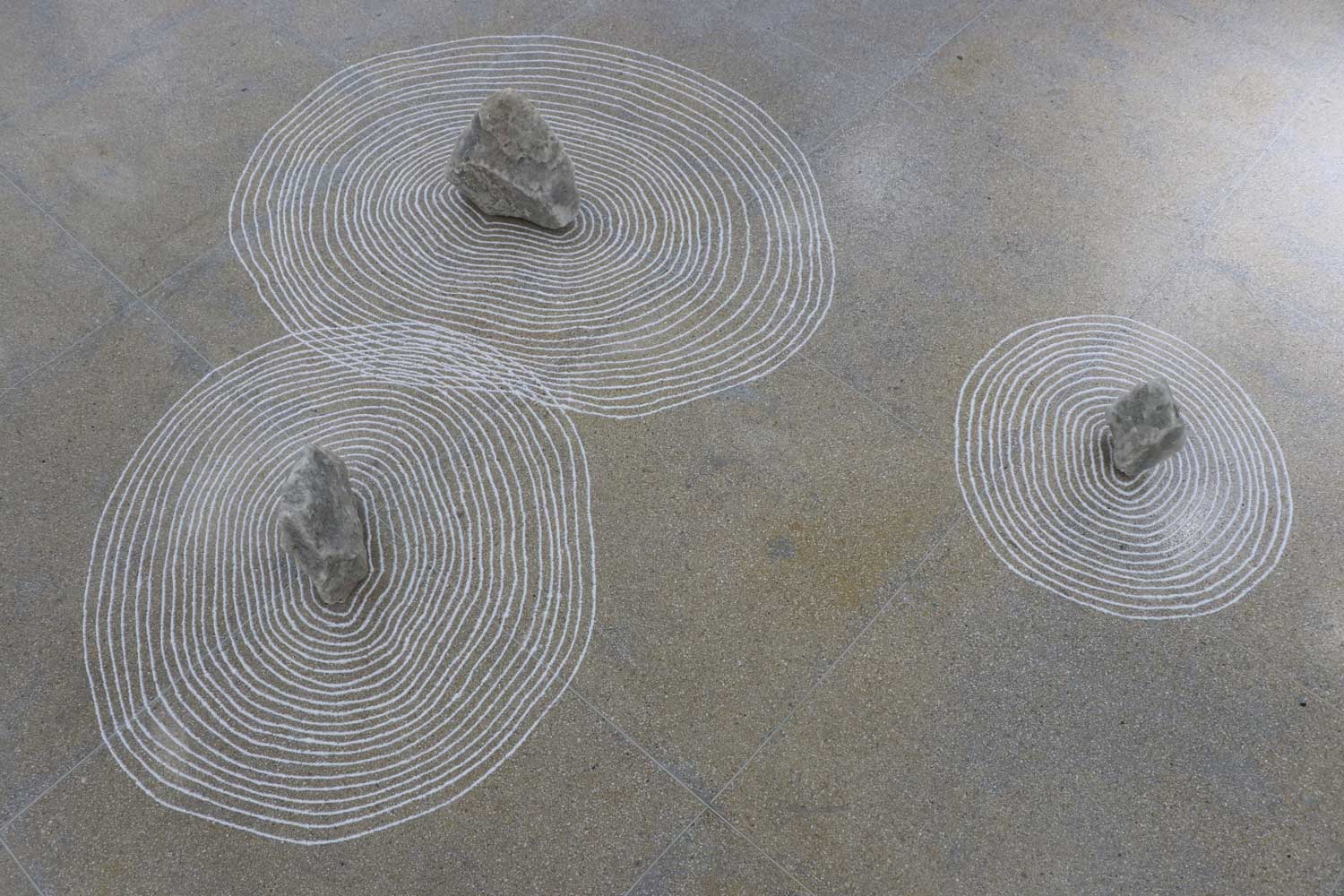
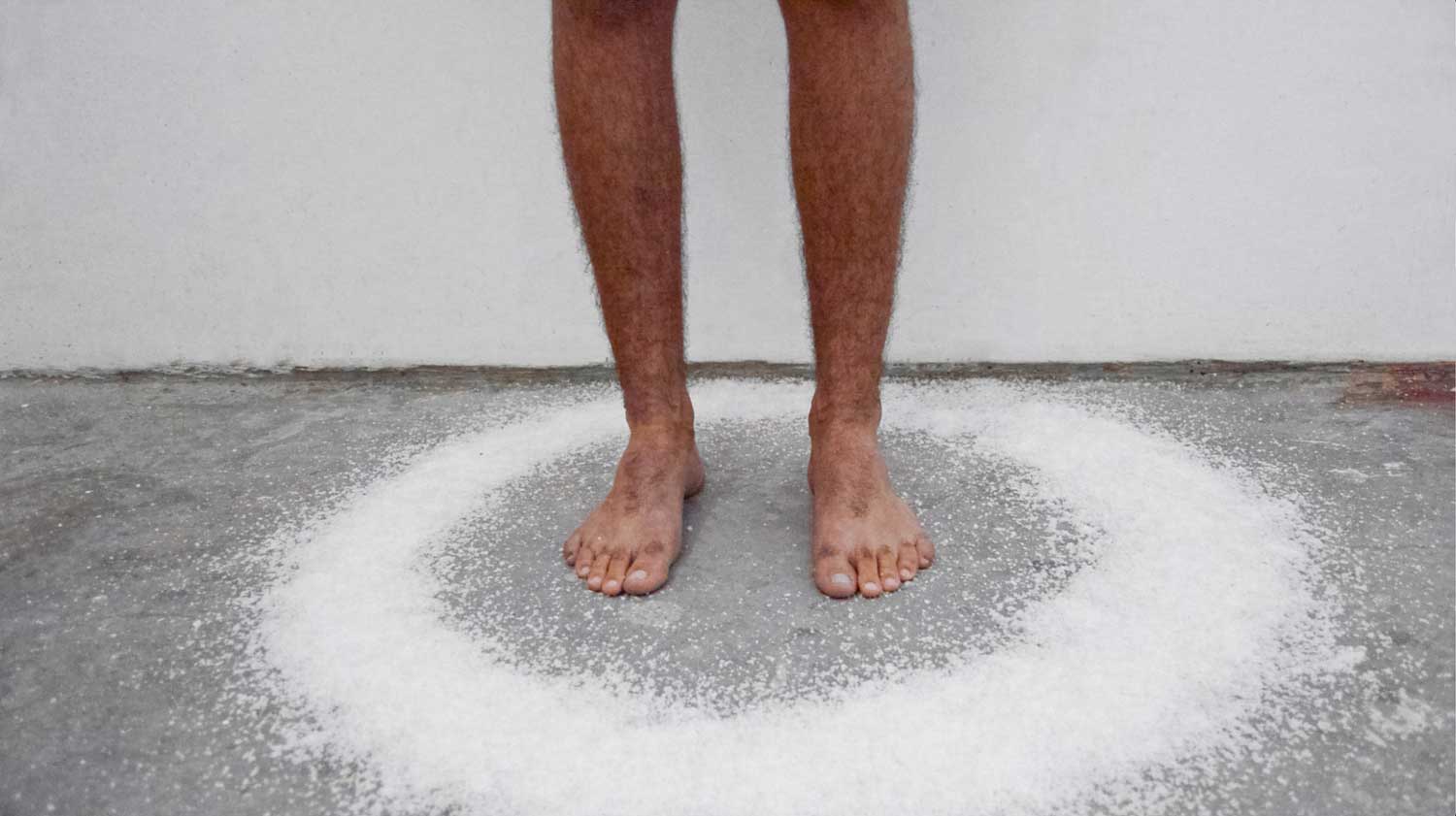
With a humble approach, Ahmad Karmouni seeks not so much to master salt as to understand what it can become. “ I’m interested in it as much for its symbolic, historical, and cultural dimensions as for its microscopic structure, chemical composition, and the formation of its crystals. ” In his studio, he observes the material, measures it, transforms it, and subjects it to various processes. It is accumulated and piled up until it replicates the mountains of the salt marshes. It comes into contact with the artist’s body and forms ramparts around bare human legs that are as fragile as they are protective.”
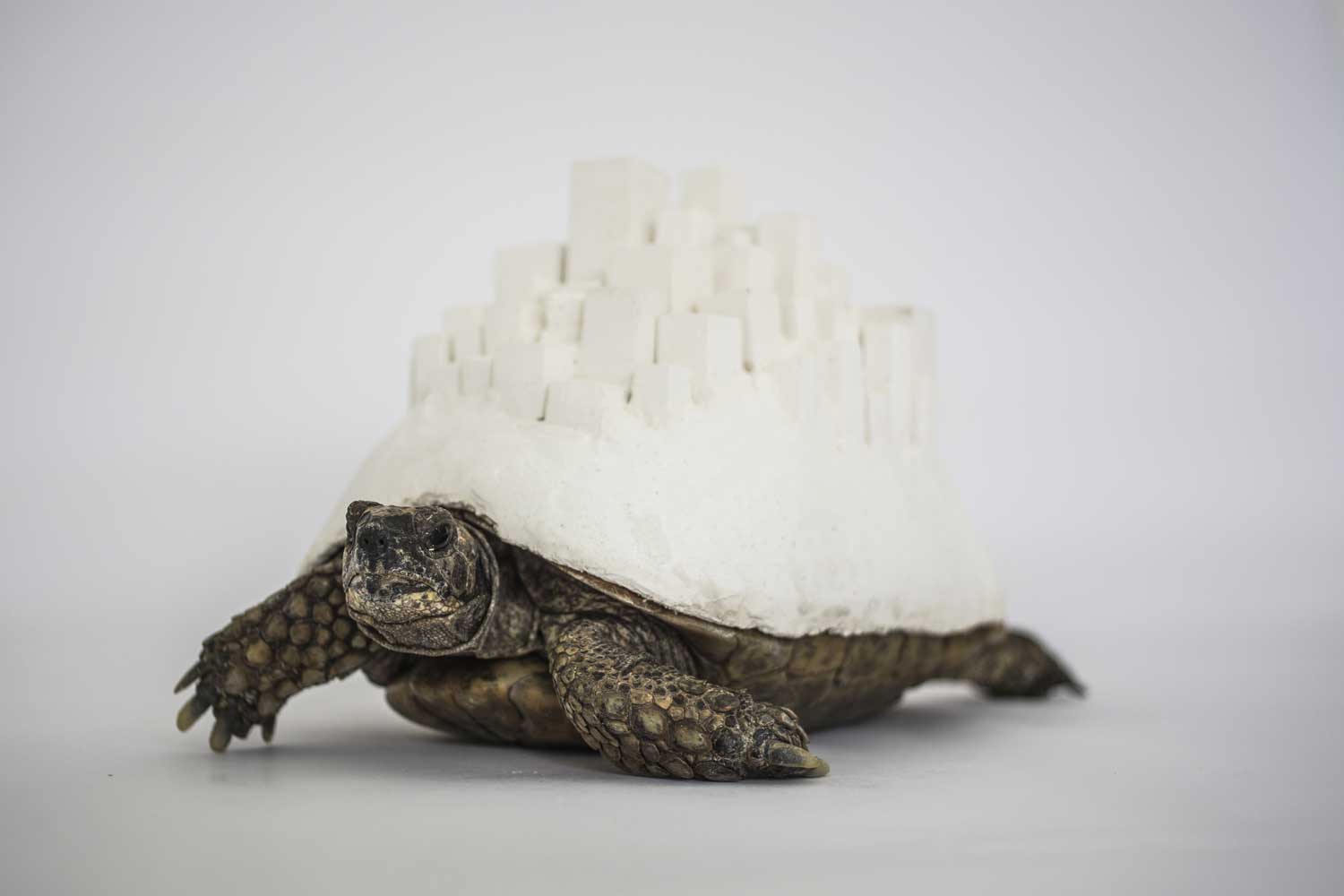
The various states of salt are meticulously dissected and documented. Engraved salt flowers, crystals transformed into pictorial material, interactions with paper, experiments with measurement: Ahmad Karmouni turns salt into a medium that allows us to conceive of and construct space. He reproduces landscapes and architectural forms with it. He imagines cities of salt, a turtle shell representing a house that one could carry everywhere with oneself. Shoes sink into a salty expanse as if into a swamp; movement seems to become impossible.
Matter becomes at once landscape, architecture, protection, and constraint. What was surrounding him becomes something he can move, reconstruct, fragment, and reinvent. These transformations accompany the approach of an artist attentive to the transitional states of matter: if matter were to change and adopt a new state, what would be the impact on the organization of human lives? Ahmad Karmouni then poses a question that remains a defining theme for the rest of his work: if the Mediterranean were to crystallize, how would we redefine our language, and what meaning would we ascribe to borders?
An Archive of Emotion
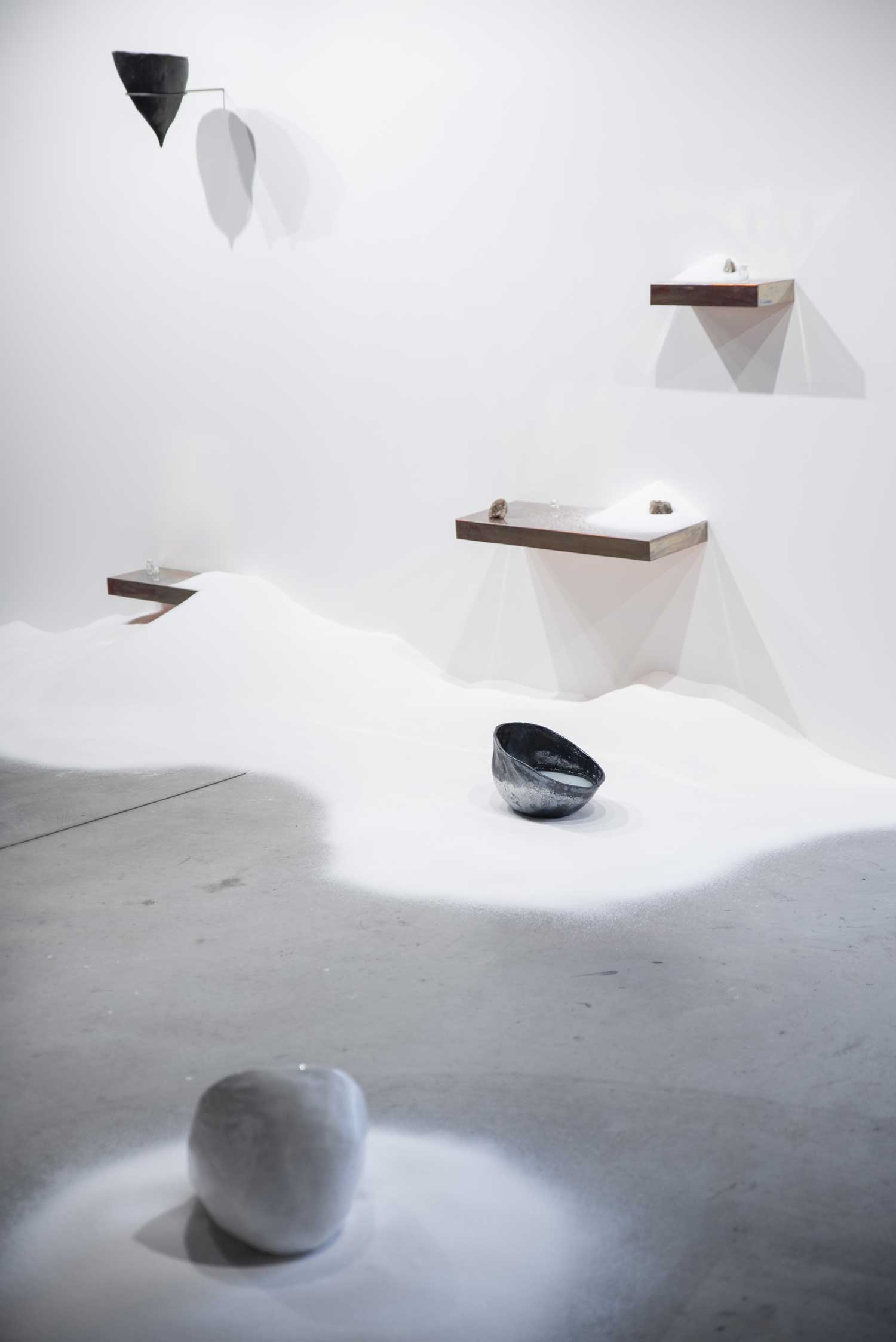
The work currently on view in the group exhibition “Au-delà de toutes les mers” (Beyond All Seas), co-curated by Le Cube independent art room (Rabat) and La Condition Publique (Roubaix), marks a decisive shift in Ahmad Karmouni’s artistic practice. Created in 2021–22 during a residency at the Fiminco Foundation in the Paris region, the installation *Le sel et des larmes* (Salt and Tears) emerged from a geographical constraint. The artist no longer has the same access to salt. The material, once abundant in his familiar surroundings, must now be sought elsewhere. The quest for salt thus becomes a quest for encounters. It shifts the focus from the landscape to the human, leading to this fundamental discovery: salt is also present in what is most intimate and vulnerable within us—our tears.
The work takes the form of an ongoing performance. For five years, Ahmad Karmouni has been handing out small vials to visitors in which they can collect their tears. These liquid fragments of individual lives gradually become a shared substance. Preserved and then subjected to a crystallization process, the tears in turn transform into salt. “ By collecting volunteers’ tears in vials—like an archive of emotional moments captured before and after evaporation—my research has shifted toward exploring the spiritual and ritual dimensions contained not only in these moments of release but also in the tear fluid itself. ”
What Matter Tells Us
In the exhibition space at La Condition Publique, salt takes over the venue. Sea salt, the salt of the body, the salt of tears: the material seems to form silent altars that visitors approach with the same reverence as holy sites. Complementing this installation are several ceramic pieces shaped around the Lambout, a term used in northern Morocco to refer to a funnel. The shape evokes the Greco-Roman lacrimatory, a small, elongated vessel made of glass or terracotta intended, according to certain traditions, to collect the tears shed during funeral rites.
This loyalty to the material is a relationship in which failure is embraced, where the passage of time does not frighten the artist but rather strengthens what has become the beating heart of a creative exploration. The collection of tears comes up against the reality that it is difficult for the people encountered to cry and to give their tears. These moments of impossibility can, however, open the door to something else, such as the immateriality of oral testimony.
Between territory and the body, between science and belief, between memory and displacement, Ahmad Karmouni thus pursues the same line of inquiry: what does a material tell us when we take the time to listen to it? And when the territory fades away behind us, perhaps there is still something left to take with us—perhaps simply a few crystals settled at the bottom of a vial.
— Exhibition “Beyond All Seas,” La Condition Publique, Roubaix, through November 1, 2026.