The Caen Memorial brings together some 40 modern and contemporary African artists in a particularly educational exhibition, which nonetheless raises questions about the selection of works on display.
By Olivier Rachet
The location is no coincidence. Situated near the D-Day beaches in Normandy, the Caen Memorial, dedicated to the history of World War II, attracts more than 500,000 visitors each year. Many are American, and most of its French visitors do not typically visit art museums. Conversely, “ art lovers are just as likely to skip a historic site like the Caen Memorial “, notes Jean-Yves Marin, co-curator with Ayoko Mensah of the exhibition “(De)colonizations: African Artists Question History.” Formerly director of the Geneva Museums of Art and History, he organized the 2025 exhibition “Beyond Appearances” there, dedicated to the CBH’s (Compagnie Bancaire Helvétique) collections of modern and contemporary African art. The CBH is one of the main lenders for “(De)colonizations,” along with a few galleries such as Cécile Fakhoury and MAGNIN-A, but above all the Gandur Foundation, which, incidentally, is preparing to open a space in 2030 just a few steps from the Memorial to showcase its collections, after a Swiss referendum had previously prevented it from doing so.
These unforeseen circumstances do not, on their own, explain why the current exhibition is taking place, but they do help put into perspective the overwhelming presence of artists from the Congo or French-speaking Africa. One will always be surprised by the absence of artists from the Maghreb in a general exhibition devoted to Africa, but, as Jean-Yves Marin explains, “ it’s simply that these artists do not appear in these collections .” That being said, but an exhibition of contemporary African art that overlooks—even if only—artists from the Casablanca Art School or the Tunis School, whose modernist quest is inseparable from the struggles for independence and the fight against an Orientalist worldview, now represents a shortcoming.
The Limits of the Collections
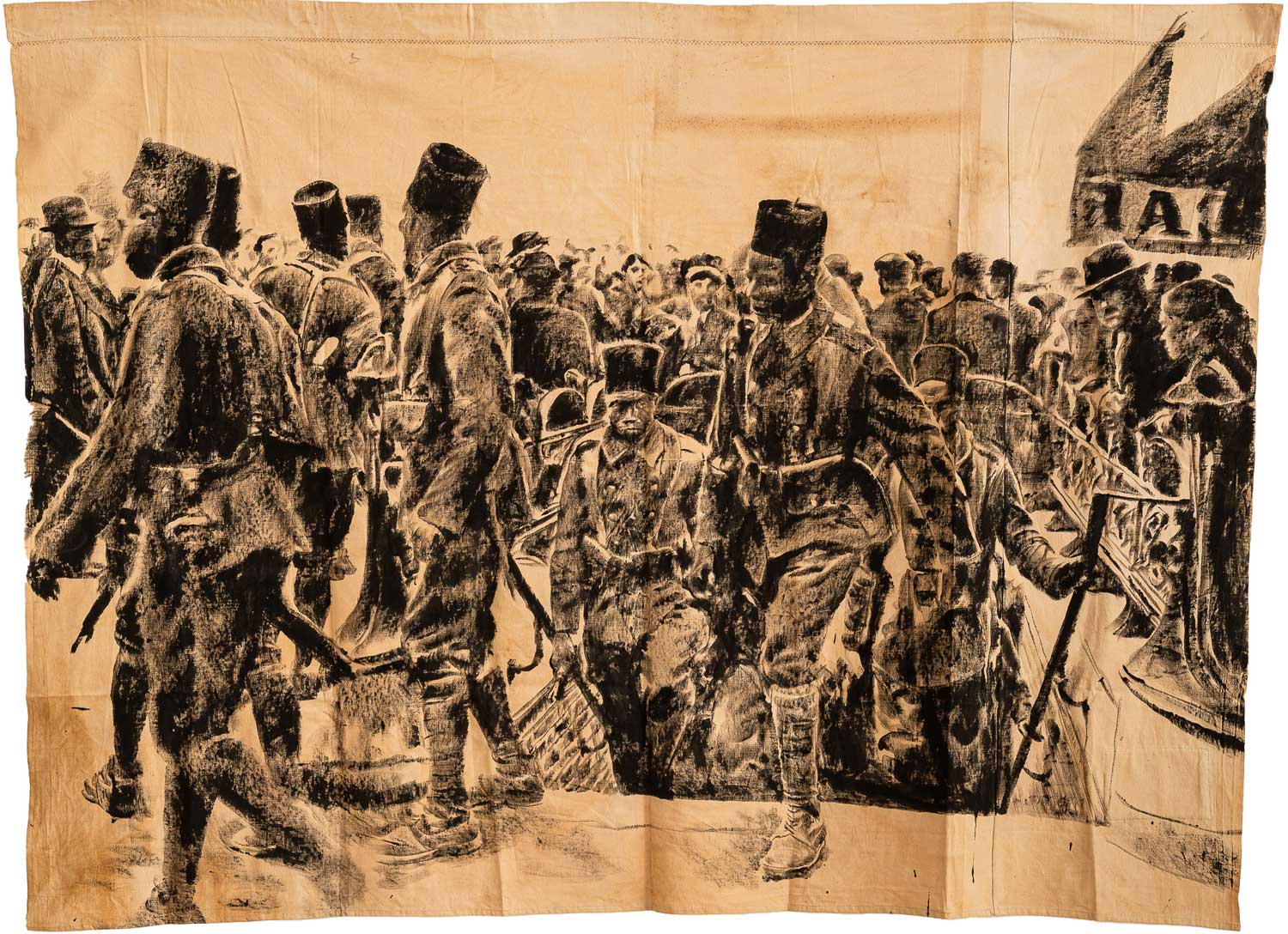
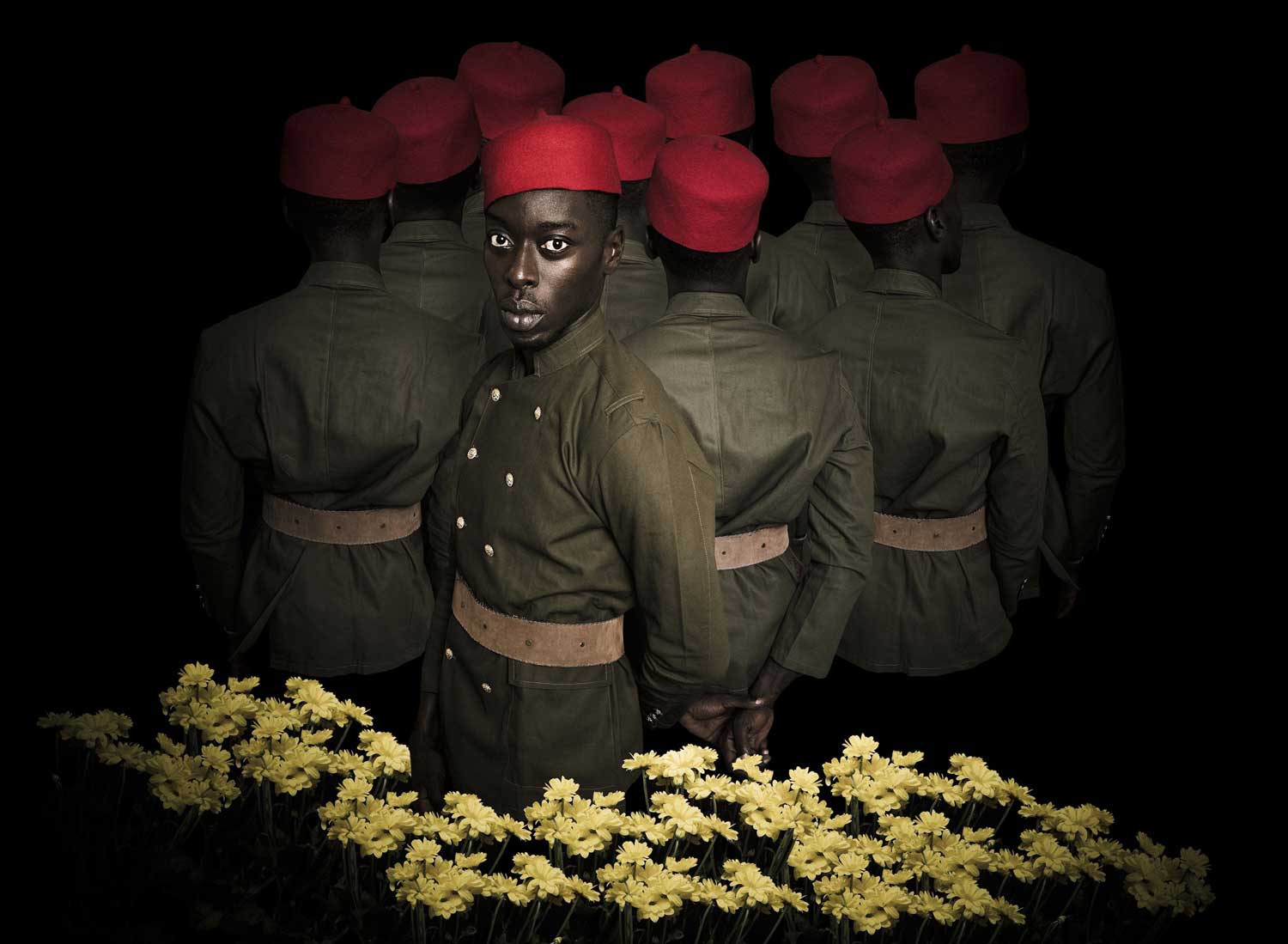
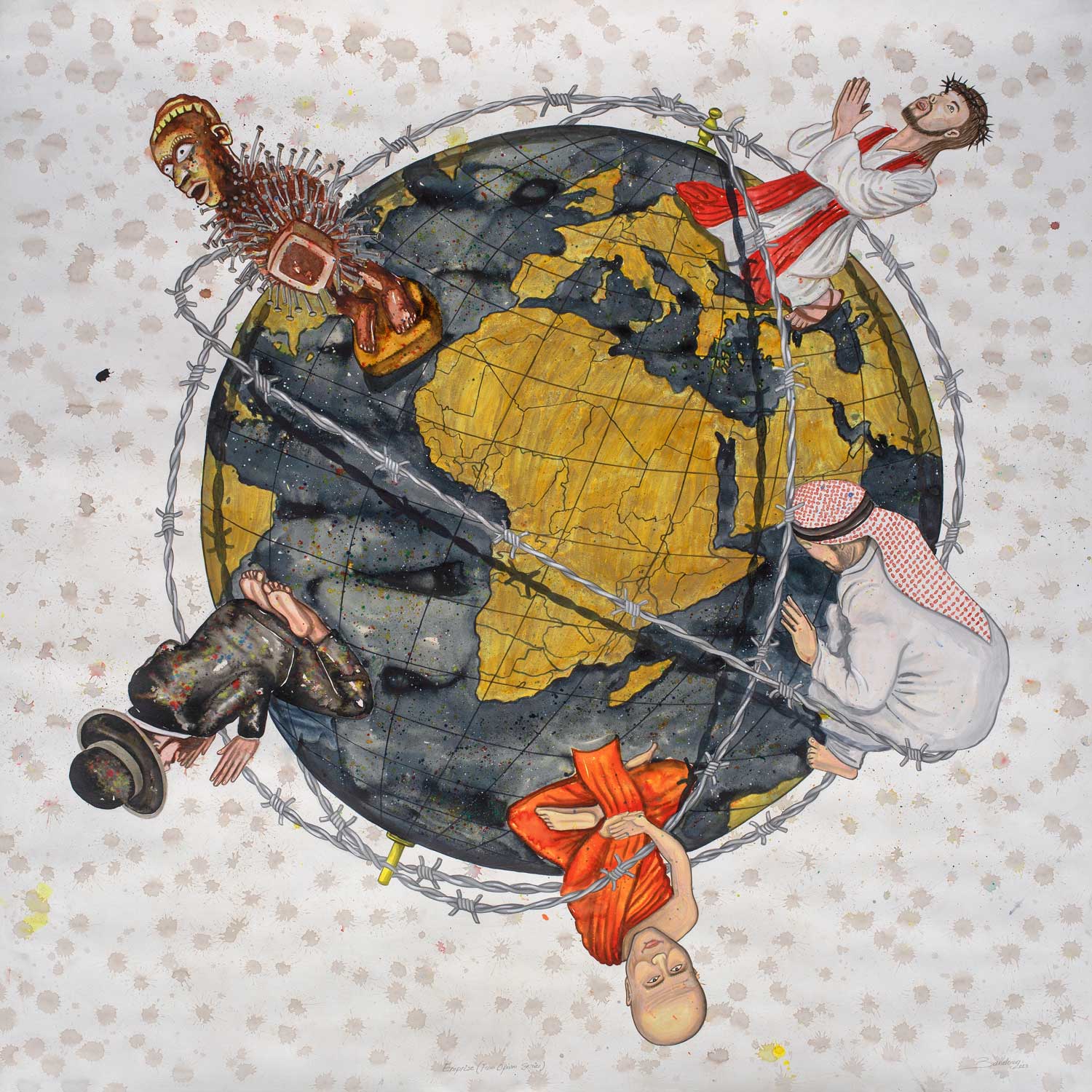
The highlight of this exhibition, however, is its educational aspect. A first section devoted to the “Senegalese riflemen” effectively ties the exhibition into the museum’s historiographical narrative. The paintings by the Franco-Beninese artist Roméo Mivekannin—including a series of acrylic portraits on newspaper—serve as an excellent introduction to the subject. They are accompanied by textual references, some of which are drawn from Senghor—whom Jean-Yves Marin reminds us spent the last twenty years of his life in Verson, near the Memorial. Opposite the 360° screening room for the film *Europe: Our History*, which recounts the history of 20th-centurye century, the self-portraits by Omar Victor Diop (Senegal)—depicting historical figures linked to colonial histories, drawn from the series Diaspora, hit the mark. Shouldn’t we, by contrast, also tell another story in which Europe plays a part—that of Africa? Echoing this are Samuel Fosso’s self-portraits from the photo series African Spirits, in which the Cameroonian-Nigerian artist embodies, in turn, the historical figures of Kwame Nkrumah, Patrice Lumumba, and Angela Davis. But this didactic approach sometimes falls short due to the inclusion of works whose allegorical dimension somewhat weighs down the message. While the painting Vultures by Sokey Edorh—the only Togolese artist in the exhibition—or the digital mural by Malagasy artist Malala Andrialavidrazana stand out for their visual inventiveness, the works by Congolese artists Steve Bandoma and Chéri Samba remain far too literal in their intent.
A section titled “The Ambiguous Adventure”—a reference to Cheikh Hamidou Kane’s novel—undoubtedly highlights the limitations of the entire exhibition. While it is commendable to highlight the role of the Senegalese riflemen, it must be acknowledged that, aside from the photograph Thiaroye, 1944 by Diop—which opens the exhibition and depicts the massacre of several hundred Senegalese soldiers by the French colonial army in Dakar—the violence of colonial history remains downplayed. The exhibition’s “decolonial” theme also raises questions, as it has become a mantra repeated by many curators, failing to provide greater clarity on an aesthetic level. It is unclear whether visitors who do not frequent international art fairs or contemporary art spaces will be receptive to a discourse inviting them to scrutinize what a “[deconstructing] colonial visions and narratives ,” as Ayoko Mensah asserts in the catalog. The visually striking photographs by Aida Muluneh (Ethiopia) and Thandiwe Muriu (Kenya), however, do not easily lend themselves to such an interpretive framework. Fortunately, a few works with a radical aesthetic stand out, such as an animated video by South African artist William Kentridge and a triptych by Beninese artist Léonce Raphaël Agbodjelou from the series Les demoiselles de Porto-Novo, drawings by Bruly Bouabré (Ivory Coast), or a painting by Moke (DRC) inspired by The Jungle Book, serve as a counterbalance to works that yield more readily to market pressures. Take, for example, the paintings by Aboudia (Ivory Coast), JP Mika (DRC), and even Hilary Balu (DRC), which capitalize on rather conventional Afrofuturist or “sapeuse” imagery, far removed from “decolonial” concerns!
— “(De)colonizations: African Artists Examine History,” Caen Memorial, through November 11, 2026.